
2026-08-30 · resistance bands, loop bands, tube bands, booty bands, home workout, strength training, weight loss, muscle preservation
Written by Priya Desai
Priya Desai is a WeightFAQ staff writer covering exercise, fitness, and the body-composition side of weight loss. She has written about strength training, HIIT, running, and the best time to exercise, alongside guides to preserving muscle during a deficit, sarcopenic obesity, body recomposition, and creatine. Her body-composition-testing piece walks through DEXA, BIA, and Bod Pod for readers who want more than a scale number, and her articles on plantar fasciitis and fibromyalgia address exercising with pain. Priya writes for readers who want to train usefully without gym pressure or hype.
15 min read
Medically reviewed on Aug 30, 2026
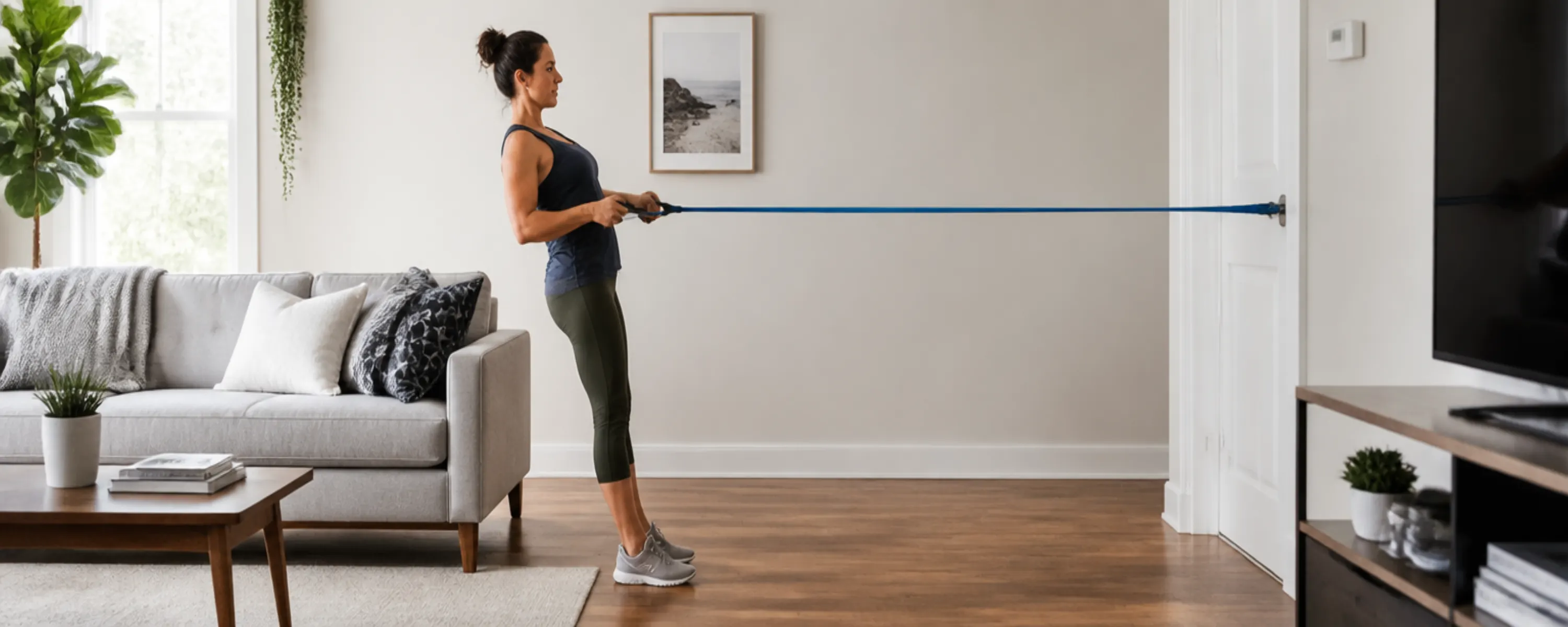
Resistance Band Training for Weight Loss: 12-Week Beginner Program, Band-Tier Loading, and Home-First Programming
Quick answer: Resistance bands can drive comparable strength and body-composition gains to free weights in beginner-to-intermediate populations when programmed with adequate volume and progression (Lopes 2019 systematic review), and they solve the two biggest home-training barriers — cost and floor space — better than any other strength modality. They are best used alongside a protein-adequate deficit rather than as a standalone “weight-loss workout.” A 30-minute band session burns ~120–200 kcal — the muscle-preservation signal, not the calorie burn, is why bands matter for weight loss.
Three 30-minute band sessions per week plus three 30–40 minute walks or bike rides, protein at 1.2–1.6 g/kg, and a 300–500 kcal daily deficit is the “no gym, no equipment budget” default that most beginners can hold for 12+ weeks. The 12-week program below ramps tension in staged steps, the band-tier table maps color-coded loads to a “add 5 lb per session” analog, and the special-situations section covers door-anchor safety, band failure inspection, and who bands are wrong for.
Quick stats — resistance band training for weight loss
- Typical calorie burn (155-lb adult, 30-min session): ~120–200 kcal at vigorous resistance intensity
- Space required: ~1 m × 1 m and a solid door with the anchor above the top hinge
- Starter band set: 5-band tube set + handles + door anchor + ankle straps, $25–50
- Weekly target for weight loss: 3 band sessions + 3 cardio bouts + 1 rest day
- Skill payoff window: 2 weeks to competent form on all 10 core exercises; 12 weeks to first-tier progression
What resistance band training does — and does not do — for weight loss
Do: drive strength gains, preserve or add lean mass in a deficit (see preserving muscle during weight loss), unlock 25–40 minutes of at-home training on a schedule most beginners can hold, travel with zero footprint (they fit in a carry-on), and treat physio-adjacent musculoskeletal issues — glute activation for hip stability, shoulder rehab work, plantar fasciitis load-management (see plantar fasciitis and weight loss). For readers who cannot get to a gym, cannot afford dumbbells, or share walls with a downstairs neighbor who would not tolerate dropped weights, bands are usually the highest-adherence strength modality available.
Do not: burn dramatic calories per session (a 30-minute band session is typically ~120–200 kcal per Compendium of Physical Activities vigorous-resistance MET values, versus ~350 kcal for a 30-minute run), replace cardiovascular work (bands do not train the aerobic system meaningfully — see cardio vs strength training for weight loss for the split), or substitute for the caloric deficit (food does 80–90% of the arithmetic; bands protect the composition of what you lose). Every fitness modality on this site lands back on the same rule: the deficit is the driver, and resistance training decides whether that loss is fat or lean tissue.
What the evidence shows
Elastic-band-specific research is a smaller literature than the barbell and dumbbell trials, but the studies that exist point consistently to meaningful strength, body-composition, and function outcomes at low weekly volume — and often to comparability with conventional loaded resistance training in beginner-to-intermediate populations.
| Study | Design | Finding |
|---|---|---|
| Lopes 2019 | SAGE Open Med, systematic review of 8 RCTs | Elastic-band resistance training produced strength and functional gains similar to conventional resistance training in the reviewed populations |
| Colado 2010 | Am J Sports Med, n=42 women, 10-wk RCT | Elastic bands vs weight machines produced comparable strength and body-composition change |
| Iversen 2017 | Br J Sports Med, n=40 older adults, 12-wk | Elastic-band program improved lean mass and function |
| Yasuda 2020 | Int J Environ Res Public Health, n=30 | Elastic-band resistance training induced meaningful lean-mass gain in adults on caloric restriction |
| Iolascon 2019 | Aging Clin Exp Res, n=52 older women | Bands + protein produced superior body-composition change vs bands alone in a shared-deficit context |
Two through-lines matter. First, bands look like weights in the outcomes that matter for weight loss — strength gain, lean-mass retention, functional capacity — for the populations most beginners fall into. Second, the effect is dose-dependent on protein and deficit shape, exactly as it is with barbells: Iolascon 2019 in particular shows that band training without adequate protein under-delivers on body composition. The band is a tool; the protocol around it is the point.
Band types: which tool for which job
Five band families cover the entire home-training exercise pool. The table below lists typical tension ranges, best use, cost, and the honest limitation for each. Colors and exact resistances vary by manufacturer — the numbers below are typical mid-market ranges.
| Type | Typical tension | Best use | Cost | Limitations |
|---|---|---|---|---|
| Loop bands (thin fabric mini) | 5–35 lb-equivalent | Glute activation, warmup, hip-abduction | $5–20 | Poor for upper-body compound loading |
| Loop bands (heavy latex) | 25–200 lb-equivalent | Pull-up assist, squat and deadlift accessory | $10–40 | Awkward to grip; not designed for handles |
| Tube bands with handles | 10–75 lb-equivalent | Seated rows, presses, curls — the workhorse | $15–50 | Handle failure risk over years of use |
| Figure-8 / short loop bands | 5–25 lb-equivalent | Upper-body isolation (rear delts, biceps) | $10–20 | Limited exercise pool |
| Fabric booty bands | 5–25 lb-equivalent | Glute isolation, hip abduction, monster walks | $10–20 | Single-purpose but excellent for what they do |
The tube band set with handles is the workhorse for a weight-loss home program. If you can only buy one thing, buy that. The five-band set-with-accessories that includes a door anchor, ankle straps, and handles is what most of this article assumes.
The 12-week beginner band program
Designed for a healthy adult new to resistance training who has a 5-band tube set (or equivalent). Three sessions per week, 30 minutes each, full-body split, 8–10 exercises, 3 sets × 8–12 reps, progressive band tension every 3–4 weeks. Every session begins with 3 minutes of dynamic warmup (arm circles, cat-cow, 10 bodyweight squats, hip-hinge review with a dowel) and ends with 3 minutes of easy walking around the room.
The 10-exercise session template rotates the same movements every training day. Alternate the two variations listed for each slot from session to session (e.g., goblet-style band squat Mon/Fri, banded RDL Wed).
| # | Exercise | Sets × reps | Notes |
|---|---|---|---|
| 1 | Band squat (band under feet, held at shoulders) | 3 × 8–12 | Squat pattern — chest tall, heels planted |
| 2 | Banded RDL (band under feet, held in front) | 3 × 8–12 | Hinge pattern — push hips back, flat back |
| 3 | Band chest press (band anchored behind, press forward) | 3 × 8–12 | Push pattern — elbows tucked at 45° |
| 4 | Band seated row (band anchored low, pull to torso) | 3 × 8–12 | Pull pattern — squeeze shoulder blades |
| 5 | Band overhead press (band under feet, press up) | 3 × 8–12 | Vertical push — ribs down, glutes squeezed |
| 6 | Band-assisted pull-up or band lat pulldown | 3 × 6–10 | Vertical pull — full range of motion |
| 7 | Band biceps curl (band under feet, curl to shoulders) | 3 × 10–12 | Elbows pinned to ribs |
| 8 | Band triceps pushdown (band anchored high, press down) | 3 × 10–12 | Elbows pinned to ribs |
| 9 | Banded glute bridge (booty band above knees) | 3 × 12–15 | Drive knees out; squeeze glutes at top |
| 10 | Dead bug with band (band anchored, hands over head) | 3 × 8 each side | Trunk stability finisher |
Tension progression — the “add 5 lb per session” analog. Barbell programs progress by adding weight to the bar. Band programs progress by five substitutable levers, in order of easiest to hardest:
- Add reps — go from 3 × 8 to 3 × 12 at the same band before moving up.
- Add sets — take 3 × 12 to 4 × 12 before jumping tension.
- Slow the tempo — a 3-second lowering phase on the chest press doubles time-under-tension without changing the band.
- Double up — clip a second band of the same or lighter tension in parallel with the current band. This is the closest band analog to a “5 lb jump.”
- Move up a tier — yellow → red → blue → green → black.
Reassess tier progression every 3–4 weeks. Most beginners move from the yellow-tier compound to the red-tier compound in the first 3 weeks, from red to blue between weeks 4 and 8, and are working the blue-to-green transition by week 12.
See strength training for weight loss for the broader progression rationale and the RPE 7–9 target that applies to bands the same way it applies to a barbell.
Progression math: the practical loading translation
Band tension is not linear with pull distance — a band pulled to 200% of resting length delivers roughly 2× the tension of the same band at 150%. That non-linearity is a feature, not a bug: the “hardest” part of the rep is the end range where a lifter’s leverage is typically strongest, which lines up nicely with the strength curve on most compound movements.
Five loading manipulations progressively increase difficulty without changing bands:
- Double the band — clip a second same-tier band in parallel with the first. Effective tension roughly doubles at the same pull distance.
- Move the anchor closer — a chest press with the anchor 3 feet behind you is harder than the same press with the anchor 6 feet behind you, because the band starts at higher stretch. Useful for adding difficulty without a heavier band.
- Add a longer moment arm — hold the band farther from the joint (e.g., a wider hand position on a curl). Uses the same tension, delivers more torque at the working joint.
- Add a static-hold isometric — pause 2 seconds at the top of each rep. Adds intensity at the strongest point of the strength curve; especially useful on presses and rows.
- Move up a band tier — the biggest single jump. Reserve for when the four levers above no longer make sets hard enough.
Typical band-tier progression (colors vary by manufacturer — this is illustrative):
| Tier | Typical tension | Position in a beginner’s arc |
|---|---|---|
| Yellow / thinnest | ~10 lb | Week 1–3 compound work; long-term accessory work |
| Red | ~15 lb | Week 3–6 for most compounds |
| Blue | ~25 lb | Week 6–10 for upper-body pulls, week 8+ for presses |
| Green | ~30 lb | Week 10+ compound work |
| Black / thickest | ~40+ lb | Week 12+ pull work; long-term compound target |
Two calibrations. First, colors are not standardized across brands — a red Rogue band and a red Bodylastics band deliver different tension. Test each band with a single-arm curl and rank them by feel, not by the manufacturer’s label. Second, doubled bands stack roughly additively — two 15-lb reds pulled the same distance deliver roughly 30 lb, which lets you build custom mid-tier resistances without buying more bands.
Combining bands with cardio — the weekly template
Bands cover the strength side; cardio covers the aerobic side. The ACSM-style weekly template below stacks both without overreaching the recovery budget of a beginner in a deficit.
- Monday — 30-minute band session (10-exercise template above)
- Tuesday — 30–40 minute walk or bike ride at conversational pace
- Wednesday — 30-minute band session
- Thursday — 30–40 minute walk, bike, or elliptical session
- Friday — 30-minute band session
- Saturday — 40–60 minute long walk or bike ride
- Sunday — Full rest day
That structure lands inside the US Physical Activity Guidelines (150+ minutes/week moderate cardio, 2+ days/week muscle-strengthening) and matches the composite-outcome sweet spot from the cardio vs strength training for weight loss evidence review. Beginners running the plan for 12 weeks should expect 0.5–1 lb of weekly weight loss with a 300–500 kcal daily food deficit — the same rate the barbell and dumbbell programs on this site deliver.
Injury and safety
Two failure modes account for almost every band-related injury: the band snapping, and the door anchor pulling loose. Both are preventable.
Band failure risk. Inspect every band at the start of each session for nicks, small tears, or thinning near the handle attachment. Latex bands develop micro-tears over 12–24 months of regular use, especially if stored in sunlight or near a heat source. Retire any band with visible damage — the failure mode is the band snapping mid-rep and lashing back into the face or hands, which produces bruising and eye risk. Buy a $10 replacement, not another physical therapy visit. Store bands in a drawer or cloth bag away from direct sun.
Door anchor safety. The door the anchor threads through must open away from you — never toward you, or the anchor pulls out at load. Anchor above the top hinge (or through the top of a solid door frame), not below shoulder height where the anchor point can lift the door off its hinges. Confirm the door is fully closed and latched before pulling on the anchor. For heavy sets, place a foot against the base of the door for extra stability. If the door has a glass panel, use a different door.
Rotator cuff caution on face-pulls and rear-delt work. These movements are physio favorites for shoulder health, but poor form — shrugging the trapezius up instead of externally rotating the humerus — can irritate the rotator cuff. Keep the elbows at shoulder height, lead with the elbows (not the hands), and stop the pull when the hands reach the sides of the head. If you feel pinching at the front of the shoulder, the band is too heavy for the movement.
General beginner safety. As with any new resistance-training program, warm up before hard sets, take each rep through a full range of motion, and stop the set if form breaks down before the target rep count. See preserving muscle during weight loss for the wider deficit-plus-training framework and exercise for weight loss for the broader beginner-to-intermediate context.
Bands vs dumbbells vs bodyweight vs kettlebell — a decision table
| Modality | Best use | Floor space | Cost (2026) | Weight-loss role |
|---|---|---|---|---|
| Resistance bands | Full-body strength, home-first, travel | Shoebox | $25–75 for a full set | Best on cost + portability + shoulder-friendly loading |
| Dumbbells | Absolute strength ceiling, hypertrophy | 2 sq ft for a pair rack | $200–500 for an adjustable pair | Best on top-end loading; loses on cost + noise |
| Bodyweight | Always-available baseline | 4 sq ft | Free | Best on availability; ceiling on lower-body pulls |
| Kettlebell | Ballistic training, posterior chain, conditioning | 1 sq ft | $40–120 per bell | Best on ballistic + hybrid metabolic (see kettlebell training for weight loss) |
The honest read: bands win on cost, portability, and shoulder-friendly loading; dumbbells win on absolute strength ceiling; bodyweight wins on always-available; kettlebells win on ballistic training and posterior chain. For most weight-loss readers who do not already own equipment, live in a small apartment, and want the highest chance of training three days a week for 12+ weeks, bands are the highest-leverage $40 they can spend. See home workouts for weight loss for the bodyweight-plus-general home training frame and how bands slot in as the first upgrade.
Who bands are wrong for
Bands are not the right primary tool for four groups:
- Powerlifters chasing 1-rep-max strength beyond the intermediate tier. The top end of absolute strength — a 200-kg back squat, a 150-kg bench — requires a load bands cannot deliver.
- Advanced hypertrophy trainees chasing near-max loading on compound lifts. Once you can complete 3 × 12 on the heaviest band you own, band tension caps out and the growth signal weakens.
- Anyone who has already outgrown the heaviest available band tier. The ceiling is real. Once you hit it, add dumbbells or a barbell rather than trying to stack five bands together.
- People who love a barbell or hate the light-load feel. The failure mode of resistance training is dropout, not injury; if the tool is hated, the program fails. Someone who feels cheated by the “gummy” band tension and would happily lift a barbell three days a week should lift a barbell three days a week.
The line is not “advanced trainee = no bands.” Even advanced lifters use bands for shoulder rehab, glute activation, and traveling weeks. The line is: bands should not be the primary loading tool for someone whose strength has outgrown them.
Priya’s practical protocol
Three sessions per week, 30 minutes each, running the 10-exercise band template. Three cardio bouts per week, 30–40 minutes each — a brisk walk, a bike ride, or an elliptical session, at a pace where you can still hold a conversation. Protein at 1.2–1.6 g/kg of body weight per day, distributed across three meals. A 300–500 kcal daily food deficit — modest enough to sustain 12+ weeks, meaningful enough to produce 0.5–1 lb/week of weight loss.
That is the “no gym, no equipment budget” default. It fits into most beginner schedules, requires under $75 of equipment, does not require driving to a facility or coordinating with anyone else, and produces roughly the same 12-week body-composition outcome as the barbell and dumbbell templates on this site. The specific bell size, band tier, or dumbbell weight is a rounding error at this training age; the schedule, the deficit, and the protein target are what actually move the numbers.
What bands do not do
Bands do not burn fat off the abs, arms, or thighs. Spot reduction remains a myth — see the spot reduction myth pillar for the six null trials that closed the case. High-rep banded ab work builds the muscle underneath, not fat loss on top of it; the fat loss above still comes from the deficit.
Bands do not create a deficit by themselves. A band-only week without a food deficit produces roughly zero weight loss — the calorie side of the arithmetic still comes from food. This is not a criticism of bands; it is the same rule that applies to every strength modality on this site.
Expensive branded band systems ($300+ door-anchor kits with barbell attachments) do not outperform $30 basics for most home-trainee use cases. The tension is a rubber band. The rubber band from Amazon and the rubber band from the premium brand deliver similar loading at similar pull distances. Spend the difference on a good pair of walking shoes.
When to see a clinician
- Persistent joint pain lasting longer than 48 hours after a session — usually a form issue but sometimes an underlying joint problem. Stop and get evaluated.
- Shoulder pain with overhead presses or face-pulls — often rotator-cuff related; get a physio assessment before continuing overhead work.
- A band snapping and striking the face or eye — even for a minor bruise, an ophthalmology check is warranted if there is any vision change or persistent pain.
- Post-operative or post-cardiac patients who have not yet cleared resistance training with their surgical or cardiac-rehab team.
- Pregnancy, especially second and third trimesters — modify presses to seated positions, avoid supine anchored work, and get obstetric clearance before continuing progressive resistance training.
Sources at a glance
- Lopes JSS et al. 2019. Strength training with elastic resistance produces analogous body composition and functional gains to conventional resistance training: a systematic review and meta-analysis. SAGE Open Med 7:2050312119831116.
- Colado JC et al. 2010. A comparison of elastic tubing and isotonic resistance exercises. Am J Sports Med 38(1):189–195.
- Iversen VM et al. 2017. Effect of elastic-band resistance training on lean mass, strength, and function in older adults. Br J Sports Med 51:812–817.
- Yasuda T et al. 2020. Elastic-band resistance training and lean-mass gain in adults under caloric restriction. Int J Environ Res Public Health 17(19):7009.
- Iolascon G et al. 2019. Combined resistance training and protein supplementation in older women: body-composition outcomes. Aging Clin Exp Res 31(9):1187–1194.
- Ainsworth BE et al. 2011. 2011 Compendium of Physical Activities. Med Sci Sports Exerc 43(8):1575–1581. — MET values for resistance training used in the calorie estimate.
- Willoughby DS et al. 2019. Body composition changes in resistance-trained adults during a calorie deficit with higher versus standard protein: a meta-analysis. Nutrients.
- Piercy KL et al. 2018. The Physical Activity Guidelines for Americans. JAMA 320(19):2020–2028.
- U.S. Department of Health & Human Services. 2018. Physical Activity Guidelines for Americans, 2nd edition.