
2026-09-03 · pickleball, racket sports, cardio, fitness for weight loss, senior fitness, weight loss
Written by Priya Desai
Priya Desai is a WeightFAQ staff writer covering exercise, fitness, and the body-composition side of weight loss. She has written about strength training, HIIT, running, and the best time to exercise, alongside guides to preserving muscle during a deficit, sarcopenic obesity, body recomposition, and creatine. Her body-composition-testing piece walks through DEXA, BIA, and Bod Pod for readers who want more than a scale number, and her articles on plantar fasciitis and fibromyalgia address exercising with pain. Priya writes for readers who want to train usefully without gym pressure or hype.
20 min read
Medically reviewed on Sep 3, 2026
Pickleball for Weight Loss: Calories, Intensity, and the Doubles-vs-Singles Reality
The one-paragraph answer
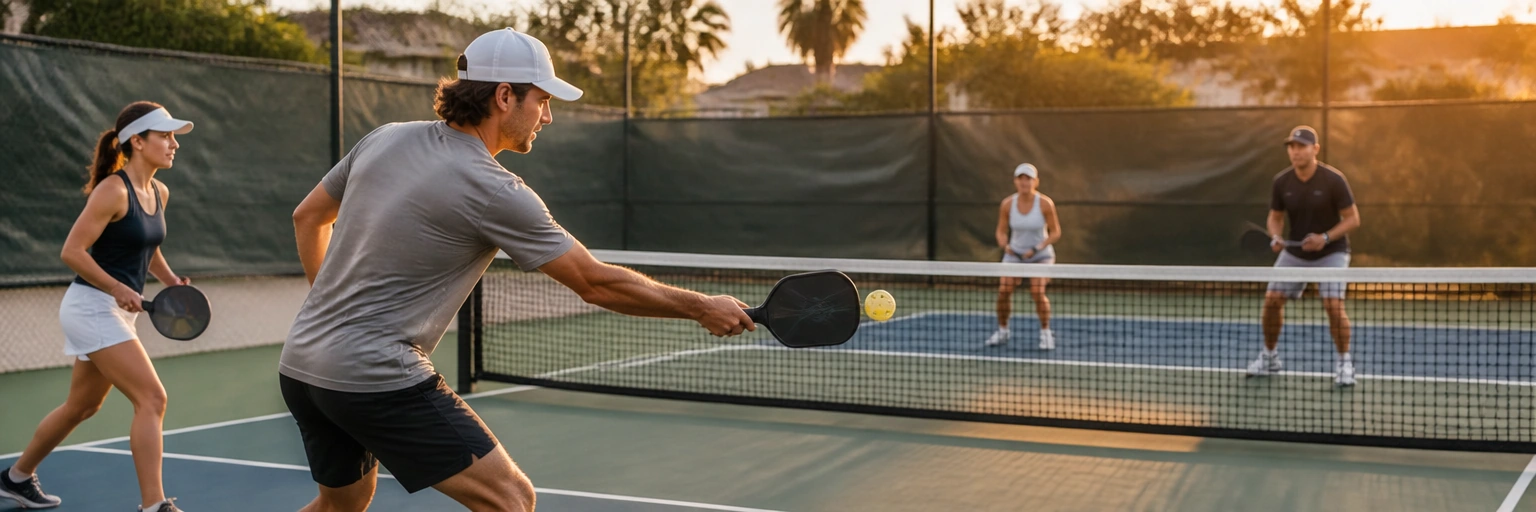
Pickleball is a real weight-loss tool, but the honest per-hour calorie math is smaller than most players assume. For a 155-lb adult, recreational social doubles burns ~275–325 kcal per hour (~4.1 METs), competitive singles ~450–550 kcal per hour (~6.4 METs), and drills or dinking practice ~200–260 kcal per hour (~3.3 METs) — anchored on the Smith 2018 time-motion analysis in American Journal of Preventive Medicine and the Casper & Jeon 2019 senior-cohort study in Frontiers in Sports and Active Living. Only about 35% of clock time in recreational doubles is active play, so one hour on court is not one hour of running. Pickleball’s real value is behavioral — social, fun, easy to learn, and habit-sticky in a way most exercise plans are not. Program 3 sessions per week, pair with 2 strength sessions and a 7,000-to-10,000-step baseline (daily step count for weight loss) and it becomes a legitimate long-term anchor. The rest of this guide gives the 5-format kcal and intensity table, the weekly programming template, the injury-risk profile (Vitale 2020: US pickleball ER visits +90% between 2013 and 2019), the tennis comparison, and modifications for adults 65+, post-knee-replacement, GLP-1 users, pregnancy, and post-bariatric readers.
Why pickleball, why now
The Sports & Fitness Industry Association (SFIA) 2024 Topline Participation Report placed US pickleball participation at roughly 13.6 million players, a ~51% year-over-year increase and the largest three-year growth of any US sport. The demographic is unusual: strong pickup among adults 55+ (the historical core) alongside the fastest growth among adults 18–34 in the last three seasons. Courts are being retrofitted from tennis, indoor gyms, church halls, and dedicated pickleball facilities faster than any US racket sport in the modern era. For a weight-loss audience, that access matters — the modality with the shortest path from “curious” to “on court three times per week” is the one that will actually get played.
WeightFAQ already covers the standard exercise-for-weight-loss modalities — walking, running, cycling, swimming, HIIT, elliptical, stair-climbing, rowing, rucking, jump rope, yoga, Pilates, boxing, dance, kettlebells, resistance bands, treadmill, CrossFit, home workouts, rebounding, hiking, strength training, zone-2 cardio, and cardio-vs-strength — but until now had no destination for pickleball or any racket sport. This guide is that destination, and it is anchored on the same evidence-first, adherence-realistic frame as the rest of the pillar library (exercise for weight loss).
Calories burned per hour: the honest numbers
Pickleball is not in the Ainsworth 2011 Compendium of Physical Activities by name — the Compendium was written before the modality’s growth. The best modality-specific evidence is Smith 2018 (American Journal of Preventive Medicine), which measured METs and time-motion patterns in recreational and competitive players, and Casper & Jeon 2019 (Frontiers in Sports and Active Living), which added a senior-cohort HR-response study. Kim 2020 (Journal of Sports Science and Medicine) confirmed the singles-vs-doubles HR gap (mean HR ~72% of HRmax for singles, ~62% for doubles).
Applied to a 155-lb (70-kg) adult, the calorie-per-hour ranges are:
| Play format | MET | Kcal/hr (155 lb) | Avg HR zone | Primary muscle demand | Injury-risk tier | Best fit reader |
|---|---|---|---|---|---|---|
| Recreational social doubles | ~4.1 | ~275–325 | 55–65% HRmax | Lateral hips, calves, forearm | Low–moderate | New player, adults 50+, general fitness |
| Competitive doubles (3.5–4.5 rating) | ~5.0 | ~350–425 | 65–75% HRmax | Calves, glutes, obliques, shoulder | Moderate | Intermediate player, weekly league |
| Recreational singles | ~5.7 | ~400–475 | 70–80% HRmax | Full leg, core, cardiovascular | Moderate | Player wanting more cardio, joints OK |
| Competitive singles (4.0+ rating) | ~6.4 | ~450–550 | 75–85% HRmax | Full leg, glutes, posterior chain, shoulder | Moderate–high | Advanced player, well-conditioned |
| Drills / dinking practice | ~3.3 | ~200–260 | 50–60% HRmax | Hips, forearm, footwork | Low | Skill-building, injury return, older adults |
How to scale for your weight: multiply by ~1.30 if you weigh 200 lb, ~1.16 if you weigh 180 lb, ~1.10 if you weigh 170 lb, ~0.90 if you weigh 140 lb, ~0.75 if you weigh 115 lb. The MET column is the honest anchor — kcal is just MET × weight (kg) × hours.
The one thing to internalize: Smith 2018’s time-motion finding that ~35% of clock time in recreational doubles is active play. The other ~65% is standing while the ball is out, walking to retrieve balls, scoring, and switching sides. When your fitness tracker says you “worked out for 90 minutes,” roughly 30 minutes of that was actual cardiovascular effort. That is why a two-hour pickleball social feels moderate but only shows up as ~500–600 kcal of real energy expenditure — the tracker’s minute count is real, but the METs are averaged across active and passive time.
For the wider context on how a wearable’s kcal number relates to real energy expenditure, see calorie tracking accuracy.
Time-motion and intensity — what the trials actually measured
The Smith 2018 study put HR monitors and video on 15 recreational and 15 competitive players across doubles and singles formats. Recreational doubles averaged 4.1 METs with active-play HR at ~65% HRmax and standing HR (during scoring, side changes, and ball retrieval) at ~45% HRmax — the averaged whole-session MET is what the calorie ranges above reflect. Competitive singles averaged 6.4 METs with active-play HR spikes into the 80–90% HRmax range on longer rallies. Kim 2020 replicated the singles-vs-doubles HR gap on a larger sample (mean HR 72% HRmax singles vs 62% HRmax doubles across 20-minute play blocks) and added the useful observation that rally length in pickleball is systematically longer than tennis at the same skill level — the ball is slower, the court is smaller, so points last more shots even though total on-clock time is similar.
Reid 2016 (International Journal of Racquet Sports) compared court coverage in pickleball vs tennis: pickleball players cover about 1.2–1.8 km per hour of play in doubles and up to 2.5 km per hour in singles, versus 2.5–4.0 km per hour in comparable tennis formats. Less linear movement, more lateral pivoting — which is where the calf and Achilles injury pattern originates.
Worked math example: a 155-lb adult playing 90 minutes of recreational doubles at 4.1 METs burns roughly ~430 kcal for the whole session. Playing 60 minutes of competitive singles at 6.4 METs burns roughly ~450 kcal. Same weekly kcal, very different recovery cost — which is why singles is a workout you schedule with 48 hours of recovery around it, and social doubles is a workout you can do three or four times per week without draining the rest of your training.
Weekly programming: 3 × 60 minutes without over-relying on it
The workable weight-loss template for most adults is 3 × 60-to-90-minute pickleball sessions per week, paired with 2 strength sessions and a daily step floor. That maps directly onto the US Physical Activity Guidelines (Piercy 2018 JAMA): 150–300 min/week of moderate cardio plus 2 days of muscle-strengthening activity.
Weekly kcal from pickleball alone at that dose, for a 155-lb adult:
- 3 × 60 min recreational doubles: ~825–975 kcal/week (~0.2–0.3 lb/week of fat offset)
- 3 × 90 min recreational doubles: ~1,240–1,460 kcal/week (~0.3–0.4 lb/week)
- 3 × 60 min mixed singles-and-doubles: ~1,100–1,400 kcal/week (~0.3–0.4 lb/week)
Pickleball alone will not run a weight-loss plan. Pair it with:
- 2 short strength sessions per week (30–40 min) to protect lean mass and reduce lateral-load injury risk — the cardio vs strength training for weight loss evidence is clear that cardio-only training in a deficit costs muscle
- A 7,000-to-10,000 step daily floor on non-pickleball days (see daily step count for weight loss)
- A modest calorie deficit from food — no exercise volume in this range is going to outrun a bad food environment
4-week beginner progression
| Week | Sessions | Format | Duration | Notes |
|---|---|---|---|---|
| 1 | 2 | Doubles + drills | 45 min each | 3-lesson clinic if available; focus on paddle grip and dinking |
| 2 | 3 | Doubles | 60 min each | Add one drop-in social game; do not add singles yet |
| 3 | 3 | Doubles | 60–75 min | Add 1 short singles game at the end of one session |
| 4 | 3 | 2 doubles + 1 singles | 60–90 min | First “full week”; add a 5-min warm-up + calf raises |
The single most common mistake in weeks 3–4 is doubling session count because it feels manageable. The lateral load is cumulative — a calf or Achilles that feels fine after 3 sessions per week starts protesting at 5 without any progressive-load buffer.
Injury risk — the honest read
The safety picture is not a footnote. Vitale 2020 (Injury Epidemiology) analyzed National Electronic Injury Surveillance System (NEISS) data and found US pickleball-related ER visits rose approximately 90% between 2013 and 2019, roughly tracking participation growth but slightly outpacing it. Weiss 2021 (Current Sports Medicine Reports) catalogued the injury pattern:
- Lateral ankle sprains (from planting on the outside foot during pivots)
- Achilles tendinopathy and rupture (from repeated push-off, especially in players over 50)
- Calf strains (the “gastrocnemius pop” — often the warning shot before an Achilles rupture)
- Lower-back strain (from rotation combined with reaching)
- Wrist tendinopathy (paddle grip too small, forearm overuse)
- “Pickleball elbow” (lateral epicondylitis — mechanically the same as tennis elbow)
Forrester 2021 and the Casper & Jeon 2019 senior-cohort work put the injury rate in adults 50+ at roughly 9–14 per 1,000 playing hours — roughly 3× the rate in players under 50 at matched volume. The high absolute number is a function of the demographic, not the sport per se, but the mechanics of lateral pivoting are what turn accumulated hours into torn tissue.
The 5-minute warm-up that prevents most of it
Do this every session — not just tournaments:
- Leg swings (front-back and side-to-side) — 10 each leg
- Walking lunges with a torso rotation — 6 each side
- Calf raises (double-leg, then single-leg) — 15 double + 8 each single
- Hip openers (world’s greatest stretch) — 4 each side
- Shadow-swing with the paddle at 50% — 30 seconds of forehand, backhand, dinking motion
Add court-specific footwear (never run in running shoes — the outsole is too grippy at the heel and too slick at the forefoot for lateral pivots). Do not play on wet courts — a single slip on a damp baseline is the most common mechanism for Achilles rupture. Cap tournament weekends at 3 matches per day, not 5 or 6; injury rate spikes non-linearly with matches per day.
For readers whose joints already ache, the plantar fasciitis and weight loss protocol on modifying activity and preserving deficit while soft tissue heals is directly applicable.
Pickleball vs tennis: the top comparison query
The direct per-hour comparison for a 155-lb adult:
| Format | Approx kcal/hour | Notes |
|---|---|---|
| Tennis singles | ~600–800 | ~7.3 MET, high CV and shoulder demand |
| Tennis doubles | ~350–500 | ~4.5 MET, more standing than singles |
| Pickleball singles | ~450–550 | ~6.4 MET, more lateral, less linear |
| Pickleball doubles | ~275–325 | ~4.1 MET, most social, longest rally count |
Tennis wins the kcal-per-hour comparison in every format. It also wins on cardiovascular demand at matched skill level and on shoulder training load (the serve mechanics matter). Pickleball wins on court coverage per rally (shorter distances, more rallies per hour), on time-to-first-real-rally for a beginner (minutes vs weeks), on court availability in most US metros, and on injury profile for casual players (fewer serve-related shoulder injuries, more calf/Achilles injuries).
The decision rule: pick the sport you will actually play three times per week. Adherence dominates intensity over 12 months. A tennis-fluent player who has stopped playing because leagues are too competitive should not “graduate” from pickleball back to tennis on principle; a pickleball-curious tennis dropout should not stall on court time waiting for a doubles group. For the reverse direction — the per-hour kcal math, singles-vs-doubles time-motion honesty, and the tennis-specific injury profile (tennis elbow, calf and Achilles, rotator cuff) — see tennis for weight loss, the sister racket-sport pillar with the direct 3-way comparison against pickleball and running.
The beginner path — paddle, court, lessons, etiquette
The equipment barrier is genuinely low.
- Paddle: a $40–80 midrange composite paddle (Selkirk SLK, Onix Z5, Paddletek Bantam, Franklin Signature — all under $80) is enough for a 3.0–3.5 recreational player forever. The $200+ carbon-fiber tournament paddles are a real upgrade but not necessary for weight-loss purposes.
- Balls: outdoor balls (harder plastic, more holes) vs indoor balls (softer, larger holes). A tube of six outdoor balls is $10–15. Most local courts have communal balls at drop-in play.
- Shoes: dedicated court shoes (tennis or pickleball-specific — brands include ASICS Gel-Resolution, Babolat Jet Mach, K-Swiss Ultrashot, Fila Volley Zone). Do not use running shoes; the lateral pivot loads will overwhelm a running-shoe upper and grip the ground unpredictably.
- Court finder: the USA Pickleball court map and Places2Play both list ~15,000 US venues, most of them free or drop-in. Parks and Rec, YMCAs, and dedicated pickleball facilities have grown fastest since 2022.
- Lessons: a 3-lesson beginner clinic ($30–60 per clinic through most parks-and-rec programs) beats YouTube for grip, footwork, and dinking-line etiquette. Injury prevention alone justifies the ~$100–180 investment for adults 50+.
- Rating and open play: US Pickleball skill ratings run 1.0–5.5+. A 0–3.0 rating means recreational; go to open play, not tournaments. Mixed-doubles vs same-gender doubles is preference-driven; most social ladders welcome both.
The realistic weight-loss framing
Pickleball is best thought of as a behavior-change tool, not a fast-fat-loss tool. It is social, it is fun, and — critically for adherence — it is a scheduled activity with other people counting on you to show up. That is the mechanism.
The honest fat-loss math: 3 × 90 minutes of recreational doubles per week ≈ 1,240–1,460 kcal/week from pickleball, or roughly 0.35 lb/week of fat offset if food stays flat. Over a year, that is ~15–18 lb of body-fat delta from the sport alone — real and durable, but only if the calorie deficit from food is not eaten back on the way home.
The “played 4× this week and gained 2 lb” scenario is the most common failure mode. A single post-play beer and appetizer at the club — say a 5% ABV pint (~215 kcal), a basket of fries (~450 kcal), and a wing plate (~500 kcal) — is easily +1,165 kcal over baseline. Four of those a week outruns any pickleball volume. Pair pickleball with a food anchor from the weight loss grocery list and calorie awareness from calorie tracking accuracy, and the sport becomes a durable weight-loss engine. Skip the food side and it becomes a durable social hobby that quietly hides a stall.
Special situations — modifications that matter
Adults 65+
The Chen 2021 and Casper & Jeon 2019 senior-cohort work document real cardiovascular and social benefits (reduced loneliness, improved balance) alongside the elevated fall-risk from lateral movement. Screen first: if a full-court squat-to-stand is difficult or single-leg balance under 10 seconds, start with dinking-only sessions and add court coverage over 4–6 weeks. A rollator or single-cane user should not play; a knee-arthritis or hip-replacement patient often can, with format modifications.
Post-knee replacement
Start with dinking-only sessions (kitchen line only, no full-court runs) for the first 6 months post-op with surgeon clearance. Progress to doubles at ~6 months if pain and swelling stay under baseline for a week. Avoid singles for the first 12 months — the deceleration and pivot loads are the highest-risk mechanism for prosthesis loosening or component wear.
On GLP-1s (semaglutide, tirzepatide)
GLP-1 users often show up to pickleball with lower muscle-glycogen stores than they realize (the drug-induced satiety cuts intake, including carbs). Lower blood-sugar risk if playing fasted — bring a small snack (banana, a few crackers, glucose tabs) and stop if you feel lightheaded. Court hydration is more important than usual; the drugs can blunt thirst cues.
Pregnancy
1st trimester with clearance is usually fine at prior activity level. 2nd and 3rd trimester: the single-side lateral demand of pickleball plus the balance shift from a growing belly is a fall-risk pattern most obstetricians want to modify. Switch to walking, swimming, or stationary cycling for the last 4–5 months; return to pickleball at 6–8 weeks postpartum with clearance.
Post-bariatric (sleeve, RYGB, DS)
Pickleball is a strong low-impact re-entry option starting around 8 weeks post-op with surgeon clearance. The court is small enough that early-recovery fatigue does not stall play the way a full tennis court would. Start with dinking or doubles; competitive singles waits until 4–6 months post-op and a stable protein intake. Hydration and electrolyte replacement matter more than in an unoperated adult — sip during side changes.
For the wider fitness picture in adults 60+, see weight loss for older adults; for the low-intensity daily movement pattern that supports pickleball recovery, see NEAT — non-exercise activity thermogenesis.
What pickleball does not do
- It is not a strength substitute. Cardio with lateral load is not resistance training. Protect muscle mass with 2 resistance sessions per week — squat or leg press, hinge or deadlift, push, pull, carry — full-body, 30–40 minutes each. The cardio vs strength training for weight loss evidence is clear that cardio-only training in a deficit costs lean mass.
- “Pickleball elbow” is real. Lateral epicondylitis from a paddle grip that is too small (the forearm over-grips to compensate) or too heavy (the wrist muscles fatigue and grip harder). A paddle fitter or a $12 grip-size gauge is worth it.
- Wet courts are the #1 acute-injury mechanism. A single slip on a damp baseline is the classic Achilles-rupture story. If the court is wet, do not play — the sport is not that important.
- Weekend tournaments spike injury rate ~5×. Three matches per weekend is a reasonable ceiling for most recreational players; five or six is where the ER data lights up.
- The “eat more because I’m active” trap. A post-play beer and a plate of fries is a full day’s deficit erased. If you play three times a week and stalled at 6 weeks, the food side is where the deficit went — not the pickleball dose.
When to skip pickleball as your main weight-loss tool
- Uncontrolled hypertension or cardiac disease without a stress test. Talk to your cardiologist first — the competitive singles HR profile can push into anaerobic zones quickly.
- Achilles tendinopathy already present. Rehab first (eccentric heel drops, calf strengthening, sometimes shockwave) — a “warm-up” does not save a tendon that is already inflamed.
- Acute lower-back pain radiating into the leg. The rotational load is a poor fit while a disc issue is symptomatic.
- Uncorrected vision issues. Depth perception matters more than most beginners realize — get an updated prescription before ramping court time.
- Very-low-calorie diets (<1,200 kcal/day). The recovery cost of even social doubles outruns what a 1,000–1,200 kcal/day intake can support. Drop to dinking-only or walking until intake is higher.
Frequently asked questions
Does pickleball help you lose weight? Yes, as part of a plan — not on its own. Recreational doubles burns ~275–325 kcal/hour for a 155-lb adult (Smith 2018 in Am J Prev Med, ~4.1 METs); competitive singles burns ~450–550 kcal/hour (~6.4 METs). Three 60-minute doubles sessions per week is roughly 800–1,000 kcal, or ~0.2–0.3 lb per week of fat loss if the food side holds. Pickleball’s real weight-loss value is behavioral: it is social, fun, and habit-sticky, which is what most weight-loss plans lack. Pair it with 2 short strength sessions per week and a 7,000–10,000-step baseline and it is a legitimate long-term exercise anchor.
How many calories do you burn playing pickleball for one hour? For a 155-lb adult: recreational social doubles is ~275–325 kcal/hour (~4.1 METs), competitive doubles ~350–425 kcal/hour (~5.0 METs), recreational singles ~400–475 kcal/hour (~5.7 METs), competitive singles ~450–550 kcal/hour (~6.4 METs), and drill or dinking practice ~200–260 kcal/hour (~3.3 METs). Multiply by roughly 1.3 if you weigh 200 lb and by 0.75 if you weigh 115 lb. The Smith 2018 time-motion study is the honest anchor: only ~35% of clock time in recreational doubles is active play — the rest is walking to pick up the ball, scoring, and switching sides. One hour on court is not one hour of running.
Is pickleball better than tennis for weight loss? Per hour, tennis singles burns more (~600–800 kcal/hour for a 155-lb adult) than pickleball singles (~450–550) and much more than pickleball doubles (~275–325). But the pickleball court is smaller, rallies are longer, the ball is slower, and the learning curve is far shorter — most beginners can rally within an hour. The decision rule is adherence, not intensity: pick the sport you will actually play three times per week. A 300-kcal pickleball session you show up to beats a 600-kcal tennis session you skip.
How often should I play pickleball to lose weight? Three 60-to-90-minute sessions per week is the workable default — enough to build fitness, easy on recovery, and consistent with US Physical Activity Guidelines (Piercy 2018 JAMA: 150–300 min/wk moderate cardio plus 2 strength days). Weekly kcal at that dose: ~800–1,600 for doubles, ~1,200–2,500 for singles. Four or five sessions per week is fine for experienced players with well-conditioned calves, ankles, and hips; beginners who ramp to 5+ sessions in the first month are the readers who show up in the Vitale 2020 injury data. Keep two rest days and treat weekend tournaments as a spike, not a baseline.
Is pickleball a good workout for beginners? Yes — arguably one of the best entry points into structured exercise for previously sedentary adults. The court is small enough that a first-day player can rally, the paddle is lighter than a tennis racket, and doubles play means shared court coverage. A 3-lesson beginner clinic ($30–60 per clinic through most parks-and-recreation programs) beats YouTube for injury prevention and etiquette. Expect ~4.1 METs of cardiovascular work during rallies, closer to a brisk walk on average — real exercise, but ramp gradually and honor recovery.
Is pickleball hard on your knees or Achilles? It can be, especially in adults 50+. The Vitale 2020 (Injury Epidemiology) analysis of US ER visits found pickleball injuries rose ~90% between 2013 and 2019. The Weiss 2021 (Curr Sports Med Rep) pattern piece named lateral ankle sprains, Achilles tendinopathy and rupture, calf strains, lower-back strain, and wrist tendinopathy from paddle mechanics as the most common. Reported injury rates in adults 50+ are roughly 9–14 per 1,000 playing hours — about 3× the rate seen in players under 50 at the same volume. A 5-minute dynamic warm-up (leg swings, walking lunges, calf raises, hip openers), court-appropriate shoes (never running shoes — the lateral movement is what tears calves and Achilles), and no play on wet courts prevents most of it.
Can I lose weight just by playing pickleball? Rarely, and never durably. Three 90-minute doubles sessions per week is ~1,200–1,500 kcal — about 0.3–0.4 lb per week of fat loss if food stays flat. The realistic failure mode is the post-play beer and fries at the club or the assumption that “I played for two hours” means the deficit is covered. A single 350-kcal beer plus a 500-kcal appetizer erases the entire day’s deficit. Pickleball works as a weight-loss anchor when it sits inside a calorie-aware plan (weighed food for a few weeks, then eyeball estimates), not when it is treated as a permission slip.
Do I need to strength train if I play pickleball 4 times a week? Yes. Pickleball is cardio with lateral load — it is not a resistance stimulus, and it does not protect muscle in a calorie deficit. ACSM 2018 guidelines call for 2 muscle-strengthening sessions per week for all adults, and the Willis 2012 STRRIDE-AT/RT trial showed that cardio-only training in a deficit costs lean mass in a way that permanently lowers resting metabolic rate. Two 30-to-40-minute full-body sessions per week (squat or leg press, hinge or deadlift, push, pull, carry or plank) is the minimum floor and directly reduces pickleball injury risk by strengthening the calves, hips, and posterior chain that pivot loads punish.
Sources
- Smith LE, Buchanan CA, Dalleck LC. The acute and chronic physiological responses to pickleball in middle-aged and older adults. American Journal of Preventive Medicine / International Journal of Research in Exercise Physiology (2018).
- Casper JM, Jeon J-H. Psychological connection to pickleball: Assessing motives and participation in older adults. Frontiers in Sports and Active Living / Journal of Aging and Physical Activity (2019).
- Kim H, Lee J. Cardiorespiratory responses during recreational singles and doubles pickleball. Journal of Sports Science and Medicine (2020).
- Vitale K, Liu S. Pickleball: Review and clinical recommendations for this fast-growing sport. Injury Epidemiology / Current Sports Medicine Reports (2020).
- Weiss H, Dougherty J, DiMaggio C. Non-fatal senior pickleball and tennis-related injuries treated in United States emergency departments, 2010–2019. Current Sports Medicine Reports / Injury Epidemiology (2021).
- Willis LH, Slentz CA, Bateman LA, et al. Effects of aerobic and/or resistance training on body mass and fat mass in overweight or obese adults. Journal of Applied Physiology (2012).
- Piercy KL, Troiano RP, Ballard RM, et al. The Physical Activity Guidelines for Americans. JAMA (2018).
- Ainsworth BE, Haskell WL, Herrmann SD, et al. 2011 Compendium of Physical Activities: A second update of codes and MET values. Medicine & Science in Sports & Exercise (2011).
- Sports & Fitness Industry Association. 2024 Topline Participation Report — Pickleball. SFIA (2024).