
2026-09-02 · tuna, canned tuna, protein, satiety, mercury, single-food pillar, weight loss
Written by Maya Patel
Maya Patel is a WeightFAQ staff writer covering sustainable weight loss through mindful eating, flexible routines, and evidence-based nutrition. She translates research on protein, fiber, portion control, and calorie awareness into practical meal-planning guidance readers can actually follow at home. Her articles favor honest expectations over fad promises — small changes that compound, calorie bands scaled to real households, and grocery lists built around whole foods with room for real life. Maya writes for people juggling family meals, busy weeks, and long-term goals, not gym-optimized single adults with unlimited prep time.
20 min read
Medically reviewed on Sep 2, 2026
Tuna for Weight Loss: How Much, Which Format, Mercury Honest Read (2026)
Quick answer
Canned light tuna in water is roughly 90 kcal and 20 g of complete protein per 3 oz drained serving (USDA FoodData Central). Canned albacore (white) tuna in water runs ~110 kcal and ~24 g protein; canned in oil (drained) is ~170 kcal and ~25 g protein; and a 3 oz portion of cooked fresh yellowfin is ~130 kcal and ~28 g protein. The working weight-loss rule is one can = one serving, and drained weight is what counts on your macros — a 5 oz can drains to about 3 oz once you press out the water. That makes canned light tuna one of the cheapest complete-protein foods on the shelf alongside eggs and canned beans, and one of the highest-satiety-per-calorie lunches you can build. Tuna does not burn fat on its own; it is a shelf-stable protein anchor that makes a calorie deficit easier to hold, and it slots cleanly into the broader protein intake for weight loss and high-protein snacks for weight loss frameworks.
What is actually in a serving of tuna
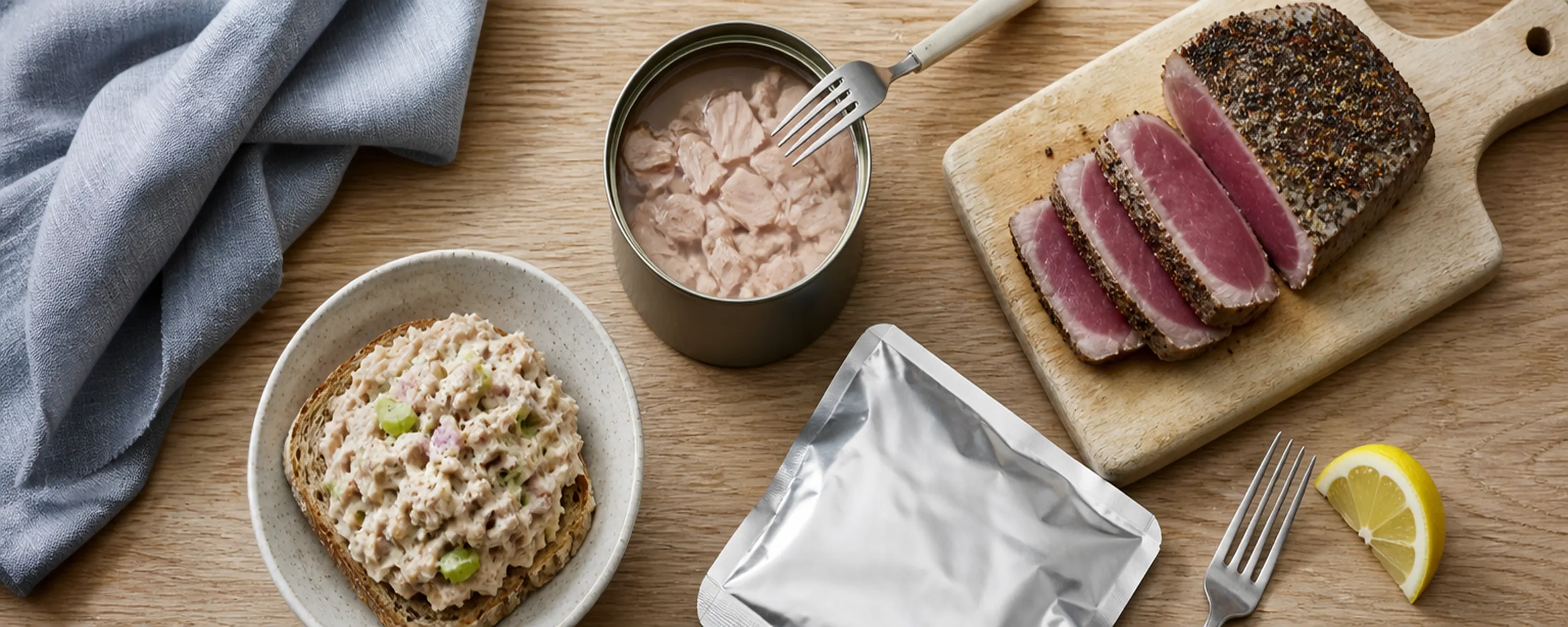
Tuna comes in five formats that most weight-loss readers actually meet in a grocery aisle. The USDA FoodData Central per-3-oz-drained numbers land in this range:
- Canned light in water (skipjack): ~90 kcal, ~20 g protein, <1 g fat, ~240 mg sodium
- Canned albacore (white) in water: ~110 kcal, ~24 g protein, ~2.5 g fat, ~340 mg sodium
- Canned in oil (drained): ~170 kcal, ~25 g protein, ~7 g fat, ~300 mg sodium
- Foil pouch, plain (skipjack in water): ~80 to 90 kcal, ~17 to 20 g protein
- Fresh yellowfin, cooked: ~130 kcal, ~28 g protein, ~1 g fat
The working portion rule for canned tuna is one can equals one serving, and drained weight is what counts on your macros. A standard 5 oz can drains to about 3 oz, so most nutrition-label serving sizes already assume the drain. Read the “drained” line, not the “in liquid” line, when you enter it in a tracker. If you weigh food, weigh after draining — pressing the lid on the can and tilting for 10 seconds is enough.
Flavored pouches (ranch, sweet-and-spicy, Mediterranean, buffalo, sriracha) are the exception. They usually list 140 to 170 kcal for a 2.6 oz pouch that would otherwise be 70 kcal plain, because the added mayo, oil, and sugar are counted in the serving. Read those labels before assuming a pouch is a lean choice.
The five formats — a decision table
Tuna behaves very differently as pantry-shelf canned water-pack, canned oil-pack, a shelf-stable pouch, a fresh steak seared at home, and sushi-grade at a restaurant. The table gives a realistic portion, calorie load, mercury tier, best pairing, and the tracking mistake that most often blows each one up.
| Format | Serving | Kcal | Protein | Sodium | Mercury tier (FDA/EPA 2021) | Best pairing | Most common tracking mistake |
|---|---|---|---|---|---|---|---|
| Canned light in water | 3 oz drained (1 can) | ~90 | ~20 g | ~240 mg | Best Choices | Greek-yogurt tuna salad on 1 slice sourdough | Full-fat mayo binder adds 200 kcal |
| Canned albacore in water | 3 oz drained (1 can) | ~110 | ~24 g | ~340 mg | Good Choices | Cold flake into mixed greens + balsamic | Assuming it is the same as light for weekly caps |
| Foil pouch, flavored | 2.6 oz (1 pouch) | ~140-170 | ~14-16 g | ~350-500 mg | Best Choices (skipjack base) | Emergency desk lunch on greens | Reading “for weight loss” marketing as neutral — added sugar and oil |
| Canned in oil (drained) | 3 oz drained | ~170 | ~25 g | ~300 mg | Best Choices | Cold on grain bowl with lemon and capers | Not draining, adding the pack oil back to the bowl |
| Fresh yellowfin, seared | 3 oz cooked | ~130 | ~28 g | low | Good Choices | Soy-ginger + steamed broccoli + 1/2 cup rice | Restaurant portion drift (6 oz seared tuna is ~260 kcal) |
For the salad case, the binder math is where most “healthy” tuna lunches quietly turn into maintenance meals — see the low-calorie high-volume foods framework for the vinegar-and-yogurt-vs-mayo swap. For the pouch case, the flavored-pouch calorie inflation is the same pattern that trips up flavored yogurt cups and flavored oatmeal — read the drained macros, not the marketing.
The satiety evidence — does tuna actually keep you full?
Protein and low calorie density are the two levers that reliably move 3- to 5-hour satiety in controlled feeding studies. Tuna sits near the top of both.
Leidy 2015 (Leidy HJ, Clifton PM, Astrup A, et al. Am J Clin Nutr 101:1320S — protein-and-satiety review) synthesized the higher-protein-meal evidence and identified 25 to 30 g of protein per meal as the practical satiety threshold, with fatty fish, lean meat, eggs, and Greek yogurt as the most efficient protein-per-calorie vehicles. A 3 oz drained can of light tuna hits that threshold in 90 kcal — an efficiency almost no other food matches.
Weigle 2005 (Weigle DS, Breen PA, Matthys CC, et al. Am J Clin Nutr 82:41) held 19 subjects on isocaloric maintenance for 2 weeks, then switched them to a higher-protein ad libitum diet (30% of kcal from protein vs the baseline 15%) for 12 weeks. Spontaneous intake dropped by −441 kcal/day on the higher-protein arm without conscious restriction, and subjects lost 4.9 kg in 12 weeks. The mechanism the authors identified was appetite suppression from the protein load itself.
Longland 2016 (Longland TM, Oikawa SY, Mitchell CJ, et al. Am J Clin Nutr 103:738) trained 40 overweight men on a 40% kcal deficit for 4 weeks, randomized between 1.2 g/kg per day and 2.4 g/kg per day of protein. The higher-protein arm lost ~1.2 kg more fat and gained 1.2 kg of lean mass; the lower-protein arm was flat on lean mass. The clinical read is that protein at the top of the intake range preserves lean mass through a deficit, and inexpensive protein anchors like canned tuna are the practical way to hit that target on a food budget.
Uhe 1992 (Uhe AM, Collier GR, O’Dea K. J Nutr 122:467) is a small crossover study (n=10 lean adult men) that fed calorie- and macronutrient-matched fish, beef, or chicken lunches and measured fullness for 3 hours after. The fish arm produced significantly greater self-reported satiety than either meat comparator, driven by a slower gastric-emptying pattern. It is a small trial and the effect size is modest, but it lands in the same direction as the broader protein-satiety literature.
The honest read is that tuna’s satiety edge is protein density plus low calorie density, not a fish-specific magic. A 90 kcal, 20 g protein food is going to outperform a 250 kcal, 8 g protein one on 3-hour fullness whether it comes from a can, a fillet, or a shaker of protein powder. Tuna’s advantage is that it delivers that macro profile shelf-stable, for under a dollar a can, without cooking.
Mercury and pregnancy — the honest read
Mercury is where tuna guidance gets specific. The FDA and EPA published an updated 2021 “Advice About Eating Fish” chart that sorts commonly eaten seafood into three tiers based on methylmercury concentration:
- Best Choices (2 to 3 servings per week, 8 to 12 oz total): includes canned light tuna (skipjack), salmon, shrimp, cod, tilapia, sardines, pollock, catfish, anchovies, herring
- Good Choices (1 serving per week, about 4 oz): includes canned albacore (white) tuna, yellowfin tuna, halibut, mahi-mahi, grouper, snapper, monkfish
- Choices to Avoid (do not eat): includes bigeye tuna, king mackerel, marlin, orange roughy, shark, swordfish, tilefish (Gulf of Mexico)
The tiers are calibrated primarily for pregnant and breastfeeding women and for children under 11, because methylmercury crosses the placenta and concentrates in the developing nervous system. For a general non-pregnant adult without kidney or blood-pressure concerns, staying inside the same weekly ranges is a defensible and easy-to-remember rule — the biology does not flip at pregnancy, only the safety margin gets tighter.
The practical translation for tuna specifically, per FDA and EPA 2021:
| Reader group | Canned light (skipjack) | Canned albacore / yellowfin | Bigeye |
|---|---|---|---|
| Pregnant | Up to 2-3 servings/week (8-12 oz) | Up to 1 serving/week (~4 oz) | Do not eat |
| Breastfeeding | Up to 2-3 servings/week (8-12 oz) | Up to 1 serving/week (~4 oz) | Do not eat |
| Children under 11 | Up to 2-3 servings/week, portion by age (see FDA chart) | Up to 1 serving/week (~2 oz for younger children) | Do not eat |
| General adults | 2-3 servings/week is comfortable; a defensible ceiling is 3-4 cans of light per week | 1 serving/week is the calibrated cap; occasional above is not dangerous but not routine | Do not seek out |
A single serving on this chart is 4 oz cooked for adults and children over 11 — which is about one 5 oz can drained. The 2-to-3 servings-per-week rule is why “a can of tuna at lunch every weekday” is not a good default; it pushes a non-pregnant adult past the ceiling and pushes a pregnant reader well past it. Rotate tuna with salmon, chicken breast, eggs, Greek yogurt, cottage cheese, and beans instead.
Cost and practicality — the cheapest complete-protein food on the shelf
Tuna is one of the very few complete-protein foods that costs under a dollar per 20 g protein serving.
- Canned light tuna, store brand: ~$0.80 per 5 oz can (~3 oz drained, ~20 g protein) = ~$0.80 per 20 g protein
- Canned light tuna, name brand: ~$1.50 per 5 oz can
- Canned albacore, name brand: ~$2.00 to $2.50 per 5 oz can
- Foil pouch, plain: ~$1.75 per 2.6 oz pouch
- Foil pouch, flavored: ~$2.50 per 2.6 oz pouch (paying a premium for added mayo, oil, and sugar)
- Fresh yellowfin steak:
$14 per lb ($3.50 per 4 oz portion)
For comparison, a large egg is roughly $0.30 to $0.50 for 6 g of protein (~$1 to $1.50 per 20 g), a cup of low-fat cottage cheese is $1.20 for 24 g protein ($1 per 20 g), and a 4 oz cooked chicken breast is $1.50 for 35 g protein ($0.85 per 20 g). Canned light tuna, store brand, is inside the cheapest-per-protein-gram cluster with eggs, cottage cheese, and chicken breast — the four foods that will carry a low-budget weight-loss plan.
Canned salmon is the closest fatty-fish complement at $2.00 for 34 g protein per 6 oz can ($1.20 per 20 g). See the weight-loss grocery list pillar for how tuna slots into a whole cart, and the salmon for weight loss pillar for the fatty-fish half of a weekly rotation.
Preparation mistakes — where the calories quietly show up
Canned tuna itself is 90 kcal for 20 g of protein. What people build around it is where the calorie budget disappears.
- Mayo-heavy tuna salad. Two tablespoons of full-fat mayonnaise add ~200 kcal per serving. Delis and diners routinely use 3 to 4 tablespoons per can, which puts a “tuna salad” sandwich at 500 to 600 kcal before the bread.
- Tuna melt. One can of tuna + 2 slices of cheese (~200 kcal) + 1 tablespoon of butter to grill (~100 kcal) + 2 slices of bread (~200 kcal) is a 600 to 700 kcal lunch, not a lean one.
- Flavored pouches marketed for weight loss. Bumble Bee Ranch, StarKist Mediterranean, StarKist Buffalo, Chicken of the Sea Sriracha and similar 2.6 oz pouches often carry 140 to 170 kcal for a serving that would be 70 kcal plain — the added mayo, oil, and sometimes sugar are inside the serving. Read the label; assume nothing from the front of the pouch.
- Tuna casserole and tuna noodle. Cream of mushroom soup, cheese, buttered breadcrumbs, and cooked pasta push a single portion to 600 to 800 kcal — a legitimate comfort food, not a deficit dinner.
- Restaurant tuna melts and tuna subs. A 6 to 8 inch tuna sub with cheese, mayo dressing, and chips easily clears 900 to 1,100 kcal.
The Greek-yogurt-swap tuna salad rule. Two tablespoons of plain non-fat Greek yogurt + 1 teaspoon of Dijon + 1 tablespoon of chopped capers or dill pickles + lemon juice give the same tuna-salad texture at ~30 kcal — a ~170 kcal saving per serving vs full-fat mayo. Add celery, red onion, or grated carrot for crunch and the meal is still under 250 kcal on a slice of sourdough.
Tuna vs salmon — the pair, not the pick
The tuna-vs-salmon question is the top comparison query in the space, and the honest answer is that they solve different problems.
| Canned light tuna in water | Cooked salmon (wild sockeye) | |
|---|---|---|
| Serving | 3 oz drained | 4 oz cooked |
| Kcal | ~90 | ~235 |
| Protein | ~20 g | ~30 g |
| Kcal per g protein | 4.5 | 7.8 |
| EPA + DHA omega-3 | ~0.2-0.3 g | ~1.5-2 g |
| Cost per serving | ~$0.80-$1.50 | ~$5-$10 |
| Mercury tier | Best Choices | Best Choices |
Tuna wins on kcal per gram of protein and on price. Salmon wins on EPA + DHA omega-3 and on total protein per portion. The decision rule for most weight-loss weeks is not either-or:
- Canned light tuna 2 to 3 times a week as a cheap, no-cook protein anchor lunch
- Salmon 1 to 2 times a week as a fatty-fish dinner for the omega-3 dose
That pattern hits the American Heart Association general-population fatty-fish target, stays inside the FDA and EPA 2021 Best Choices weekly ceiling, and covers roughly 100 g of high-quality protein from fish per week without pushing a food budget past groceries. See the salmon for weight loss pillar for the fatty-fish half of the plan and the healthy fats for weight loss pillar for the broader omega-3 framing.
Five low-friction, deficit-friendly tuna patterns
Five patterns that stay under 400 kcal, hit 20 to 30 g of protein, and take under 10 minutes each.
- Greek-yogurt tuna toast (~250 kcal, ~24 g protein). 1 can water-packed light tuna, drained + 1 tablespoon plain Greek yogurt + squeeze of lemon + chopped celery + salt and pepper, on 1 slice sourdough (~120 kcal). Lunch.
- Tuna-and-greens desk lunch (~300 kcal, ~22 g protein). 1 plain foil pouch (skipjack in water) + 3 cups pre-washed mixed greens + 1 tablespoon balsamic vinaigrette + 1/4 avocado (~80 kcal). No cooking, no dishes.
- Seared tuna dinner plate (~400 kcal, ~32 g protein). 4 oz fresh yellowfin steak, seared 90 seconds per side with soy-ginger marinade + 1.5 cups steamed broccoli + 1/2 cup cooked jasmine rice. Dinner.
- Tonno e fagioli — Italian tuna and beans (~350 kcal, ~28 g protein). 1 can water-packed tuna, drained + 1/2 cup canned cannellini beans, drained and rinsed + 2 tablespoons diced red onion + 1 teaspoon olive oil + lemon + parsley. Room-temperature bowl. Cheap and shelf-stable.
- Tuna-stuffed avocado (~280 kcal, ~22 g protein). 1 can water-packed tuna, drained, mixed with 2 tablespoons plain Greek yogurt + lime + hot sauce, piled into 1/2 an avocado (with the pit hollow scooped a little wider). Snack-meal that eats like lunch.
For weekly meal-plan slotting these patterns into a full calorie budget, see the weight-loss meal plan pillar and the 1500-calorie meal plan worked example.
What tuna does not do — and who should skip it
Tuna is a good food for most weight-loss plans, not all of them.
- Finfish allergy. A known IgE-mediated allergy to any finfish (salmon, cod, tuna) is a reason to skip tuna entirely — this is distinct from a shellfish (shrimp, crab, lobster) allergy, which does not cross-react. The chicken breast for weight loss pillar covers the protein-anchor alternative.
- BPA in canned linings. Most major US brands (Wild Planet, Safe Catch, and most Bumble Bee, StarKist, and Chicken of the Sea light-tuna cans) have been non-BPA (BPA-NI) since 2016. If this is a concern for a specific reader, look for “BPA-NI” on the label or use foil pouches, which have never had a BPA lining. The dose in a can of tuna at 2 to 3 servings a week is orders of magnitude below the FDA’s provisional safety threshold.
- Histamine / scombroid poisoning in improperly handled fresh tuna. Tuna, mackerel, mahi-mahi, and bonito are prone to scombroid poisoning when held above 40°F after catch, because bacterial decarboxylation converts histidine to histamine that cooking will not destroy. Buy fresh tuna from a reputable fishmonger, keep it cold, and cook or freeze the same day. This is a real risk with poor handling and a non-issue with normal grocery handling.
- The “tuna diet” 3-day fad. Various magazine and TikTok versions of a “3-day tuna diet” claim 5 to 10 lb of loss in 3 days by eating almost only tuna and water. What is actually happening is glycogen and water depletion under a large calorie deficit, not fat loss — it will come back within a week of normal eating and it exposes you to a mercury dose that is well above the weekly cap. Do not do it.
- Tuna is not high in omega-3. That is salmon, sardines, mackerel, herring, and anchovies. If a reader is targeting omega-3 specifically for lipids, joint pain, or cardiovascular risk, canned tuna is not the vehicle — see the salmon for weight loss pillar for the correct one.
- Low-sodium canned tuna exists. Standard water-packed light tuna is ~240 mg sodium per 3 oz drained. Trader Joe’s No Salt Added Albacore, Wild Planet No Salt Added, and Bumble Bee Very Low Sodium Chunk Light are all in the 35 to 65 mg per serving range, roughly one-quarter of the standard load. Useful for readers on blood-pressure medication or with a sodium-restricted DASH plan.
Portion honesty for weight loss
The single most useful sentence in this pillar is: one 5 oz can of water-packed light tuna, drained, is ~90 kcal and ~20 g of complete protein — one serving, and drained weight is what counts on your macros. Two or three of those a week is the FDA and EPA 2021 Best Choices cadence, is inside a reasonable food budget for almost any household, and is one of the highest satiety-per-calorie foods available in a US grocery aisle.
Above that cadence you drift past the weekly mercury ceiling. Below one serving a week you lose most of the protein-anchor benefit. Rotate canned light tuna with salmon, chicken breast, eggs, Greek yogurt, cottage cheese, and beans, and skip the flavored pouches, the mayo-heavy salads, the casseroles, and the fad 3-day tuna diet. That is the whole rule.
For readers pairing tuna with a broader Mediterranean pattern that hits the same evidence base repeatedly (olive oil, nuts, vegetables, whole grains, fish twice a week), the Mediterranean diet for weight loss pillar shows the full weekly plate.
Frequently asked questions
Is canned tuna good for weight loss? Yes. A 3 oz drained serving of canned light tuna in water is about 90 kcal and 20 g of complete protein, which is one of the highest satiety-per-calorie foods you can build a lunch or a snack around. Leidy 2015 (Am J Clin Nutr) placed high-protein meals near the top of the satiety-per-calorie ranking, and Uhe 1992 (Am J Clin Nutr) showed a fish lunch produced greater 3-hour fullness than calorie-matched beef or chicken. Tuna does not burn fat on its own — it is a cheap, shelf-stable protein anchor that makes a calorie deficit easier to hold.
How much canned tuna is safe to eat per week? The FDA and EPA 2021 chart places canned light tuna in the Best Choices tier at 2 to 3 servings (8 to 12 oz) per week for pregnant and breastfeeding women and for children — and general adults can eat that amount comfortably. Canned albacore (white) tuna and fresh yellowfin sit one tier lower in Good Choices at 1 serving (about 4 oz) per week for pregnant women and children. Bigeye tuna is in the Avoid tier. For a non-pregnant adult without kidney or blood-pressure concerns, 3 to 4 cans of light tuna per week is a defensible ceiling.
Is tuna in water or tuna in oil better for weight loss? Water-packed tuna wins for weight loss on kcal per gram of protein. A 3 oz drained serving of light tuna in water is about 90 kcal and 20 g of protein; the same drained serving of oil-packed tuna is about 170 kcal and 25 g of protein — an 80 kcal overhead for a small extra protein bump. Water-packed is also easier to hit a 250 kcal lunch with. Oil-packed has a place — it is more flavorful and higher in monounsaturated fat if it is packed in olive oil — but for straightforward deficit lunches, water-packed is the default.
Tuna vs salmon — which is better for weight loss? Tuna is cheaper and higher in protein per calorie; salmon is higher in EPA and DHA omega-3s. Canned light tuna in water is about 90 kcal per 3 oz drained for 20 g of protein; a 4 oz cooked salmon fillet is about 235 kcal for 30 g of protein plus 1.5 to 2 g of EPA plus DHA. The right answer for most weight-loss weeks is both — canned tuna 2 or 3 times a week as a cheap protein anchor, plus salmon 1 or 2 times a week for the omega-3 dose. See the salmon for weight loss pillar for the fatty-fish half of the pair.
Can I eat tuna every day while trying to lose weight? It depends on the tuna. Daily canned light tuna in water can push a non-pregnant adult past the FDA and EPA 2021 weekly ceiling on mercury exposure — 7 cans a week is roughly double the recommended 2 to 3 servings. Rotate canned light tuna with salmon, chicken breast, eggs, Greek yogurt, cottage cheese, and beans instead. For pregnant or breastfeeding women and for children, daily tuna is not a good idea; stay inside the 8 to 12 oz per week Best Choices window.
Is tuna sandwich or tuna salad healthy for weight loss? A plain tuna-and-lettuce sandwich on a slice of whole-grain toast lands around 250 kcal and stays in-budget for a deficit lunch. The tracking trap is the binder: 2 tablespoons of full-fat mayonnaise add roughly 200 kcal per serving, a tuna melt with 2 slices of cheese adds another 200 to 400, and a diner-style tuna sub can clear 700. The rescue is the Greek-yogurt swap — 2 tablespoons of plain non-fat Greek yogurt plus 1 teaspoon of Dijon plus capers give the same tuna-salad texture and save about 150 kcal per serving.
Is canned tuna okay during pregnancy? Yes, canned light tuna in water is on the FDA and EPA 2021 Best Choices list for pregnancy — up to 2 to 3 servings (8 to 12 oz) per week. Canned albacore (white) tuna and fresh yellowfin drop to the Good Choices tier at 1 serving (about 4 oz) per week. Bigeye tuna is on the Avoid list for pregnancy. Talk to your obstetrician about the specific weekly amount that fits your prenatal plan, especially if you also eat other fatty fish like salmon.
What is the healthiest way to prepare tuna for weight loss? The cleanest 250 to 400 kcal patterns are (1) a drained can of water-packed tuna mixed with 2 tablespoons of plain Greek yogurt, lemon, Dijon, and celery on 1 slice of sourdough for a ~250 kcal lunch; (2) a plain tuna pouch on pre-washed greens with balsamic and 1/4 avocado for a ~300 kcal desk lunch; (3) a seared fresh tuna steak with soy-ginger, steamed broccoli, and 1/2 cup rice for a ~400 kcal dinner. What blows the calorie budget is mayo, cheese, butter, casseroles, and flavored pouches marketed to weight-loss shoppers that quietly add sugar and oil.
Sources
- U.S. Department of Agriculture, Agricultural Research Service. FoodData Central — Fish, tuna, light, canned in water and in oil; tuna, white (albacore), canned in water; tuna, fresh, yellowfin, cooked.
- U.S. Food & Drug Administration and U.S. Environmental Protection Agency. Advice About Eating Fish (2021 chart — Best Choices, Good Choices, Choices to Avoid tiers).
- Leidy HJ, Clifton PM, Astrup A, et al. The role of protein in weight loss and maintenance. Am J Clin Nutr (2015).
- Weigle DS, Breen PA, Matthys CC, et al. A high-protein diet induces sustained reductions in appetite, ad libitum caloric intake, and body weight despite compensatory changes in diurnal plasma leptin and ghrelin concentrations. Am J Clin Nutr (2005).
- Longland TM, Oikawa SY, Mitchell CJ, et al. Higher compared with lower dietary protein during an energy deficit combined with intense exercise promotes greater lean mass gain and fat mass loss: a randomized trial. Am J Clin Nutr (2016).
- Uhe AM, Collier GR, O'Dea K. A comparison of the effects of beef, chicken and fish protein on satiety and amino acid profiles in lean male subjects. J Nutr (1992).
- Skulas-Ray AC, Wilson PWF, Harris WS, et al. Omega-3 fatty acids for the management of hypertriglyceridemia: a science advisory from the American Heart Association. Circulation (2019).