
2026-08-28 · avocado, healthy fats, monounsaturated fats, satiety, single-food pillar, weight loss
Written by Maya Patel
Maya Patel is a WeightFAQ staff writer covering sustainable weight loss through mindful eating, flexible routines, and evidence-based nutrition. She translates research on protein, fiber, portion control, and calorie awareness into practical meal-planning guidance readers can actually follow at home. Her articles favor honest expectations over fad promises — small changes that compound, calorie bands scaled to real households, and grocery lists built around whole foods with room for real life. Maya writes for people juggling family meals, busy weeks, and long-term goals, not gym-optimized single adults with unlimited prep time.
14 min read
Medically reviewed on Aug 28, 2026
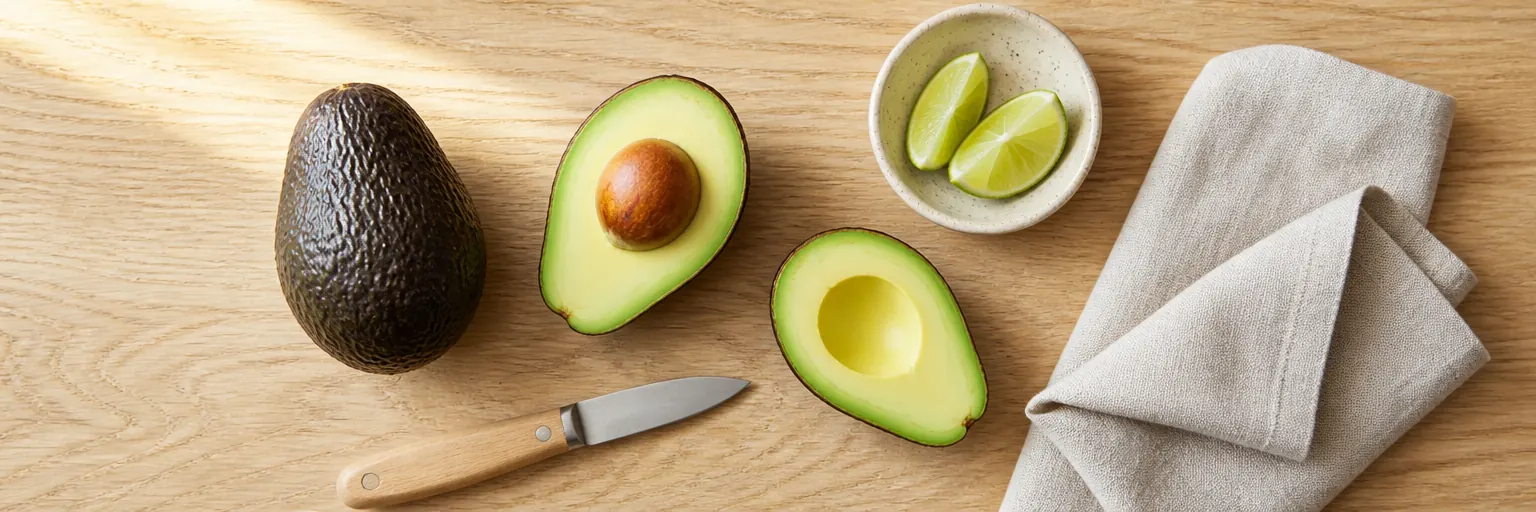
Avocado for Weight Loss: How Much, How Often, What Works (2026)
Quick answer
One medium Hass avocado carries about 240 kcal, ~22 g of fat (~15 g monounsaturated), ~10 g of fiber, ~700 mg of potassium, and ~3 g of protein. In controlled feeding, half an avocado added to a mixed lunch raised 3-hour satiety by ~26% and 5-hour satiety by ~40% versus a calorie-matched control (Wien 2013, Nutrition Journal), and a 26-week whole-avocado-per-day RCT in over 1,000 adults with elevated waist circumference showed neutral body weight, a small LDL improvement, and no meaningful visceral-fat difference (Mattes 2018, Nutrients, the HAT trial). The working rule for a deficit is half a medium avocado per meal, one whole avocado per day maximum — not “all the guacamole you want.” Avocado belongs in the broader healthy fats for weight loss picture as a monounsaturated-fat anchor with a real calorie tag.
What is actually in an avocado
Avocado is a fruit, but nutritionally it behaves like a fat source. USDA FoodData Central puts raw Hass at roughly 160 kcal per 100 g, with ~15 g total fat (~10 g monounsaturated, mostly oleic acid), ~9 g carbohydrate of which ~7 g is fiber, ~2 g protein, and around 485 mg potassium. A typical medium Hass weighs 150 to 170 g of edible flesh, which is where the 200 to 240 kcal figure comes from. A large Hass can be 300 to 320 kcal, and a “small” avocado at the store is not always small — this is the most common tracking failure in avocado logging.
Florida (Fuerte-type) avocados are larger, waterier, and lower in fat per gram; a medium Florida runs 350 to 400 kcal for the whole fruit and eats more like a vegetable-dominant fruit than a fat source. Almost all published avocado-and-weight-loss trials use Hass, and grocery-store avocados in the US are overwhelmingly Hass, so the numbers in this guide map to Hass unless noted.
The honest calorie load matters because avocado is easy to eat past a portion — half an avocado feels like a garnish, not a fat serving. If you are new to weighing food, the practical anchor is: half a Hass ≈ 68 g ≈ ~120 kcal ≈ ~10 g fat. That is one measured portion. If you are tracking your intake, see how to count calories for the weigh-vs-estimate approach that keeps avocado in range.
The satiety evidence — does it actually keep you full?
The Wien 2013 trial (Wien M, Haddad E, Oda K, Sabaté J. Nutrition Journal, n=26 overweight adults) tested half a Hass avocado added to a standardized lunch versus a calorie-matched control lunch without avocado. Self-reported satisfaction was ~26% higher at 3 hours and ~40% higher at 5 hours in the avocado arm, and desire to eat over the same window was blunted. Blood-glucose and insulin responses were also lower after the avocado meal. Zhu 2019 (Nutrients, breakfast avocado design) replicated the direction of the satiety finding and showed slower gastric emptying by ultrasound.
The mechanism is not mysterious: avocado brings fiber and monounsaturated fat, both of which slow gastric emptying and trigger cholecystokinin (CCK) release, the small-intestine hormone that signals fullness to the brain. It is the same mechanism that makes olive oil, nuts, and eggs filling per calorie. What matters for weight loss is the framing: half an avocado replacing ~240 kcal of low-satiety carbohydrate (a small bagel, a handful of crackers) is a satiety upgrade. Half an avocado added on top of an already-complete lunch is 120 kcal of extra intake with no calorie displacement, which is where “healthy fats” quietly stall a deficit.
What a whole avocado a day does over 26 weeks (Mattes 2018)
The best evidence on daily avocado use comes from the Habitual Diet + Avocado Trial (HAT) — Lichtenstein AH, Kris-Etherton PM, Petersen KS, et al. Nutrients 2018 and follow-up Journal of the American Heart Association 2022 (Sabaté / Mattes group). HAT randomized 1,008 adults with elevated waist circumference to either one whole avocado per day added to their habitual diet or a calorie-matched control, for 26 weeks. Key results:
- Body weight: no meaningful difference between arms.
- Visceral fat by MRI: no meaningful difference.
- LDL cholesterol: small but statistically significant improvement in the avocado arm (~2.5 mg/dL).
- Dietary quality (HEI): improved in the avocado arm, driven by more fruit and healthy fat and less discretionary fat.
The practical translation is unglamorous but useful: avocado is not a weight-loss driver on its own. It is a swap that can improve diet quality and lipid profile without derailing a deficit — provided the calories are accounted for. HAT deliberately did not build in a calorie deficit; participants added avocado on top of habitual intake, and body weight held steady, which is the correct read for a food that is calorie-dense but nutrient-dense. In a real weight-loss plan, the avocado still needs to fit inside the daily calorie target.
The LDL / cardiometabolic case
For a reader also managing cholesterol during weight loss, avocado has a specific dossier. Peou 2016 (Journal of Clinical Lipidology) meta-analyzed 10 controlled feeding trials of avocado-inclusive diets versus lower-fat controls and reported significant reductions in total cholesterol, LDL cholesterol, and triglycerides in the avocado arms, driven by the substitution of monounsaturated fat for saturated fat and refined carbohydrate. Wang 2015 (Journal of the American Heart Association) modeled avocado as part of a broader dietary-fat-substitution analysis and reached the same direction of effect. The Dreher 2013 review in Critical Reviews in Food Science and Nutrition remains the standard nutrient-density summary — the reason avocado shows up in the “eat more of” column in most cardiology-adjacent guidance.
None of this makes avocado a cholesterol drug. But if you are pairing weight loss with a lipid goal, swapping some of your daily saturated fat (butter, cheese, fatty cured meats) for a measured half-avocado is one of the higher-leverage food moves you can make. For the full weight-loss-and-lipid picture, see cholesterol and weight loss.
The five formats — a decision table
Avocado behaves differently as a topping, a spread, a dip, and a shake ingredient. The table below gives realistic portions, calorie loads, and the tracking mistake that most often blows each one up.
| Format | Portion | Kcal added (avocado only) | Best pairing | Most common tracking mistake |
|---|---|---|---|---|
| Half at lunch on a salad | ½ medium Hass, sliced | ~120 | Grilled chicken or salmon + leafy greens + vinegar-based dressing | Also using olive oil dressing (doubles the fat) |
| Quarter on whole-grain toast | ¼ medium Hass, mashed | ~60 | One egg + one slice of dense whole-grain bread | Eating two slices and using half the avocado |
| Guacamole as a dip | 2 tbsp per serving | ~80 | Sliced bell pepper, carrot, or jicama sticks | Eating it with tortilla chips (chips add ~150 kcal per oz) |
| Whole in a bowl | 1 whole medium Hass | ~240 | Tuna, shrimp, or chicken as the protein anchor | Adding cheese and mayo on top |
| Blended into a shake | ¼ medium Hass | ~60 | Whey or plant protein + frozen berries + unsweetened milk | Also adding nut butter (adds ~100 kcal) |
For the dip case, the vegetable-vehicle rule is the same one that makes cottage cheese, hummus, and yogurt dips work in a deficit — see high-protein snacks for weight loss for the crunch-plus-protein pairing. For the smoothie case, portion honesty for the whole drink matters more than the avocado alone — see weight loss smoothies for the total-calorie framework.
The tracking-failure modes — where avocado quietly wrecks a deficit
Avocado is often described as “you can’t overeat healthy fat,” which is wrong in a real kitchen. Four failure modes account for most of the damage.
Restaurant guacamole. A standard restaurant portion is roughly half a cup, or about 200 kcal of guacamole, and it is almost never eaten by the spoon — it is eaten by the chip. A standard tortilla-chip serving is 140 to 150 kcal per ounce, and a shared basket is easily 3 to 4 oz per person. Total damage on what the reader mentally logs as “a little guac before dinner”: ~450 to 650 kcal, or a full lunch.
Coffee-shop avocado toast. The commercial version averages 550 to 700 kcal — a whole avocado (or one and a half) mashed on a thick slab of sourdough that has been brushed with olive oil and finished with flaky salt. Add a poached egg and it clears 700 kcal. This is not the same food as the home version at ~200 kcal for the same visual plate.
“Half an avocado for a snack.” Halving an avocado between breakfast and lunch adds ~120 kcal on top of a complete breakfast — not a snack, a partial meal. If the goal is a 300 to 400 kcal deficit, a mid-morning half-avocado uses roughly a third of it before lunch has happened.
Large-avocado overshoot. A “medium” avocado at the store is anywhere from 150 to 320 g of flesh. Logging “one avocado, 240 kcal” for a large fruit undercounts by 60 to 100 kcal per meal, which compounds quickly. When you are new to avocado tracking, weigh the flesh once or twice to calibrate.
For the broader restaurant-portion framework — how kitchens portion avocado, oil, and cheese versus home cooking — see eating out for weight loss.
When avocado is the wrong food to add
Avocado is a good food for most weight-loss plans but not all of them.
- Very-low-calorie plans (<1,500 kcal/day) where the fat budget is genuinely tight. One avocado is 20 to 30 percent of the day’s fat target on a 1,200 kcal plan, and it crowds out lean protein and vegetables. On low-calorie plans the portion drops to a quarter avocado at most, or the fat comes from oil and nuts instead.
- Gastroparesis or delayed gastric emptying. The same slow-gastric-emptying property that makes avocado filling can worsen symptoms — see gastroparesis and weight loss for the fat-and-fiber ceilings that condition sets.
- Latex-fruit syndrome allergy. Avocado is one of the classic cross-reactive foods with natural rubber latex (Blanco 1994 cross-reactivity data); readers with a known latex allergy should ask a clinician before adding avocado.
- Advanced CKD on potassium restriction. One medium avocado carries ~700 mg of potassium — roughly 20 to 30 percent of the daily allowance for many CKD stages on a low-potassium prescription. See chronic kidney disease and weight loss for the food-substitution framework in that context; avocado is not automatically off the plate, but it is a food that needs to be counted.
Portion honesty for weight loss
The single most useful sentence in this pillar is: half a medium Hass avocado per meal, no more than one whole avocado per day, is the working default for a weight-loss plan. Half a Hass is about 68 g of flesh and roughly 120 kcal, or about 10 g of mostly-monounsaturated fat and 5 g of fiber. That is a real fat serving in a mixed meal — not a garnish, not a snack.
The upstream framing is that “avocado is heart-healthy” is not license to eat unlimited avocado in a calorie deficit. Every food in a deficit competes for the same calorie budget, and avocado at 9 kcal per gram of fat is more calorie-dense than most vegetables, most fruits, and even most lean proteins by weight. This is exactly the point covered in the low-calorie high-volume foods pillar, where avocado shows up as a counter-example — an intentionally calorie-dense whole food you portion, not a volume food you fill up on.
The 7-day starter template
A realistic week of avocado use for a reader on a ~1,600 kcal weight-loss plan looks like this:
- Monday. Lunch: mixed greens with grilled chicken, half a Hass avocado sliced, cherry tomatoes, cucumber, red-wine vinegar. (~120 kcal from avocado.)
- Tuesday. Breakfast: one slice of dense whole-grain toast with a quarter of a Hass mashed on top, one poached egg, black pepper. (~60 kcal from avocado.)
- Wednesday. No avocado. Rest day for the food. (Nothing on the plan requires daily avocado.)
- Thursday. Afternoon snack: 2 tbsp of guacamole with 8 baby carrots and 4 whole-grain crackers. (~80 kcal from avocado.)
- Friday. Dinner: shrimp-and-chicken bowl with brown rice, black beans, salsa, half a Hass, cilantro, and lime. (~120 kcal from avocado.)
- Saturday. No avocado. Social meal out or leftovers.
- Sunday. Breakfast smoothie: whey protein, unsweetened milk, frozen berries, a handful of spinach, and a quarter of a Hass for creaminess. (~60 kcal from avocado.)
Weekly avocado total ≈ 2 whole fruit ≈ ~440 to 480 kcal, spread across five days. This template pairs cleanly with the meal-frame approach in how to build a weight loss meal plan and the batch-prep patterns in meal prep for weight loss — cut the avocado at the meal, not the day before, or store the unused half cut-side-down in lemon water in the fridge.
Frequently asked questions
Is avocado good for weight loss? Yes, in reasonable portions. Half a medium Hass avocado (about 120 kcal) added to a lunch salad improves 3- and 5-hour satiety compared with a calorie-matched control (Wien 2013, Nutrition Journal), and swapping avocado for lower-quality fat can improve LDL without derailing a deficit. But avocado is not a fat-burning food — it is a calorie-dense whole food that helps a deficit when portioned and hurts one when treated as unlimited.
How much avocado per day is safe for weight loss? The working default is half a medium Hass avocado per meal, no more than one whole avocado per day. Half a Hass is roughly 68 g and about 120 kcal, with ~10 g of monounsaturated fat, ~5 g of fiber, and ~350 mg of potassium. Going over one avocado a day in a 1,500 to 1,800 kcal deficit is usually where portion creep quietly stalls weight loss.
Can I eat avocado every day and still lose weight? Yes, if it fits your calorie target. The 26-week Habitual Diet + Avocado Trial (HAT, Mattes 2018, Nutrients) had adults eat one whole avocado daily and found neutral body weight and a small LDL improvement compared with a calorie-matched control. Daily avocado is compatible with weight loss when it replaces other calories rather than stacking on top of them.
Is avocado better than butter or olive oil for weight loss? For a satiety-plus-fiber combination on toast or a salad, avocado usually wins over butter, calorie for calorie. Olive oil is roughly comparable on fat quality but carries almost no fiber or potassium, so avocado edges it out on nutrient density; olive oil wins on precision — you can measure a tablespoon, but half an avocado varies by fruit size. The best answer for most weight-loss plans is to use both in measured amounts and skip the mayonnaise.
Does avocado help burn belly fat? No single food burns belly fat. The HAT trial (Mattes 2018) specifically measured visceral fat and found no meaningful difference between the avocado-a-day arm and the calorie-matched control. Where avocado helps is at the whole-diet level — better satiety and better LDL make a deficit easier to sustain, and the deficit is what drives fat loss.
Are Hass avocados different from Florida avocados for weight loss? Yes, meaningfully. A medium Hass is roughly 200 to 240 kcal and about 22 g of fat; a medium Florida avocado is closer to 350 to 400 kcal and lower in fat per gram but larger overall. Most US grocery-store avocados are Hass, and most published RCTs use Hass, so the guidance in this article maps to Hass. If you buy Florida avocados, treat one whole Florida avocado as roughly one and a half Hass for tracking purposes.
Is avocado toast a good weight-loss breakfast? It can be, if you portion the avocado (a quarter, ~60 kcal) on one slice of whole-grain bread and pair it with a protein anchor — an egg, cottage cheese, or smoked salmon. Restaurant and coffee-shop avocado toast typically runs 550 to 700 kcal, because it uses a full or double avocado on thick sourdough brushed with olive oil, which is a completely different meal from the home version.
Does guacamole count the same as a whole avocado? Yes, calorie-for-calorie, with a caveat: restaurant guacamole is usually eaten by-the-chip, and a standard tortilla-chip serving adds ~150 kcal on its own. A typical restaurant portion of guacamole is around half a cup (roughly 200 kcal) plus chips can push a shared appetizer well past 450 kcal — which is a meal, not a snack. Guacamole with sliced vegetables (carrot, bell pepper, jicama) is a much better vehicle in a deficit.
Sources
- Wien M, Haddad E, Oda K, Sabaté J. A randomized 3x3 crossover study to evaluate the effect of Hass avocado intake on post-ingestive satiety, glucose and insulin responses. Nutrition Journal (2013).
- Lichtenstein AH, Kris-Etherton PM, Petersen KS, et al. Design and Baseline Characteristics of the Habitual Diet and Avocado Trial (HAT). Nutrients (2021; HAT trial, Mattes group).
- Zhu L, Huang Y, Edirisinghe I, Park E, Burton-Freeman B. Using the Avocado to Test the Satiety Effects of a Fat-Fiber Combination in Place of Carbohydrate Energy in a Breakfast Meal in Overweight and Obese Men and Women. Nutrients (2019).
- Peou S, Milliard-Hasting B, Shah SA. Impact of avocado-enriched diets on plasma lipoproteins: A meta-analysis. Journal of Clinical Lipidology (2016).
- Wang L, Bordi PL, Fleming JA, Hill AM, Kris-Etherton PM. Effect of a moderate fat diet with and without avocados on lipoprotein particle number, size and subclasses in overweight and obese adults. Journal of the American Heart Association (2015).
- Dreher ML, Davenport AJ. Hass avocado composition and potential health effects. Critical Reviews in Food Science and Nutrition (2013).
- U.S. Department of Agriculture, Agricultural Research Service. FoodData Central — Avocados, raw, all commercial varieties (Hass reference).