
2026-09-01 · peanut butter, healthy fats, high protein, satiety, single-food pillar, weight loss
Written by Maya Patel
Maya Patel is a WeightFAQ staff writer covering sustainable weight loss through mindful eating, flexible routines, and evidence-based nutrition. She translates research on protein, fiber, portion control, and calorie awareness into practical meal-planning guidance readers can actually follow at home. Her articles favor honest expectations over fad promises — small changes that compound, calorie bands scaled to real households, and grocery lists built around whole foods with room for real life. Maya writes for people juggling family meals, busy weeks, and long-term goals, not gym-optimized single adults with unlimited prep time.
18 min read
Medically reviewed on Sep 1, 2026
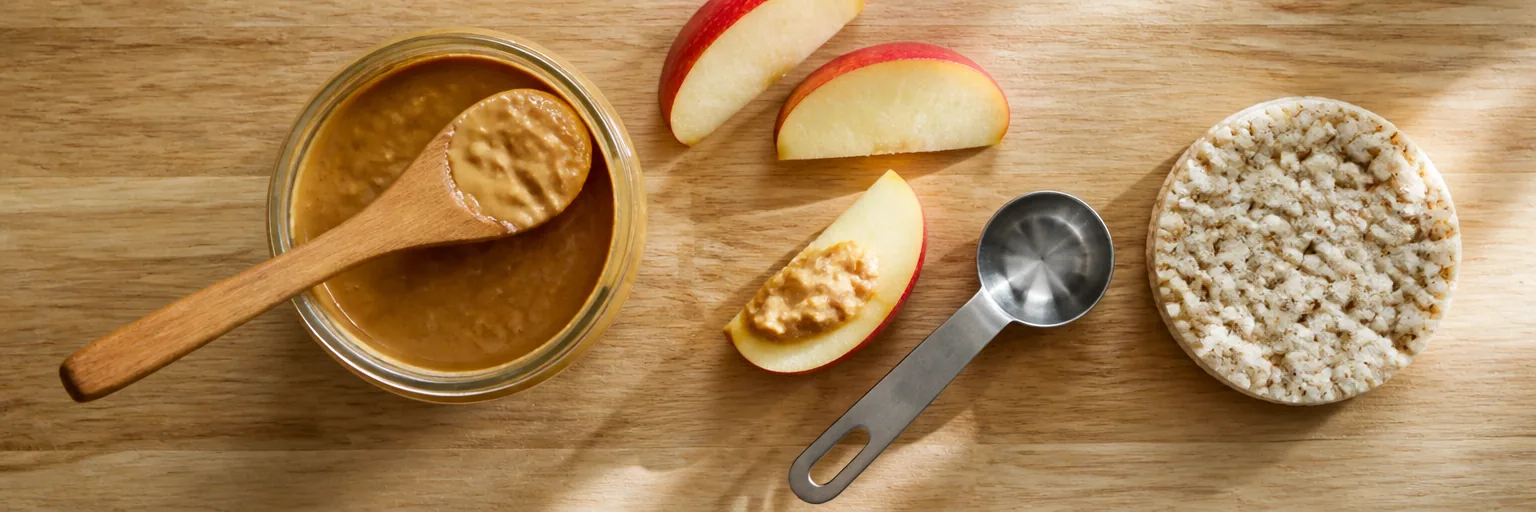
Peanut Butter for Weight Loss: Portion, Format, and What the Evidence Actually Says (2026)
Quick answer
Two tablespoons of standard smooth peanut butter carries about 190 kcal, ~7 to 8 g of protein, ~16 g of total fat (~3 g saturated), ~2 g of fiber, and ~140 mg of sodium per USDA FoodData Central. The satiety and adherence literature — Mattes 2008 in J Nutr, Reis 2013 in Br J Nutr, Barbour 2014 in Nutr Rev, Alper 2002 in Int J Obes — shows chronic peanut and peanut-butter intake does not produce weight gain in ad-libitum feeding, and modest short-term trials in a deficit show near-null-to-slight-benefit rather than miracle-food effects. The working portion rule for a weight-loss plan is 1 tablespoon = 95 kcal, count it every time; 2 tablespoons is a meal component, not a snack; keep total daily intake at 1 to 2 tablespoons unless you are actively adjusting the fat budget. Powdered peanut butter (PB2, PBfit) is about 60 kcal per 2 tablespoons reconstituted — useful in shakes and oatmeal, less useful as a straight replacement where the fat is doing satiety work. Peanut butter belongs in the broader healthy fats for weight loss picture as a whole-food fat with a real calorie tag.
What is actually in peanut butter
Peanuts are a legume, but nutritionally peanut butter behaves like a fat-and-protein source. USDA FoodData Central puts standard smooth peanut butter at roughly 588 kcal per 100 g — a 2 tablespoon (32 g) serving is ~190 kcal, with about 7 to 8 g of protein, 16 g of total fat (mostly monounsaturated oleic acid and polyunsaturated linoleic acid, with ~3 g saturated), 6 to 7 g of carbohydrate of which ~2 g is fiber, and ~140 mg of sodium. Natural peanut butter (peanuts and salt only) lands within a few calories of the same serving because the calories come from the peanuts, not the sugar or the palm oil.
A 1 tablespoon serving is ~95 kcal — call it 100 for math. That is the number to keep in your head, because the single most common tracking mistake with peanut butter is measuring by spoon rather than by scale. A “tablespoon” scraped from the jar with an actual tablespoon typically weighs 20 to 30 g, not the 16 g the nutrition label assumes, and a heaping spoon from the drawer lands at 30 to 40 g. Weigh once or twice on a $12 kitchen scale to calibrate. For the wider weigh-vs-estimate playbook, see how to count calories.
The satiety and adherence evidence
The peanut and peanut-butter satiety literature is unusually consistent. Mattes 2008 (Journal of Nutrition) reviewed the intervention and observational evidence through 2007: chronic ad-libitum peanut and peanut-butter intake did not produce the weight gain the calorie load would predict, largely because the fat-and-protein combination partially displaced other calories through satiety, and because peanut lipid is incompletely absorbed (about 15 percent of the fat calories in whole peanuts pass through unabsorbed; smaller but non-zero for peanut butter). Reis 2013 (British Journal of Nutrition) synthesized acute-feeding trials and reported consistently lower subsequent hunger and modestly lower next-meal intake in peanut arms versus calorie-matched controls. Barbour 2014 (Nutrition Reviews) meta-analyzed 33 tree-nut and peanut trials and found a neutral-to-very-slightly-negative pooled effect on body weight. Alper 2002 (International Journal of Obesity) added ~500 kcal/day of peanuts to 15 adults’ usual diet for 19 weeks; weight gain was substantially less than the calorie load would predict because participants spontaneously compensated at other meals.
The honest read: peanut butter is not a weight-loss driver on its own. The evidence points to near-null-to-slight-benefit rather than miracle-food status. Where it earns its place is at the whole-diet level — it is filling per calorie, affordable, nutritionally dense, and one of the foods most people actually enjoy long enough to stay adherent to. See why am I not losing weight for the failure-mode framework where “healthy” foods stall a deficit through portion drift.
Portion honesty — the single most useful sentence in this article
A dry-weighed 2 tablespoon serving of peanut butter is 32 g on the scale and 190 kcal; a spoon-estimated portion from the jar is typically 40 to 55 g and 240 to 330 kcal. That gap — 50 to 140 kcal per serving, depending on how heavy the spoon — is the difference between a peanut-butter habit that fits inside a deficit and one that quietly cancels it.
The rule is mechanical: if peanut butter is a food you eat more than twice a week, weigh it once. A $12 digital kitchen scale zeroed under an empty jar tells you how many grams you actually just scooped. Do this three or four times over a week and your spoon estimate becomes reliable; after that you can go back to eyeballing. The weight loss grocery list covers the scale as the highest-leverage single piece of kitchen equipment for weight loss, and peanut butter is one of the specific foods where it earns its keep.
The other portion failure mode is straight from the jar. “Just a spoonful” of peanut butter eaten standing at the counter is one of the property’s most-cited nut-butter tracking failures — a heaping soup spoon is easily 40 to 50 g, or 240 to 300 kcal, and it never gets logged. If you know jar-grazing is a pattern for you, the practical fix is to portion the day’s peanut butter into a small bowl or ramekin before you sit down, and then close the jar and put it back in the pantry.
Powdered peanut butter — where it wins, where it loses
Powdered peanut butter (PB2, PBfit, Betterbody Foods, and store-brand equivalents) is made by pressing roasted peanuts to remove most of the oil, then milling the defatted cake. Two tablespoons of powder reconstituted with water is about 60 kcal, ~6 g of protein, ~1.5 g of fat, versus 190 / 8 / 16 for regular. The protein per gram is essentially identical; the calorie cut comes entirely from removed oil.
Where it wins: shakes and protein smoothies (peanut flavor for 30 to 60 kcal instead of 95 to 190), oatmeal and Greek yogurt bowls where the oatmeal for weight loss “toppings quietly double the calories” trap is a real risk, satay-style sauces (whisk with soy sauce, lime, ginger, water), and baking (pancakes, muffins, homemade bars for one-third the calorie budget).
Where it loses: spread on toast or a sandwich (chalkier texture and missing fat matrix, less filling per calorie — you finish and are hungry in an hour), and as a satiety anchor with an apple or celery, where the 8 g of fat in 1 tbsp of regular PB is doing real gastric-emptying work.
The clean rule: use PB2 where the fat is not doing the satiety job (shakes, oatmeal, sauces, baking); use real peanut butter where the fat is the point (sandwiches, apple snacks).
Added sugar and hydrogenated oil — reading the label
Calorie-for-calorie, standard Jif and Skippy land within a few kcal per serving of Smucker’s Natural, so portion beats brand for weight loss. What actually matters at the label is ingredient list length: natural peanut butter is peanuts + salt, or at most peanuts + salt + palm oil (added to stop oil separation; small amount, modest saturated-fat bump). Standard Jif and Skippy add sugar and fully hydrogenated vegetable oils plus mono- and diglycerides — not the trans-fat villain old marketing made them out to be, but not doing anything useful for you either. The 3-gram-sugar-per-serving line separates “natural” claims from spreads closer to a dessert topping. And anything with “partially hydrogenated” belongs on the shelf — the FDA banned it in 2018, but it lingers on imported and older-stock jars.
Brand shortcuts for a US grocery store in 2026: Smucker’s Natural, 365 (Whole Foods), Trader Joe’s Organic, Teddie, and Kirkland Organic are peanuts and salt only; Jif Natural and Skippy Natural are peanuts + sugar + salt + palm oil (clean enough for most plans, not sugar-free); standard Jif and Skippy carry added sugar and fully-hydrogenated fats. All four tiers are functional at 1 to 2 tbsp; the natural options edge the standard ones out on ingredient quality for the same calorie cost. For the wider label-reading framework, see how to read nutrition labels.
The five formats — a decision table
Peanut butter behaves differently as a spread, a smoothie add, a sauce, and a snack. The table below gives realistic portions, calorie loads, protein contribution, the added-sugar ceiling to look for, and the tracking mistake that most often blows each one up.
| Format | Portion (2 tbsp reference) | Kcal | Protein (g) | Added-sugar ceiling | Best pairing | Most common tracking mistake |
|---|---|---|---|---|---|---|
| Regular jarred smooth or crunchy | 2 tbsp / 32 g | ~190 | ~7 to 8 | ≤2 g | Apple slices, whole-grain toast, celery | Eyeballing a “spoonful” that is really 40 to 55 g |
| Natural stir-and-store (peanuts + salt) | 2 tbsp / 32 g | ~190 | ~7 to 8 | 0 g | Same as above; better label profile | Draining the oil layer to “reduce fat” — reduces flavor, not calories |
| Powdered PB reconstituted (PB2, PBfit) | 2 tbsp powder + water | ~60 | ~6 | ≤1 g (added sugar in some brands) | Satay sauce, low-cal spread on toast | Treating reconstituted volume as identical to real PB (it is not) |
| Powdered PB dry-added | 2 tbsp powder | ~60 | ~6 | ≤1 g | Stirred into oatmeal, Greek yogurt, protein shake | Under-tracking the shake it goes into (fruit + milk + protein powder can add 250+ kcal) |
| PB-filled protein bar | 1 bar, ~50 g | 200 to 240 | 15 to 20 | ≤6 g (bar-level) | Bag-stashed snack on travel days | Treating a 240 kcal bar as a “snack” instead of a mini-meal |
For the standalone protein-bar decision framework (fiber, protein, ingredient length), see high-protein snacks for weight loss, which covers the “bar that reads like a candy bar” test.
Five low-friction weight-loss uses for peanut butter
Beyond the sandwich, peanut butter shows up in five specific patterns that reliably fit inside a deficit.
- 1 tbsp PB on a small apple. ~150 kcal snack, ~4 g protein, ~3 g fiber, real chewing time. This is the classic mid-afternoon pairing — the apple brings volume and fiber, the peanut butter brings the fat-and-protein satiety anchor. Weigh the peanut butter the first few times so “one spoon” does not drift to two.
- 2 tbsp PB + banana + protein shake. ~350 kcal meal replacement built from a scoop of whey, 8 oz of unsweetened milk or soy milk, a medium banana, and 2 tbsp of regular peanut butter, blended. Roughly 25 to 30 g of protein and enough fat to hold two to three hours — a genuine breakfast or post-workout meal, not a snack.
- 1 tbsp PB2 stirred into ½ cup oats plus a scoop of protein powder. ~300 kcal high-protein breakfast at roughly 25 to 30 g of protein. The PB2 gives the peanut flavor without doubling the calorie load of a regular PB oatmeal; see high-protein breakfast ideas for the wider protein-oatmeal template.
- 1 tbsp PB with celery, cucumber ribbons, or bell-pepper strips. ~120 kcal snack with real crunch and negligible carbs — a kid-and-adult snack that works for keto and low-carb plans without the bread carb load.
- PB satay sauce over chicken and vegetables. Whisk 1 to 2 tbsp of PB2 (or 1 tbsp of regular PB) with soy sauce, lime juice, grated ginger, a pinch of chili flake, and a splash of water. Spooned over 5 oz of grilled chicken and a plate of stir-fried vegetables, this is a 400 to 450 kcal restaurant-style dinner built at home for pennies. The full restaurant-portion framework for takeout versions is in eating out for weight loss.
Peanut butter before a workout — the actual answer
“Should I eat peanut butter before my workout?” is one of the most-searched peanut-butter queries and one of the least-honestly-answered. The reasonable read:
- For a workout longer than about 60 minutes — a long run, a long bike ride, a lift-plus-cardio session — 1 to 2 tbsp of peanut butter 30 to 60 minutes ahead is a reasonable fat-and-protein anchor, ideally paired with a small carbohydrate source (half a banana, a slice of toast). Peanut butter alone is slow to digest, and fat sitting in the stomach during high-intensity work can feel uncomfortable.
- For a workout of 30 to 45 minutes — most gym sessions, a short run, a lunchtime walk-and-lift — the calorie cost of a peanut butter snack usually outweighs the performance return. A piece of fruit, a small handful of dates, or nothing at all is a better fit inside a deficit.
- After training, protein plus some fast-digesting carbohydrate beats peanut butter alone. A whey shake with a banana, or Greek yogurt with berries, restores glycogen and muscle protein faster than a fat-dominant snack. If your post-workout window is really a meal, then peanut butter has a place in that meal — but it is not doing recovery work on its own.
For the broader pre- and post-workout meal framework, see best time to exercise for weight loss and strength training for weight loss.
What peanut butter does not do
Peanut butter is a useful food in a weight-loss diet, and it is not a lot of other things.
- Peanut allergy is a life-threatening reality. People with a diagnosed peanut allergy should avoid all peanut butter and all products from facilities that also process peanuts. Cross-contact is real; there is no small-portion carve-out.
- Aflatoxin is a real but small concern. Peanuts can host Aspergillus flavus mold, which produces aflatoxin, a liver toxin at high chronic doses. Major-brand jarred peanut butter has consistently low measured aflatoxin because of USDA sorting and processing standards; freshly-ground grind-your-own peanut butter at some grocery stores has higher variability. If you are eating a peanut-butter-heavy diet, jarred is the lower-risk choice.
- Peanut butter is not a fiber source. Two tablespoons is only about 2 g of fiber, versus a target of ~25 to 35 g per day. For the actual fiber sources — beans, oats, berries, whole grains, vegetables — see fiber for weight loss.
- Reese’s Peanut Butter Cups, PB M&Ms, and PB cookies are not “peanut butter.” They are candy with peanut flavor. A single Reese’s cup is ~110 kcal of mostly sugar and confectioner’s fat; a package of two is ~210 kcal with 20 g of sugar. Treating them as a peanut butter serving is a math error.
- “Reduced-fat” peanut butter is a trap. The fat is what makes peanut butter filling. Most reduced-fat jars replace the removed peanut oil with added sugar and maltodextrin — same calorie count, worse satiety, worse ingredient list. If you want fewer calories, use powdered peanut butter, not reduced-fat jarred.
- Watch sodium if blood pressure is a live concern. Standard peanut butter has about 140 mg of sodium per 2 tbsp; unsalted natural jars have essentially zero. Two tablespoons is not a big sodium hit, but if you are on a low-sodium prescription, unsalted is the default. See blood pressure and weight loss for the wider sodium framework.
Cost and practicality
Peanut butter is one of the cheapest calories per gram of protein on any grocery shelf, which is a real reason it holds up as a weight-loss staple for households on a budget. Approximate 2026 US shelf prices:
- Name-brand jarred (Jif, Skippy) 16 oz jar: ~$0.20 per 2 tbsp serving.
- Store-brand natural (365, Trader Joe’s, Kirkland) 16 to 26 oz jar: ~$0.15 per 2 tbsp serving.
- Powdered peanut butter (PB2, PBfit, store brands) 16 oz tub: ~$0.35 per 2 tbsp reconstituted serving. More expensive per gram; cheaper per calorie because you are paying for a lower-calorie ingredient.
- PB-filled protein bar: $2 to $3 each. The most expensive way to buy the same protein and fat, and worth it only for portable convenience on a travel day.
A single 16 oz jar of regular peanut butter is roughly 14 two-tablespoon servings, or ~$0.15 to $0.20 per serving at either the natural or the name-brand end. That works out to about 4 g of protein per cent, which is competitive with dry beans, eggs, and canned tuna — the other budget protein sources on the weight loss grocery list.
For a low-carb or keto plan specifically, peanut butter’s ~4 g of net carbs per 2 tbsp is one of the easiest ways to hit a fat target without eating more meat or cheese; see low-carb and keto diets for the wider macro framework, including where peanut butter fits inside a strict keto carb ceiling.
When peanut butter is the wrong food to add
Peanut butter is a good food for most weight-loss plans but not all of them.
- Diagnosed peanut allergy. As above — total avoidance, including facilities that co-process peanuts. Almond butter, sunflower seed butter, and tahini are the standard swaps; note that some tree-nut allergies cross-react with peanuts, so ingredient substitution is a clinician question, not a grocery-store one. The full portion-and-format framework for the almond side of the swap lives in almonds for weight loss.
- Advanced kidney disease on potassium and phosphorus restriction. Two tablespoons of peanut butter carries ~208 mg of potassium and ~107 mg of phosphorus, which is a real number on a low-potassium prescription. See chronic kidney disease and weight loss for the food-substitution framework in that context.
- Very-low-calorie plans under ~1,200 kcal/day. The fat budget is tight enough that a 2 tbsp peanut-butter serving is 15 to 20 percent of the day’s total calories. On plans this low, the portion drops to 1 tbsp at most, and the fat comes from oil, seeds, or fatty fish where the protein-plus-fat mix is more favorable.
- Gastroparesis or delayed gastric emptying. The same fat-and-fiber matrix that makes peanut butter filling can worsen fullness and nausea symptoms — see gastroparesis and weight loss for the fat-and-fiber ceilings that condition sets.
- A history of eating past a portion on nut butters specifically. Some people find peanut butter is a food they cannot keep in the house and stay within a portion. If that is you, powdered peanut butter or single-serve travel packets are the honest workaround — the pattern is the problem, not the food.
Frequently asked questions
Is peanut butter good for weight loss? Yes, in measured portions. Two tablespoons of standard smooth peanut butter carries about 190 kcal with ~7 to 8 g of protein, ~16 g of mostly-unsaturated fat, and ~2 g of fiber, and the peanut-and-peanut-butter satiety literature (Mattes 2008 in J Nutr, Reis 2013 in Br J Nutr) shows chronic intake does not produce weight gain in ad-libitum feeding. But peanut butter is not a fat-burning food — it is a calorie-dense whole food that helps a deficit when portioned and quietly stalls one when you eat straight from the jar.
How much peanut butter can I eat per day when trying to lose weight? The working default is 1 to 2 tablespoons per day, treated as a fat serving rather than a snack. One tablespoon is about 95 kcal; two is a meal component at ~190 kcal. Going above 3 tablespoons in a 1,500 to 1,800 kcal deficit is where portion creep most often erases the daily deficit — one unmeasured spoon out of the jar can easily be 40 to 55 g, or 240 to 330 kcal.
Is PB2 or powdered peanut butter better than regular for weight loss? Powdered peanut butter (PB2, PBfit, Betterbody Foods) has the same protein per gram as regular but roughly 70 percent fewer calories because most of the oil has been pressed out — about 60 kcal per 2 tablespoons reconstituted, versus 190 kcal for regular. It is useful for shakes, oatmeal, and yogurt bowls where texture does not matter. It loses the satiety-relevant fat matrix, so it works best as a flavor-plus-protein add, not as a straight replacement inside sandwiches where the fat is doing real work.
Does eating peanut butter at night cause weight gain? No. Weight gain is driven by total calories over days and weeks, not by the clock on the wall. A 1 tablespoon serving of peanut butter on a small apple as an evening snack is about 190 kcal and fits inside most 1,500 to 1,800 kcal weight-loss plans. The late-night failure mode is portion, not timing: eating a few unmeasured spoons out of the jar in front of a screen can add 300 to 500 kcal that never make it into the day’s log.
Can I eat peanut butter on a low-carb or keto diet? Yes. Two tablespoons of standard natural peanut butter has ~6 g of total carbs and ~2 g of fiber, so ~4 g of net carbs, which fits inside most keto and low-carb plans. Choose a natural jar with peanuts and salt only — commercial jars often add sugar or partially hydrogenated oil, which pushes both the carb count and the fat quality in the wrong direction. Powdered peanut butter has slightly more relative carbs per gram but still fits in small amounts.
Is natural peanut butter better than Jif or Skippy for weight loss? For weight loss, calories are nearly identical (~190 kcal per 2 tbsp for all three), so the honest answer is that portion beats brand. The differences matter for diet quality: natural jars (Smucker’s Natural, 365, Trader Joe’s, Teddie) are peanuts plus salt; standard Jif and Skippy add ~2 to 3 g of sugar and mono- and diglycerides per serving. If a natural jar is what keeps you from eating past a tablespoon, it is the better weight-loss choice.
Should I eat peanut butter before or after a workout? Before a workout longer than about 60 minutes, 1 to 2 tablespoons of peanut butter 30 to 60 minutes ahead can give a small fat-and-protein anchor. For a 30 to 45 minute lift or run, the calorie cost usually outweighs the performance return — a piece of fruit alone is enough. After training, protein plus some carbohydrate (a shake with whey plus a banana, or Greek yogurt with berries) beats peanut butter alone because peanut butter is fat-dominant and slower to digest.
Is almond butter better than peanut butter for weight loss? Not meaningfully. Two tablespoons of almond butter is ~200 kcal versus ~190 kcal for peanut butter, with almost identical protein (~7 g) and similar fat quality. Almond butter has slightly more fiber (~3 g vs ~2 g) and more vitamin E, and it costs two to three times as much per ounce. For a weight-loss plan the choice is preference and budget — peanut butter is the more affordable calorie.
Sources
- Mattes RD, Kris-Etherton PM, Foster GD. Impact of peanuts and tree nuts on body weight and healthy weight loss in adults. Journal of Nutrition (2008).
- Reis CE, Ribeiro DN, Costa NM, Bressan J, Alfenas RC, Mattes RD. Acute and second-meal effects of peanuts on glycaemic response and appetite in obese women with high type 2 diabetes risk: a randomised cross-over clinical trial. British Journal of Nutrition (2013).
- Barbour JA, Howe PR, Buckley JD, Bryan J, Coates AM. Nut consumption for vascular health and cognitive function. Nutrition Reviews (2014).
- Alper CM, Mattes RD. Effects of chronic peanut consumption on energy balance and hedonics. International Journal of Obesity (2002).
- U.S. Department of Agriculture, Agricultural Research Service. FoodData Central — Peanut butter, smooth style, with salt (reference).