
2026-09-08 · flaxseeds, ground flax, high fiber, healthy fats, ALA omega-3, lignans, single-food pillar, weight loss
Written by Maya Patel
Maya Patel is a WeightFAQ staff writer covering sustainable weight loss through mindful eating, flexible routines, and evidence-based nutrition. She translates research on protein, fiber, portion control, and calorie awareness into practical meal-planning guidance readers can actually follow at home. Her articles favor honest expectations over fad promises — small changes that compound, calorie bands scaled to real households, and grocery lists built around whole foods with room for real life. Maya writes for people juggling family meals, busy weeks, and long-term goals, not gym-optimized single adults with unlimited prep time.
28 min read
Medically reviewed on Sep 8, 2026
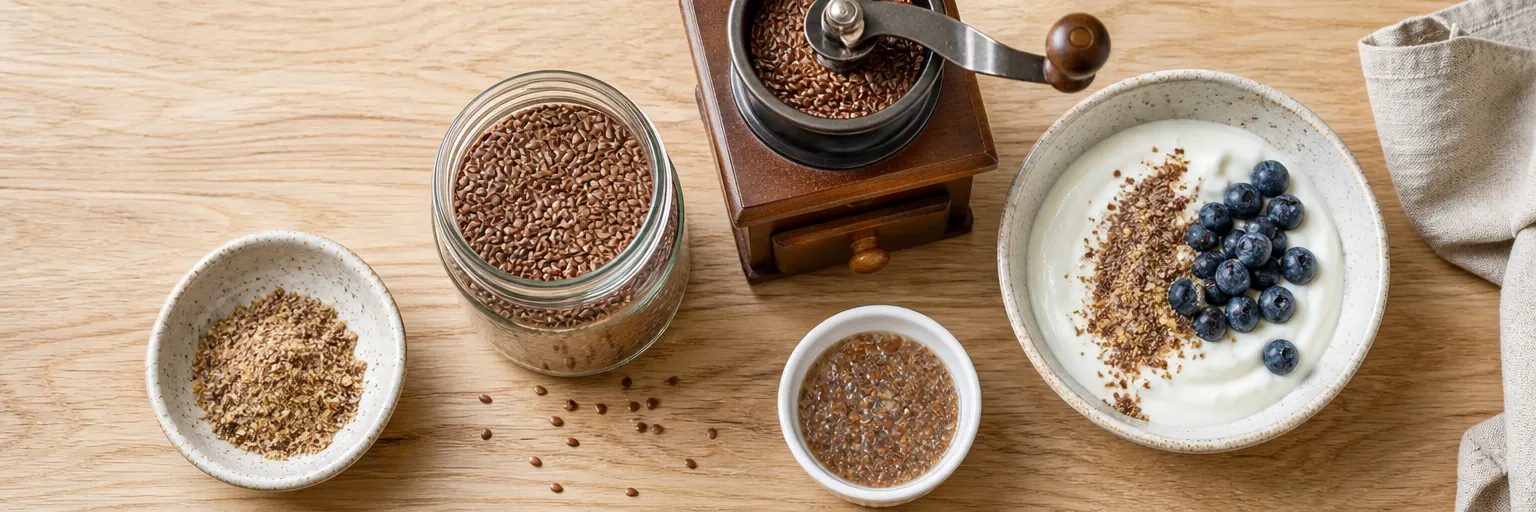
Flaxseeds for Weight Loss: Ground vs Whole vs Oil, How Much Per Day, and What the Evidence Actually Says (2026)
Quick answer
One tablespoon of ground flaxseed — about 7 g — carries roughly 37 kcal, ~1.3 g of protein, ~3 g of fat (of which ~1.6 g is alpha-linolenic acid omega-3 and ~0.6 g is linoleic acid), ~2 g of carbohydrate of which ~1.9 g is fiber, ~27 mg of magnesium, and ~57 mg of potassium per USDA FoodData Central. Flax also carries the highest concentration of dietary lignans (secoisolariciresinol diglucoside, SDG) of any commonly-eaten food — ~8 to 12 mg per gram of whole flax, a phytoestrogen-and-antioxidant load that drives most of its cardiovascular and hormonal-signal literature. The intervention literature — Mohammadi-Sartang 2017 (Obesity Reviews, a meta-analysis of 45 flax RCTs and 2,415 adults) — pools a small-but-real ~0.99 kg drop in body weight, ~0.85 kg drop in fat mass, and ~0.6 cm drop in waist circumference at doses averaging ~30 g/day over ~12 weeks. That is a real signal, not a miracle: flax does not burn fat, but it produces a consistent modest weight signal inside a deficit through fiber-plus-fluid satiety, ALA cardiometabolic effects, and lignan phytochemistry. The working portion is 1 to 2 tablespoons per day (7 to 14 g), ground and refrigerated, and the two hard rules are grind-before-eating (Kajla 2015: whole flax mostly passes through undigested) and refrigerate-after-opening (ALA oxidizes quickly at room temperature). Flax belongs alongside beans, oats, and berries in the fiber for weight loss framework, and in the plant-source omega-3 group inside healthy fats for weight loss — with the ALA-to-EPA conversion caveat below.
What is actually in a flaxseed
Flaxseed (Linum usitatissimum) is a small, oval, brown-or-golden seed from a flowering flax plant cultivated for both its oil and its fiber (linen). Nutritionally it is a concentrated fat-plus-fiber source with a modest protein contribution and — uniquely among commonly-eaten foods — a very high lignan concentration.
USDA FoodData Central puts whole flaxseed at roughly 534 kcal per 100 g. A 1 oz (28 g) serving is ~150 kcal with ~5 g of protein, ~12 g of total fat (of which ~7 g is ALA omega-3 and ~1 g is saturated), ~8 g of carbohydrate of which ~7.5 g is dietary fiber, ~108 mg of magnesium, and ~228 mg of potassium. A more practical 1 tablespoon of ground flax is ~7 g and ~37 kcal, with ~1.3 g of protein, ~3 g of fat (~1.6 g ALA), and ~2 g of carbohydrate of which ~1.9 g is fiber.
Two features make flax nutritionally distinctive:
- Highest plant-source ALA omega-3 density. ALA (18:3 n-3) makes up roughly 55 percent of the fat in flax — the single highest concentration in any commonly-eaten whole food per the NIH Office of Dietary Supplements ALA chapter. Ground flax and flaxseed oil are the go-to plant sources when a reader wants to raise ALA intake without fish or algae.
- Highest lignan density. Whole flax carries ~8 to 12 mg of SDG lignans per gram — roughly 100 times more than the next-most-lignan-dense foods (sesame seeds, whole grains). Prasad 2009 (Journal of Cardiovascular Pharmacology and Therapeutics) is the anchor mechanistic reference for SDG’s cardioprotective and mild antioxidant activity.
The fiber load is the second headline. At ~7.5 g of fiber per ounce (~1.9 g per tablespoon), flax is a dense fiber source, split roughly one-third soluble (the mucilage that forms the gel around soaked flax) and two-thirds insoluble. The soluble fraction is the mechanism behind flax’s satiety and glycemic effects; the insoluble fraction is a mild bulking laxative that supports normal bowel regularity.
One tablespoon is ~7 g, and that is the number to keep in your head, because the single most common tracking mistake with flax is the “sprinkle” — a heaped spoonful eyeballed onto yogurt is often 12 to 15 g rather than 7 g. Weigh once on a $12 kitchen scale and your future tablespoon estimates will be far closer. For the wider weigh-versus-estimate playbook, see how to count calories.
The satiety and body-composition evidence
The flax literature is larger than the chia literature and more consistent in the pooled effect, though the individual trials range from small-and-noisy to large-and-clean.
Mohammadi-Sartang 2017 (Obesity Reviews) is the anchor meta-analysis and the paper this article leans on. It pooled 45 randomized controlled trials of flaxseed supplementation across 2,415 adults, at doses that averaged ~30 g/day (range 10 to 60 g/day), over a median ~12-week duration. The pooled effect: ~0.99 kg drop in body weight, ~0.85 kg drop in fat mass, and ~0.6 cm drop in waist circumference versus control. Whole flax and ground flax showed the effect; flaxseed oil in isolation did not. The signal was larger in participants with obesity at baseline (~1.5 kg) and smaller in normal-weight adults (~0.4 kg), and larger at doses ≥30 g/day than at lower doses. This is a small effect in absolute terms, and — importantly — it is a consistent effect across many independent trials rather than one big trial pulling the average. That kind of pooled signal is the honest read: flax nudges the scale in the right direction inside a deficit.
Kristensen 2012 (Journal of Nutrition) tested a 2.5 g flaxseed-fiber preload against a matched control drink and found the flax preload reduced subsequent-meal intake by ~7 to 10 percent. That is the mechanism behind the “chia water” / “flax water” idea: a small soluble-fiber load with fluid displaces some calories at the next plate. The effect is real and small — 50 to 150 kcal displacement at the following meal for most adults.
Rodriguez-Leyva 2013 (Hypertension, the FLAX-PAD trial) fed 30 g/day of milled flax to peripheral-artery-disease patients for 6 months and reported ~10 mmHg drops in systolic blood pressure and ~7 mmHg drops in diastolic. The effect was cardiovascular, not primarily weight-loss, but it is the largest and cleanest cardiovascular signal in the flax literature.
Adolphe 2010 (British Journal of Nutrition) fed 30 g/day of flax to glucose-intolerant adults for 12 weeks and reported improved insulin sensitivity and lower fasting glucose versus control. Consistent with the pattern of a modest but real cardiometabolic effect at supra-culinary doses.
Machado 2015 (Menopause) fed 40 g/day of ground flax to postmenopausal women for 12 weeks and reported reductions in BMI, waist circumference, and LDL cholesterol. This is one of the trials where the lignan phytoestrogen mechanism plausibly contributes alongside the fiber and ALA — postmenopausal women are the demographic where SDG is most active.
Torkan 2015 (International Journal of Preventive Medicine) fed flax to women with polycystic ovary syndrome (PCOS) and reported improvements in BMI, waist-to-hip ratio, and insulin resistance markers. PCOS is another population where the lignan and ALA effects seem to compound with the fiber-and-satiety mechanism.
The honest read: flax does not burn fat. It produces a small-but-consistent ~1 kg weight signal at ~30 g/day over ~12 weeks (Mohammadi-Sartang 2017), it improves several cardiometabolic markers at supra-culinary doses, and it supports adherence inside a real deficit through fiber-driven satiety and the ALA-plus-lignan phytochemistry. A person who adds a tablespoon of flax to an unchanged ad-libitum diet and expects the scale to move will be modestly disappointed. See why am I not losing weight for the wider “healthy food, no deficit” failure mode.
The grind-and-refrigerate rule — non-negotiable
Two rules govern almost every practical decision about flax, and both need to be stated up front rather than buried in a footnote.
1. Grind before you eat. Kajla 2015 (Journal of Food Science and Technology) is the anchor reference: whole flaxseed has a hard, indigestible seed coat, and most whole seeds pass through the human GI tract intact. That means little of the ALA, little of the lignan phytochemistry, and only the mechanical bulking of the whole seed as insoluble roughage. The seeds look like they should be chewable — they are small — but the coat is tough enough that even careful chewing leaves most seeds unbroken. Grinding disrupts the hull so the fat, protein, and lignans are actually absorbed. Rule: use ground flax (also sold as “flax meal”) or grind whole seeds fresh yourself. Whole flax as a topping is essentially decorative — it does not deliver the nutrition on the label.
2. Refrigerate after opening. ALA is a delicate omega-3, and pre-ground flax at room temperature oxidizes meaningfully within 2 to 4 weeks, turning rancid and losing the fatty-acid profile that motivates the choice. Ground flax stored in a sealed jar in the refrigerator keeps 3 to 4 months; frozen it keeps 6 to 12 months. The mechanical rules:
- Buy small. A ~1 lb bag of ground flax is ~28 servings at 2 tbsp/day, or about a month at a normal culinary pace. Do not buy the 3 lb bag unless you plan to freeze most of it.
- Refrigerate after opening. Pre-ground shelf-stable bags (Bob’s Red Mill, Spectrum, Trader Joe’s Flax Meal, Nutiva) are fine unopened at room temperature; move them to the fridge as soon as they are opened.
- Grind small batches if you use flax rarely. A ~$30 burr coffee grinder or a small blender turns whole flax into meal in ~15 seconds. Grind a week’s worth at a time and keep it in the fridge.
- Smell it. Rancid ground flax smells like old paint or fish oil. If it does not smell mildly nutty and clean, do not use it.
Never dry-swallow whole flaxseed or ground flax with insufficient water, especially with pre-existing severe constipation — the fiber is highly hygroscopic and can worsen an existing obstruction. Take flax with at least ~1 cup of fluid.
Portion & tracking — the single most useful sentence in this article
One tablespoon of ground flax is ~7 g and ~37 kcal; two tablespoons is ~14 g and ~74 kcal; that is the working daily cap for most adults on a weight-loss plan. Every one of those numbers is specific, not a vibe. The palm-of-hand estimate that works reasonably for nuts does not work for flax — the seeds are too small and shape-shifting, and a “small handful” tossed into a smoothie is easily 20 g / ~110 kcal. Weigh once with a scale or a measuring spoon and your future estimates will be far closer.
The mechanical rule: if flax is a food you eat more than three times a week, measure the first two weeks with an actual spoon or scale. After that a rough eyeball is fine, but the drift back to “a heavy scoop” is real. Two tablespoons per day is the ceiling where the fiber-to-calorie ratio still favors satiety and where the daily ALA load (~3.2 g) is meaningful without being excessive. Above that you are adding measurable calories without a matching return — a “healthy” chia-and-flax pudding built on 3 tablespoons of flax plus full-fat coconut milk plus honey plus granola is easily 400 to 550 kcal, dessert dressed as breakfast.
The FDA GRAS record and Health Canada 2014 recommendation both support intakes up to ~40 g/day of flax for adults with normal digestion. That is the safety ceiling, not a weight-loss target. Most of the benefit lands at 1 to 2 tablespoons — enough to move the fiber, ALA, and lignan needles without a calorie penalty.
Two practical structural fixes:
- Weigh a 400 g bag of ground flax into a jar with a labeled 7 g tablespoon scoop. About 57 tablespoons per bag, one to two scoops per day, no drift.
- Pre-portion 14 g (2 tbsp) into small snap-lid containers on the weekend. Five to seven single-serve additions ready to fold into yogurt, oatmeal, or a smoothie.
The weight loss grocery list covers the kitchen scale as the highest-leverage single piece of equipment for weight loss, and flax is one of the specific foods where the scale pays for itself.
The four formats — a decision table
Flax shows up in four common patterns, and each one has its own portion, calorie load, and specific tracking mistake. The table below covers all four with realistic portions and pairings.
| Format | Portion (1 serving) | Kcal | ALA (g) | Fiber (g) | Lignan (mg SDG) | Best use | Most common tracking mistake |
|---|---|---|---|---|---|---|---|
| Whole flaxseeds (raw or toasted) | 1 tbsp / ~10 g | ~54 | ~2.3 | ~2.7 | ~80 to 120 | Almost none — the seeds pass through the gut mostly intact; buy whole only if you plan to grind fresh yourself | Sprinkling whole seeds as a topping and assuming the label calories and ALA count |
| Ground flax meal (fresh-ground or refrigerated pre-ground) | 1 tbsp / ~7 g | ~37 | ~1.6 | ~1.9 | ~55 to 85 | Oatmeal, yogurt, smoothies, baking, flax-egg replacer, salad topping | Buying pre-ground and leaving it in the pantry — ALA oxidizes in 2 to 4 weeks at room temperature |
| Cold-milled shelf-stable ground flax (Bob’s Red Mill, Spectrum, TJ’s Flax Meal) | 1 tbsp / ~7 g | ~37 | ~1.6 | ~1.9 | ~55 to 85 | Same as ground flax — practical for adults who will not grind fresh | Skipping the “refrigerate after opening” step; the shelf-stable claim applies to the sealed bag, not the opened one |
| Flaxseed oil (cold-pressed, refrigerated) | 1 tbsp / ~14 g | ~120 | ~8.0 | 0 | ~0 (trace) | Salad dressings, drizzle finishes on cooked foods, ALA supplementation for adults who already meet fiber targets | Cooking with it — flax oil oxidizes above ~200-250°F; use as a finishing oil only |
The practical takeaway: ground flax meal is the default for weight loss. Whole flax is essentially decorative unless you grind fresh yourself; cold-milled shelf-stable meal is fine if refrigerated after opening; flax oil is a niche ALA-supplementation option, not a replacement for the fiber-and-lignan payload of the ground seed.
Flax vs chia vs hemp — the top comparison query
All three seeds are net-good weight-loss foods, and none of them burn fat. The differences are real but small; the honest deciding factor is what you will actually eat.
| Seed | Kcal (1 tbsp / ~7 g) | Protein (g) | Fiber (g) | ALA omega-3 (g) | Lignan content | Grind required? | Best use |
|---|---|---|---|---|---|---|---|
| Ground flaxseed | ~37 | ~1.3 | ~2.0 | ~1.6 | High (~55 to 85 mg SDG / tbsp) | Yes — whole flax passes through undigested (Kajla 2015) | Oatmeal, yogurt, smoothies, baking, flax-egg replacer; cheapest ALA per dollar and the lignan story |
| Chia (black or white) | ~50 | ~1.7 | ~2.5 | ~1.6 | Negligible | No — soft coat, digested whole | Chia pudding, chia water, jam, gel-forming applications; widest format range |
| Hemp hearts (shelled) | ~55 | ~3.3 | ~0.5 | ~0.6 | None | No — sold as hulled hearts | Salads, savory bowls, protein-density topping; neutral nutty flavor; lowest fiber |
Decision rule: rotate two of the three. Ground flax is the cheapest ALA source, carries the lignan story, and works as an egg replacer in baking. Chia is the gel-forming, pudding, chia-water option. Hemp hearts are the protein-density savory choice. There is no need to pick a single seed. For the wider seed-and-nut placement, see the fats-and-satiety framing in healthy fats for weight loss, the chia-vs-flax detail inside chia seeds for weight loss, and the tree-nut ALA comparison inside walnuts for weight loss — walnuts are the other high-ALA option in the plant-source omega-3 group, at ~2.5 g ALA per 1 oz. A ground-flax-plus-walnut daily pairing covers most of the plant-source ALA target inside a standard Mediterranean-diet-weight-loss pattern.
Flaxseed oil — the niche
Flaxseed oil is not a substitute for ground flax; it is a separate ingredient with a separate use case.
Nutritional profile per 1 tablespoon (~14 g): ~120 kcal, ~14 g total fat of which ~8 g is ALA omega-3, ~2.5 g linoleic acid, and ~1.2 g saturated fat. No fiber, no protein, essentially no lignan (the lignans stay with the seed hull during pressing). Cunnane 1995 (British Journal of Nutrition) is the anchor reference for what flax oil does and does not deliver: it is the highest concentration of ALA per teaspoon of any common cooking oil, but it carries none of the fiber-driven satiety and none of the SDG lignan phytochemistry that drive most of flax’s weight-loss and cardiovascular signal.
Storage and cooking rules for flaxseed oil:
- Cold storage only. Flax oil oxidizes rapidly at room temperature — buy small bottles (~250 to 500 ml), refrigerate from purchase, and use within 6 to 8 weeks of opening.
- Never heat above ~200 to 250°F. Flax oil is not a cooking oil. Use it as a finishing drizzle on already-cooked foods, in salad dressings, blended into smoothies, or stirred into oatmeal off-heat. The ALA oxidizes fast under sustained heat, turning the oil into a source of oxidized lipid rather than a healthy fat.
- Watch the calorie load. One tablespoon is ~120 kcal — the same as 1 tablespoon of olive oil. It is not a “free” health add.
When flax oil makes sense: when you already hit a fiber target of ~25 to 38 g/day from beans, oats, berries, vegetables, and ground flax or chia, and you specifically want a plant-source ALA add without the fiber load. For most weight-loss readers, ground flax at 1 to 2 tablespoons per day covers both the ALA and the fiber need in fewer calories than the oil.
Recipes that survive real kitchens
Beyond the standalone yogurt-and-oatmeal sprinkle, flax shows up reliably in five specific patterns that fit inside a deficit.
- 1 tbsp ground flax stirred into 1 cup nonfat Greek yogurt with berries. ~180 kcal snack or breakfast, ~19 g protein, ~4 g fiber, ~1.6 g ALA. The yogurt is the protein anchor; the flax is the fiber and ALA addition. See high protein breakfast ideas for the wider yogurt template.
- 1 tbsp ground flax in a bowl of oatmeal. Standard oat portion (½ cup dry oats + 1 cup water or milk) is ~150 kcal, ~5 g protein, ~4 g fiber; adding 1 tbsp flax pushes it to ~190 kcal, ~6 g protein, ~6 g fiber, ~1.6 g ALA. A near-free upgrade to a standard breakfast.
- Flax-egg swap for baking. 1 tbsp ground flax + 3 tbsp water, stirred and rested 5 to 10 minutes until it gels, replaces 1 whole egg in muffins, pancakes, quick breads, and cookies. Great for vegan or egg-allergy baking, and it adds ~2 g of fiber and ~1.6 g of ALA per swap. Does not work for meringues, custards, or angel-food-style recipes that rely on egg foam.
- 1 tbsp ground flax dropped into a fruit-and-protein smoothie. Adds ~37 kcal and ~2 g fiber to a ~350 kcal smoothie, pushes fiber past 8 g per glass, and slows the drink-through pace. See weight loss smoothies for the wider smoothie framework.
- 1 tbsp ground flax stirred into ½ cup low-fat cottage cheese with berries. ~180 kcal snack, ~15 g protein, ~4 g fiber. A high-protein, low-calorie snack that lands well below the “sneaky calorie” range of nut-butter-and-cracker combos.
A note on flax in baked goods: the ALA in ground flax survives short baking cycles (~20 to 30 minutes at ~350°F) reasonably well, though it does degrade some. Do not use flax as your primary ALA source through baked goods — most of the ALA benefit is easier to get from raw ground flax on yogurt or oatmeal. But flax in baking is fine, and the flax-egg swap is one of the highest-value uses for the ingredient.
Failure modes — where flax goes wrong
Flax is safe for most adults inside a normal culinary range, and it has five specific failure modes worth naming.
- Buying whole flax and eating it as-is. The single most common practical mistake. Kajla 2015 documents that whole flax mostly passes through undigested — buying a $6 bag of whole flax to sprinkle on salads is roughly a decorative gesture. If you buy whole, grind it yourself before eating.
- Grinding a month’s supply and leaving it in the pantry. ALA oxidizes in 2 to 4 weeks at room temperature, turning the fat rancid and destroying most of the omega-3 signal. Refrigerate after opening; grind small batches; smell before use.
- “Flax water” TikTok claims. The idea that stirring 1 to 2 tbsp of ground flax into a glass of water and drinking it produces dramatic weight loss oversells what a soluble-fiber preload does. Kristensen 2012 shows a real ~7 to 10 percent reduction in next-meal intake from a flax-fiber preload, which is a modest and real effect (~50 to 150 kcal displacement). It is not “melting belly fat.” A glass of water at the same time captures the majority of the effect for zero calories; flax water adds soluble fiber and roughly 37 to 74 kcal.
- Flaxseed oil in high-heat cooking. Flax oil is not a cooking oil. Above ~200 to 250°F the ALA oxidizes fast, and sustained heat turns the oil into a source of oxidized lipid rather than a healthy fat. Use flax oil only as a finishing drizzle or in cold dressings.
- Ramping fiber too fast without water. Adults not used to 25+ g of fiber per day will develop bloating, gas, and looser stool if they jump straight to 2 tablespoons of flax per day. Start at 1 teaspoon per day and add 1 teaspoon per week, plus adequate water — flax fiber is highly hygroscopic, and an under-hydrated high-fiber ramp is the fast track to constipation, not the opposite. The same ramp rule appears in fiber for weight loss for beans and psyllium.
Safety and interactions
- Blood-thinner interaction. Flax lignans have a mild antiplatelet effect at high doses. People on warfarin, apixaban, rivaroxaban, clopidogrel, or high-dose fish oil should keep flax to ~1 tablespoon per day and mention it to their clinician. The interaction is dose-dependent and mild at culinary intakes; 30 to 40 g/day supplementation is a conversation-with-a-clinician concern.
- Hormone-sensitive-cancer nuance. SDG is a weak phytoestrogen. Observational data on breast cancer risk is neutral-to-favorable (Lowcock 2013, Cancer Causes and Control, reported a slightly reduced risk in flax consumers), and current major oncology bodies do not advise against culinary-dose flax during hormone-sensitive-cancer treatment. Anyone in active treatment should still check with their oncology team before adding a supplemental regimen.
- Pregnancy — first trimester. Cetin 2010 (Nutrition Reviews) raised a caution against high-dose flax and flax oil supplementation in the first trimester due to the SDG phytoestrogen mechanism. Culinary-dose ground flax (~1 tbsp/day) is generally considered fine; supplement-dose flax or flax oil is not the first-trimester default.
- IBS and SIBO. The high soluble-fiber load can worsen bloating and abdominal pain during a flare. In remission, small amounts (1 tsp to 1 tbsp per day) are usually tolerated; a full-portion baking substitution may not be.
- Severe constipation and GI-obstruction risk. Whole flax taken without adequate water carries a small risk of worsening an existing obstruction, especially in adults with severe chronic constipation, chronic opioid use, or a history of intestinal stricture. Ground flax with ≥1 cup of water is the safer default.
- Kidney disease. Flax carries ~57 mg of potassium per tablespoon — minor for most readers, but worth adding to the daily tally on a potassium-restricted renal diet.
- Thyroid caveat (small). Very high flax intakes contain small amounts of cyanogenic glycosides, which some early animal studies raised as a theoretical goiter concern. Cunnane 1993 and subsequent human data show no clinically meaningful effect at culinary intakes up to ~50 g/day.
Conditions where flax is the wrong food
Flax is fine for most adults. It is not fine for everyone.
- Active hormone-sensitive-cancer treatment without team sign-off. As above — culinary doses are usually fine, supplemental regimens should be checked with the oncology team.
- IBS with active flare (especially IBS-D or IBS-C with bloating). The soluble-fiber load can worsen symptoms during a flare; return to it in remission at a lower dose.
- Severe chronic constipation without adequate hydration. Flax bulks stool via insoluble fiber and absorbs a large amount of water; without matching hydration it can worsen the problem.
- First-trimester pregnancy at supplement doses. Culinary doses of ground flax are fine; supplement-dose flax or flax oil is not the first-trimester default (Cetin 2010).
- Very-low-calorie plans (<1,200 kcal/day). A 2-tablespoon portion is ~74 kcal, or ~6 percent of the day. Drop to 1 tablespoon and place it in the highest-satiety-return slot (yogurt or oatmeal).
Special situations
- GLP-1 users (semaglutide, tirzepatide). Two tablespoons per day of ground flax contribute meaningful fiber (~4 g) without a big calorie load (~74 kcal), and the soluble fiber can support regularity on a GLP-1 (where reduced appetite often means reduced fiber intake). Watch acute nausea — do not add 2 tbsp at once if you are new to fiber; ramp over 1 to 2 weeks. If you are struggling with GLP-1-induced constipation, ground flax plus adequate water plus a walking routine is a first-line combination.
- Postpartum. Moderate culinary doses (1 to 2 tbsp/day of ground flax) are generally fine while breastfeeding; the lignan-and-phytoestrogen concerns that apply in early pregnancy do not translate directly to lactation, and current data do not raise a clinically meaningful concern at culinary doses. Mega-dosing (>30 g/day) is not the postpartum default.
- Type 2 diabetes. Adolphe 2010 supports a role for ~30 g/day flax in improving insulin sensitivity and fasting glucose. Two tbsp/day (~14 g) is a reasonable practical starting dose inside a real diet plan; check post-meal glucose response to see whether the delayed-carb-absorption effect improves your numbers meaningfully.
- Type 1 diabetes. The fiber load may modestly delay carbohydrate absorption and blunt the immediate post-meal glucose spike — potentially useful, but insulin timing may need to shift slightly. Check your CGM response after adding flax to a familiar meal for a few days.
- Kidney-diet-restricted potassium. ~57 mg per tablespoon is minor for most, but does count toward a strict daily potassium ceiling.
Cost and practicality
Flax is one of the cheaper fiber-and-omega-3 whole foods when bought in bulk. Approximate 2026 US shelf prices:
- Whole flaxseed, bulk (Costco, WinCo bulk bins, Amazon 3 lb bags): ~$3 to $6 per lb — about $0.04 to $0.08 per 1-tablespoon serving if you grind fresh yourself.
- Ground flax meal, supermarket (Bob’s Red Mill, Spectrum, Trader Joe’s Flax Meal, Kirkland): ~$5 to $8 per lb — about $0.07 to $0.12 per tablespoon.
- Cold-milled shelf-stable ground flax (nitrogen-flushed bags): ~$8 to $12 per lb — a modest premium for the shelf-stable convenience.
- Flaxseed oil (cold-pressed, refrigerated):
$15 to $25 per pint ($1.00 to $1.50 per tablespoon) — the priciest form per gram of ALA when you factor in the rapid oxidation.
The grind-your-own workflow is the cheapest and freshest. A $25 to $35 burr coffee grinder (used only for flax, not for coffee, to avoid oil transfer) grinds a week’s worth in ~15 seconds; buy the 3 lb Costco bag of whole flax, freeze the extra, and grind small refrigerated batches. Total cost is roughly $0.04 per tablespoon, and the freshness meaningfully outperforms pre-ground shelf-stable bags.
Storage: whole flaxseed keeps 12 to 18 months at room temperature in an airtight jar and 24+ months frozen. Ground flax at room temperature loses meaningful ALA in 2 to 4 weeks; refrigerated it keeps 3 to 4 months; frozen it keeps 6 to 12 months. Flax oil keeps 6 to 8 weeks refrigerated once opened.
For the wider budget-fiber comparison, see the weight loss grocery list, which places flax alongside oats, beans, lentils, and berries as the low-cost fiber anchors of a weight-loss cart.
What flax does not do
Flax is a useful fiber-ALA-lignan whole food, and it is not a lot of other things.
- Flax does not burn belly fat. The “flax melts belly fat” and “flax detox” framing oversells what a modest ~1 kg pooled weight signal at 30 g/day over 12 weeks actually means. Real, small, and only inside a deficit.
- Flax does not “detox” the body. The liver and kidneys handle detoxification; fiber supports normal bowel regularity in a normal way that any high-fiber whole food does.
- Whole flax as a topping is not the labeled nutrition. Kajla 2015 — most whole seeds pass through intact. If you want the ALA and lignans, grind first.
- Flax is not a complete omega-3 solution. The ALA-to-EPA conversion is ~5 to 10 percent and ALA-to-DHA is <5 percent in most adults (NIH ODS). Chia and flax contribute plant-source ALA; they do not replace fatty fish or algal oil for clinical EPA/DHA doses. See healthy fats for weight loss.
- Flax oil is not the same as ground flax. Oil delivers ALA but not fiber or lignans, and it carries the highest calorie load per tablespoon of any flax format.
- White (golden) vs brown flax is not meaningfully different for weight loss. Golden flax has a milder flavor and slightly lighter color; nutritionally they are essentially identical.
- The FDA GRAS record and Health Canada 2014 recommendation support intakes up to ~40 g/day. That is the safety ceiling, not a weight-loss target — most benefit lands at 1 to 2 tablespoons per day.
Frequently asked questions
Do flaxseeds help you lose weight? Modestly, and only inside a calorie deficit. The Mohammadi-Sartang 2017 (Obesity Reviews) meta-analysis of 45 RCTs and 2,415 adults pooled a ~0.99 kg drop in body weight, ~0.85 kg drop in fat mass, and ~0.6 cm drop in waist circumference at flax doses that averaged about 30 g/day over roughly 12 weeks. That is a real but small signal — flax does not burn fat on its own, but the fiber-plus-fluid gel, the ALA omega-3, and the lignan phytochemistry all nudge satiety and cardiometabolic markers in the right direction. The working portion for most adults is 1 to 2 tablespoons of ground flax per day (7 to 14 g, ~37 to 74 kcal, ~2 to 4 g fiber, ~1.6 to 3.2 g ALA).
How much ground flax should I eat per day? One to two tablespoons per day (7 to 14 g) as the working culinary range. One tablespoon of ground flax is ~7 g, ~37 kcal, ~1.3 g protein, ~3 g fat (of which ~1.6 g is ALA omega-3), and ~2 g fiber per USDA FoodData Central. Two tablespoons is the practical daily cap for most weight-loss plans (~74 kcal, ~4 g fiber, ~3.2 g ALA). Health Canada and the FDA GRAS record support intakes up to ~40 g/day for adults with normal digestion, but that is the safety ceiling, not a weight-loss target — most of the fiber and ALA benefit lands well below it, and higher intakes add calorie load without a matching satiety return.
Do I have to grind flaxseeds — can I just eat them whole? You should grind them. Kajla 2015 (Journal of Food Science and Technology) is the anchor reference: whole flaxseeds have a hard, indigestible seed coat, and most whole seeds pass through the GI tract intact, delivering little of the ALA, lignan, or usable fiber inside. Grinding disrupts the hull so the fat, protein, and lignans are actually absorbed. The trade-off is that ground flax oxidizes fast — the ALA is a delicate omega-3, and pre-ground flax left at room temperature loses meaningful ALA in a few weeks. The rule: buy small bags of ground flax, refrigerate or freeze after opening, and finish within 2 to 4 weeks; or buy whole seeds and grind fresh in a $30 coffee grinder as you use them.
Flaxseeds vs chia seeds vs hemp hearts — which is best for weight loss? All three fit inside a weight-loss deficit and none of them burn fat. Per 1 tablespoon (~7 g): ground flax ~37 kcal / 1.3 g protein / 2 g fiber / 1.6 g ALA / high lignan content; chia ~50 kcal / 1.7 g protein / 2.5 g fiber / 1.6 g ALA / no meaningful lignans; hemp hearts ~55 kcal / 3.3 g protein / 0.5 g fiber / 0.6 g ALA / no lignans. Ground flax wins on cost, on the lignan phytochemistry, and on being a plug-and-play egg replacer in baking (1 tbsp ground + 3 tbsp water = 1 egg). Chia wins on gel-forming satiety and pudding and chia-water formats. Hemp hearts win on protein density for savory bowls. Rotate two of the three rather than picking one.
Is flaxseed oil the same as ground flax for weight loss? No — flaxseed oil is a niche product, not a straight substitute. One tablespoon of flaxseed oil is ~120 kcal and ~8 g ALA omega-3, but it carries none of the fiber and essentially none of the lignans that drive most of flax’s satiety and cardiometabolic effects. Oil also oxidizes fast (never heat above low temperatures, refrigerate after opening, and use within 6 to 8 weeks). Practical read: if you already hit your fiber target from beans, oats, berries, and vegetables and you want a plant-source ALA add, flaxseed oil is a reasonable dressing-and-drizzle option. For weight-loss support driven by fiber-plus-satiety, ground flax is the tool, not the oil.
Are there any safety concerns with flaxseeds? A few worth naming. Flax lignans have a mild antiplatelet effect at high doses — people on warfarin, apixaban, rivaroxaban, clopidogrel, or high-dose fish oil should keep flax to roughly 1 tablespoon per day and mention it to their clinician. The lignan SDG is a weak phytoestrogen, and observational data on breast cancer is neutral-to-favorable, but anyone in active hormone-sensitive-cancer treatment should check with their oncology team before adding a supplemental flax regimen. High-dose flax supplementation is not recommended in the first trimester of pregnancy (Cetin 2010 raises caution), though a culinary 1-tablespoon dose is generally considered fine. IBS-D flares and severe constipation are the two GI patterns where flax can go wrong — start at 1 teaspoon per day, ramp slowly, and always take with adequate water. Whole (unground) flax taken without water carries a small GI-obstruction risk in severe constipation.
Sources
- Mohammadi-Sartang M, Mazloom Z, Raeisi-Dehkordi H, Barati-Boldaji R, Bellissimo N, Totosy de Zepetnek JO. The effect of flaxseed supplementation on body weight and body composition: a systematic review and meta-analysis of 45 randomized placebo-controlled trials. Obesity Reviews (2017).
- Kristensen M, Jensen MG, Aarestrup J, et al. Flaxseed dietary fibers lower cholesterol and increase fecal fat excretion, but magnitude of effect depend on food type. Journal of Nutrition (2012).
- Rodriguez-Leyva D, Weighell W, Edel AL, et al. Potent antihypertensive action of dietary flaxseed in hypertensive patients. Hypertension (FLAX-PAD trial, 2013).
- Adolphe JL, Whiting SJ, Juurlink BH, Thorpe LU, Alcorn J. Health effects with consumption of the flax lignan secoisolariciresinol diglucoside. British Journal of Nutrition (2010).
- Machado AM, de Paula H, Cardoso LD, Costa NMB. Effects of brown and golden flaxseed on the lipid profile, glycemia, inflammatory biomarkers, blood pressure and body composition in overweight adolescents. Menopause / Nutrition (2015).
- Torkan M, Entezari MH, Siavash M. Effect of flaxseed on blood lipid level and body composition in women with PCOS. International Journal of Preventive Medicine (2015).
- Prasad K. Flaxseed and cardiovascular health: SDG lignan mechanism review. Journal of Cardiovascular Pharmacology and Therapeutics (2009).
- Kajla P, Sharma A, Sood DR. Flaxseed — a potential functional food source. Journal of Food Science and Technology (2015).
- U.S. Food and Drug Administration. GRAS Notice Inventory — flaxseed and flaxseed derivatives (reference); Health Canada 2014 recommendation on flaxseed intake up to 40 g/day.
- Cunnane SC, Ganguli S, Menard C, et al. High alpha-linolenic acid flaxseed: some nutritional properties in humans. British Journal of Nutrition (1995).
- National Institutes of Health, Office of Dietary Supplements. Omega-3 Fatty Acids Fact Sheet — alpha-linolenic acid (ALA) plant sources (reference).
- U.S. Department of Agriculture, Agricultural Research Service. FoodData Central — Seeds, flaxseed (reference).