
2026-09-02 · calorie tracking accuracy, myfitnesspal accuracy, food label accuracy, restaurant calorie counts, fitness tracker accuracy, under-reporting, calorie counting, weight loss tracking
Written by Tessa Morgan
Tessa Morgan is a WeightFAQ staff writer focused on the long-game side of weight loss: habits, motivation, tracking, and what happens after the first pound comes off. She has written about weight-loss maintenance, plateaus, why the scale sometimes stops moving, water-weight fluctuations, and adaptive thermogenesis, as well as practical guides to weight-loss apps, non-scale victories, emotional eating, and cheat meals and refeed days. Tessa covers realistic timelines — how long weight loss actually takes — and travel-friendly strategies. She writes for readers building routines they can hold for years, not weeks.
18 min read
Medically reviewed on Sep 2, 2026
Calorie Tracking Accuracy: How Wrong Your Food Log Really Is (and How to Fix It)
Quick answer: Self-reported food logs typically under-report intake by ~20–40% in overweight adults (Lichtman 1992; Champagne 2002; Ravelli 2020). Packaged-food labels are FDA-allowed to be off by ±20% under 21 CFR 101.9(g). Chain-restaurant menu calories average within about ±20% but individual items are 200–500 kcal off (Urban 2010). Fitness-tracker calorie-burn is off by ±15–90% depending on device (Shcherbina 2017). Stack those errors in the same direction and a “1,800 kcal in / 2,300 kcal out” log can be a real energy balance closer to break-even. The fix is not to give up tracking — a rough log still outperforms no log (Burke 2011) — but to know where the slack lives, close the biggest leaks (weigh oils and dressings; do not eat back tracker calories; use the 7-day weight trend as the truth), and never use precision tracking with a history of disordered eating.
Who this is for and who it is not for
This guide is for the reader who has been tracking honestly for weeks and is not seeing the loss the arithmetic promises. It is for the reader who wants an honest number on how far off “1,800 calories logged” actually is, and for the reader trying to decide whether MyFitnessPal, Cronometer, an Apple Watch, or a fresh spreadsheet is worth the friction.
It is not the right first stop for readers with a history of anorexia, bulimia, binge-eating disorder, orthorexia, or ARFID — the eating-disorder carveout section below covers why, and points to the right resources. It is not medical nutrition therapy — for individualized targets and monitoring, work with a registered dietitian.
The five stacked sources of error
Every calorie number that reaches your log passes through five separate error steps. Each one is measurable, most are asymmetric (they tend to underestimate intake and overestimate burn), and they stack.
- User portioning. A “1 tablespoon” of oil eyeballed from the bottle averages 1.5–2 tablespoons — a 60–120 kcal miss per pour. A “handful” of nuts is 30–90 g, or 170–500 kcal. Portion drift is the single biggest source of error in most logs.
- Database entry variance. Search “1 medium banana” in a large app database and the top 10 hits range from about 73 to 121 kcal — a 65% spread on a single food. User-submitted entries dominate top hits; verification is optional.
- Label tolerance. Under 21 CFR 101.9(g) the FDA allows Class II nutrients (calories, fat, sugar, sodium) up to 20% above the printed value. A 200 kcal snack can legally be 240 kcal; over a day of packaged foods that slack compounds.
- Restaurant menu deviation. Chain-restaurant posted calories average about 18% above the menu number, and individual dishes are 200–500 kcal off (Urban 2010, JAMA). Independent restaurants have no requirement to measure at all.
- Tracker exercise-calorie estimate. Consumer wristable calorie-burn numbers are off by ±27–93% vs indirect-calorimetry gold standard (Shcherbina 2017, J Pers Med) — heart-rate is accurate, the calorie conversion is not.
The rest of this article walks through the evidence behind each and quantifies the compound effect.
Under-reporting: what the doubly-labeled water studies show
The gold standard for measuring true energy intake is doubly-labeled water (DLW) — a stable-isotope method that measures total energy expenditure over 1–2 weeks with roughly ±5% accuracy, which under a stable body weight equals true energy intake. Every DLW-vs-food-record comparison since the 1980s tells the same story.
- Lichtman 1992 (NEJM). The foundational paper. Obese subjects who reported “diet-resistant” weight loss under-reported intake by an average of ~47% and over-reported activity by ~51% when measured against doubly-labeled water. The perceived-metabolism gap was almost entirely measurement error.
- Schoeller 1990 (Metabolism). A review of the early DLW-vs-diet-record literature quantifying the systematic under-report in adults across weight categories.
- Champagne 2002 (J Am Diet Assoc). A DLW study of n=254 adults across the Baton Rouge cohort found under-reporting of 12–28% by 7-day food records, with the gap widest in higher-BMI participants.
- Champagne 2013 (J Acad Nutr Diet). A later DLW review confirming the pattern held through the smartphone era — modern app logs did not close the gap materially.
- Ravelli 2020 (Nutrients). A modern systematic review of self-report dietary assessment accuracy across 7 methods and 220+ validation studies, concluding that self-report methods “should not be used as the sole measure of energy intake” for clinical or research purposes.
The convergent number across four decades of validation work is that a typical adult under-reports intake by roughly 20% and an overweight adult by roughly 30–40% compared with true energy expenditure. The under-report is not conscious dishonesty; it is a combination of forgotten items, portion under-estimation, and social-desirability bias baked into any recall or record method.
App-database variance: the “1 medium banana” problem
The largest food-tracking app in the world, MyFitnessPal, hosts over 14 million database entries, most of them user-submitted with no verification step. Jayawardena 2016 (Nutrition & Dietetics) reviewed the accuracy of MyFitnessPal’s top-hit entries and documented consistent over- and under-count errors on common foods; the same food appears with a wide spread of calorie values across the top 10 database results.
The “1 medium banana” search is a useful worked example — the top 10 database entries typically range from about 73 to 121 kcal, a ~65% spread on a single well-characterized food. The USDA reference for a 118 g medium banana is 105 kcal; entries below 80 kcal or above 130 kcal are wrong. A user who happens to tap the 73 kcal entry every morning is silently under-logging their breakfast by ~30 kcal.
Two practical fixes:
- Filter to verified entries in the app settings. In MyFitnessPal the setting is called “Verified”; Lose It calls its curated set the “official” database; Cronometer is verified-only by design.
- Prefer barcode scans over typed searches for packaged foods. Barcode scans pull the manufacturer label, which is subject to the FDA ±20% tolerance but not to database noise on top. Typed searches multiply the two error sources.
Cronometer is the outlier — it seeds its database from NCCDB (Nutrition Coordinating Center Database) and USDA SR entries, which have known provenance. That does not fix portioning or forgotten items, but it removes the top-hit-lottery problem.
FDA label tolerance: the ±20% rule most trackers do not know
Under 21 CFR 101.9(g) the FDA sets two different compliance regimes for label accuracy:
- Class I nutrients (added vitamins, added minerals, protein, dietary fiber, potassium) have a floor: the actual value must be at least 80% of the label value.
- Class II nutrients (naturally occurring vitamins, calories, sugar, total fat, saturated fat, sodium, cholesterol, carbohydrate) have a ceiling: the actual value can be up to 120% of the label value.
The direction of the slack matters for a calorie tracker. Calories fall under Class II, so the FDA-permitted error is asymmetric: the actual calorie content can legally be up to 20% higher than what the label says. Urban 2010 (JAMA) tested 29 supermarket frozen meals and 10 restaurant chain dishes against bomb-calorimetry gold standard and found an average of 8% above the label; the highest-deviation items were ~20% above. Ten packaged foods a day at the FDA ceiling is a 400 kcal daily miss on a 2,000 kcal diet — enough to erase a modest deficit on its own.
The broader mechanics of label reading, serving sizes, and rounding rules are covered in how to read nutrition labels.
Restaurant menu evidence: chains, salads, and the “just a drizzle” problem
Under the 2018 federal menu-labeling rule (Section 4205 of the ACA, implemented via 21 CFR 101.11), chain restaurants with 20+ US locations must post calorie counts on menus. Compliance is high; accuracy is another matter.
- Urban 2010 (JAMA) tested 269 dishes from 42 chain restaurants and found an average of ~18% above the posted menu calories. The variance was widest in sandwich chains and salad-bowl chains — categories where dressings, cheeses, sauces, and “just a drizzle” oil add-ons are added by hand rather than portion-controlled at the factory.
- Feldman 2011 (Am J Prev Med) documented compliance and accuracy under the New York City posting law, one of the first jurisdictions to require it.
- Jarlenski 2016 (Prev Med) reviewed the post-ACA federal menu-labeling landscape and its impact on consumer behavior and industry compliance.
Coffee-shop drinks are typically closest to label because they are formula-poured from a barista training standard. Made-to-order sandwich bowls and salad bowls are the worst — a 480 kcal posted bowl can be a 700–900 kcal real bowl by the time the dressing goes on. Independent (non-chain) restaurants have no posting requirement and no measurement infrastructure; a home-cooked dinner you weighed yourself is almost always a better calorie estimate than a plated meal at a small restaurant. The broader restaurant-ordering tactics are in eating out for weight loss.
Fitness-tracker burn accuracy: heart-rate is fine, the calorie number is not
The Stanford wearables comparison is the cleanest published test of consumer wristables against gold-standard energy-expenditure measurement.
- Shcherbina 2017 (J Pers Med). Compared 7 consumer devices (Apple Watch, Fitbit Surge, Basis Peak, Microsoft Band, Mio Alpha 2, PulseOn, Samsung Gear S2) against indirect calorimetry during rest, walking, running, and cycling. Heart-rate error was tight — median absolute percent error under 5% for the best devices. Calorie-expenditure error was wide — from ±27% at the best device to ±93% at the worst.
- Case 2015 (JAMA). Compared Fitbit step count and calorie estimate to research-grade Actigraph and found the calorie estimates over-stated true expenditure by roughly 15–20% on average across activities.
- Chowdhury 2017 (Int J Behav Nutr Phys Act). Randomized adults to tracker-informed intake adjustment vs no adjustment and found no weight-loss benefit from eating back the reported exercise burn. The eating-back arm did not lose more weight than the fixed-target arm; if anything, the eating-back protocol added noise without adding signal.
The physiology of why is not mysterious. Converting a heart-rate curve to energy expenditure requires assumptions about VO2max, mechanical efficiency, body composition, and fitness level that no wrist device can measure. A 500 kcal reported workout burn might be a real 300–700 kcal spend — and you have no way to tell which.
The single most useful practical rule is: do not eat back your exercise calories off the watch estimate. Set your calorie target in the app directly and treat the exercise number as a health metric, not a food budget. The broader picture of tracker features and evidence is in weight loss apps and trackers.
The compound error: a worked “500 kcal deficit” example
The point of listing the five error sources separately is not to argue that tracking is pointless — a rough honest log outperforms no log (Burke 2011 in the Journal of the American Dietetic Association meta-analysis of self-monitoring for weight loss). The point is that when the errors stack, a plan can look right on the app and be wrong in the body. The table below walks through what a “1,800 kcal in / 2,400 kcal out = 500 kcal deficit” tracker readout actually spans as a true energy balance.
| Layer | Nominal | Range at typical error | Notes |
|---|---|---|---|
| Logged intake | 1,800 kcal | 1,800–2,400 kcal | 20–30% under-report typical (Champagne 2002) |
| App database noise | ±10–15% on 1,800 | ±180–270 kcal on top | User-submitted top hits (Jayawardena 2016) |
| Label tolerance | up to +20% on packaged | +80–200 kcal/day at typical use | 21 CFR 101.9(g); Urban 2010 JAMA |
| Restaurant deviation | +18% on dining-out days | +200–500 kcal per meal | Urban 2010 JAMA chains sample |
| Tracker burn | 2,400 kcal reported | 1,700–2,700 kcal real | ±27–93% error (Shcherbina 2017) |
| Net deficit | 500 kcal | ~0 to ~1,000 kcal | Errors stack; direction is asymmetric toward “no deficit” |
The one-sentence read: a logged 500 kcal deficit is honestly closer to a range of −500 to +1,000 kcal, and the modal case for an overweight adult with an active tracker is a real deficit of ~100–200 kcal — enough to lose weight slowly, but not at the pace the app implies. That is why an honest log can still stall for weeks, and why the 2-week body-weight trend (not the daily log) is the truth check.
Six concrete moves that lift accuracy
Precision tracking is possible; it just requires knowing which levers actually move the number. These six, in priority order, close roughly 80% of the typical accuracy gap.
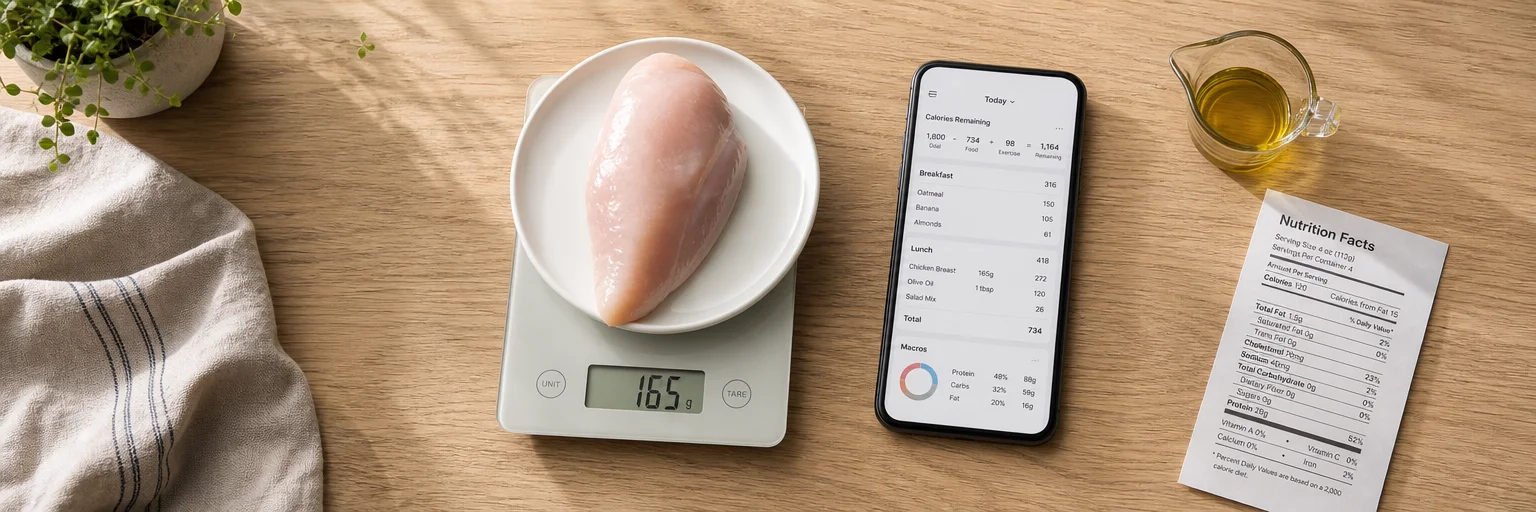
- Weigh, don’t measure. A $15 digital kitchen scale is the single biggest one-time accuracy upgrade a tracker can make. Weigh in grams, tare between foods on the same plate. Volume measures fail worst on the foods that matter most.
- Weigh oils, dressings, nut butters, cheese, and grains dry. These are the five categories most under-logged. Oil is 120 kcal per tablespoon; nut butter 190 kcal per 2 tbsp; cheese ~110 kcal per oz. A 10-gram eyeball error on each stacks to 200–400 kcal a day.
- Use verified-entry-only in the app. MyFitnessPal has a “Verified” filter; Lose It has an “official” database; Cronometer is verified-only by design. Prefer barcode scans over typed searches for packaged foods.
- Cook and log in bulk. Weigh the whole batch (raw + cooking oil + seasoning), log the batch as a single recipe, then log servings by weight after cooking. This removes daily portioning error on repeat meals.
- Do not eat back tracker calories. Set your calorie target in the app directly and treat the exercise number as a health metric, not a food budget. Chowdhury 2017 found no weight-loss benefit from eating back the reported burn.
- Use the 2-week body-weight trend as the truth, not the daily log. A 7-day rolling average of daily weights is the final arbiter of whether the deficit is real. See weighing yourself daily vs weekly for the protocol.
The how to count calories guide covers the mechanics of setting a target and running the log; this article is about the accuracy layer on top.
The “I’m tracking and still not losing” 5-question audit
If the app is reporting a deficit but the 2-week body-weight trend is flat, walk through these five questions in order. A “yes to worse” on any single question is usually 100–300 kcal/day of likely miscount, and stacking two or three of them fully explains a stalled plan without invoking metabolism.
- Are you weighing oils and dressings? Or eyeballing them from the bottle. A pour that reads as “1 tablespoon” is usually 1.5–2. Fix: weigh in grams, tare from the plate.
- Are your restaurant meals verified vs eyeballed? Or estimated from a “similar dish” in the database. Chain-restaurant posted calories run ~18% low on average, and independent restaurants have no measurement at all. Fix: cook at home for a 2-week diagnostic window.
- Are you including bites, licks, and tastes (BLTs)? A spoonful of pasta sauce while cooking, the last few fries off your kid’s plate, a piece of bread at dinner. Fix: if it went in your mouth, log it.
- Are you weekend-tracking with the same rigor as weekday? A clean Monday–Thursday can be erased by two loose days. Weight loss is a weekly total, not a daily one. See weekend weight loss for the weekend-cycle picture.
- Are you eating back tracker exercise calories? The single most reliable way to erase a deficit. Chowdhury 2017 found no weight-loss benefit from doing so.
Fix the top yes-to-worse first, hold the plan for 2 weeks, then re-check the 7-day trend. The broader diagnostic map for stalled loss is in why am I not losing weight and weight loss plateau.
Eating-disorder carveout — precision tracking is contraindicated
Precision calorie tracking is contraindicated in anyone with an active or recovering eating disorder — anorexia nervosa, bulimia nervosa, binge-eating disorder, orthorexia, ARFID — and in anyone whose mood or eating behavior swings materially with the number. This is not a soft caveat; it is a hard line.
- Levinson 2017 (Eating Behaviors) surveyed 105 patients in eating-disorder treatment and found that a large majority of MyFitnessPal users reported the app worsened their symptoms.
- Simpson 2017 (Eating Behaviors) linked calorie-tracking-app use to higher orthorexia and eating-disorder measures in college women.
If a tracking habit is triggering restricting, purging, binge patterns, food avoidance, or a persistent dread of the log — stop, tell a clinician, and switch to body-based signals (hunger, fullness, energy, performance markers, how clothes fit). The right recovery tracking is guided by a therapist and a registered dietitian, not a food-logging app.
If you or someone you know is struggling: the NEDA (National Eating Disorders Association) helpline is 1-800-931-2237, or text “NEDA” to 741741 for crisis support. Recovery-specific tracking guidance is in the binge eating disorder, bulimia recovery, and anorexia recovery guides.
What this article does NOT do
- It is not a criticism of tracking. A rough honest log still outperforms no log — Burke 2011 (J Acad Nutr Diet) meta-analyzed 22 self-monitoring trials and found consistent-loggers lose roughly twice as much as inconsistent-loggers. The point of accuracy work is to fix the biggest leaks, not to give up.
- It does not claim CGMs or DEXA solve the accuracy problem. Continuous glucose monitors are marketed hard for non-diabetic weight loss but do not measure intake or expenditure directly; DEXA is a body-composition test, not an intake measurement. See continuous glucose monitors for weight loss and body composition testing — DEXA, BIA, and Bod Pod for the honest reads on each.
- It is not medical nutrition therapy. Individualized calorie targets, macronutrient prescriptions, and monitoring for medical conditions require a registered dietitian or physician, not an article.
- GLP-1 and bariatric patients are a special case. The tracker often over-estimates intake in these populations because physical portion sizes have shrunk (a “medium banana” is now half a banana). Under-eating and muscle loss are the risk to watch. See preventing muscle loss on GLP-1 and bariatric post-op vitamin and nutrition protocol for the group-specific guidance.
Tessa’s practical protocol
The default I write into most reader plans that use tracking:
- A $15 digital kitchen scale on the counter. Weigh oils, dressings, nut butters, cheese, and grains dry. Everything else by weight when you cook, by portion after.
- Verified-entry-only in the tracking app of choice (MyFitnessPal, Lose It, Cronometer). Barcode scans over typed searches for packaged foods.
- Set the calorie target directly. Do not eat back tracker exercise calories.
- Log weekends with the same rigor as weekdays. Weight loss is a weekly total.
- 7-day rolling weight average as the truth check; ignore the daily log’s own arithmetic in favor of the trend. See weighing yourself daily vs weekly.
- Two-week diagnostic window at home cooking before you conclude the plan is not working. Restaurants add too much variance to blame the plan.
- If tracking becomes emotionally corrosive, stop. The eating-disorder carveout is not optional.
How this article was researched
We reviewed the peer-reviewed self-report validation literature against doubly-labeled water — Lichtman 1992 in the New England Journal of Medicine, Schoeller 1990 in Metabolism, Champagne 2002 in the Journal of the American Dietetic Association, Champagne 2013 in the Journal of the Academy of Nutrition and Dietetics, and Ravelli 2020 in Nutrients. We paired those with the packaged-food and restaurant-menu accuracy literature — Urban 2010 in JAMA, Feldman 2011 in the American Journal of Preventive Medicine, Jarlenski 2016 in Preventive Medicine — and with the wearable-accuracy literature — Shcherbina 2017 in the Journal of Personalized Medicine, Case 2015 in JAMA, Chowdhury 2017 in the International Journal of Behavioral Nutrition and Physical Activity. The self-monitoring-and-weight-loss anchor is Burke 2011 in the Journal of the American Dietetic Association, and the app-database accuracy anchor is Jayawardena 2016 in Nutrition & Dietetics. FDA compliance rules are drawn from 21 CFR 101.9(g). Practical recommendations are framed as starting points for self-tracking rather than individualized medical advice, and the eating-disorder carveout follows current NEDA and AED clinical guidance.
Sources
- Lichtman SW, Pisarska K, Berman ER, et al. Discrepancy between self-reported and actual caloric intake and exercise in obese subjects. New England Journal of Medicine (1992).
- Schoeller DA. How accurate is self-reported dietary energy intake? Nutrition Reviews / Metabolism reviews (1990).
- Champagne CM, Bray GA, Kurtz AA, et al. Energy intake and energy expenditure: a controlled study comparing dietitians and non-dietitians. Journal of the American Dietetic Association (2002).
- Champagne CM, et al. Dietary intake assessed by food records — measurement error and doubly labeled water review. Journal of the Academy of Nutrition and Dietetics (2013).
- Ravelli MN, Schoeller DA. Traditional self-reported dietary instruments are prone to inaccuracies and new approaches are needed. Nutrients (2020).
- Urban LE, McCrory MA, Dallal GE, et al. Accuracy of stated energy contents of restaurant foods. JAMA (2010).
- Feldman CH, Elbel B. Menu labeling in New York City and consumer response. American Journal of Preventive Medicine (2011).
- Jarlenski MP, Wolfson JA, Bleich SN. Menu labeling laws — the federal rule and effects on consumer behavior. Preventive Medicine (2016).
- Shcherbina A, Mattsson CM, Waggott D, et al. Accuracy in wrist-worn, sensor-based measurements of heart rate and energy expenditure in a diverse cohort. Journal of Personalized Medicine (2017).
- Case MA, Burwick HA, Volpp KG, Patel MS. Accuracy of smartphone applications and wearable devices for tracking physical activity data. JAMA (2015).
- Chowdhury EA, Western MJ, Nightingale TE, Peacock OJ, Thompson D. Assessment of laboratory and daily energy expenditure estimates from consumer multi-sensor physical activity monitors. International Journal of Behavioral Nutrition and Physical Activity (2017).
- Burke LE, Wang J, Sevick MA. Self-monitoring in weight loss: a systematic review of the literature. Journal of the American Dietetic Association (2011).
- Jayawardena R, et al. Evaluation of the nutrient content of foods and calorie-tracking app database accuracy. Nutrition & Dietetics (2016).
- 21 CFR 101.9 — Nutrition labeling of food, subsection (g) compliance provisions. US Code of Federal Regulations.
- Levinson CA, Fewell L, Brosof LC. My Fitness Pal calorie tracker usage in the eating disorders. Eating Behaviors (2017).
- Simpson CC, Mazzeo SE. Calorie counting and fitness tracking technology: associations with eating disorder symptomatology. Eating Behaviors (2017).