
2026-09-04 · weight loss, budget, cheap meals, grocery, nutrition, meal plan
Written by Tessa Morgan
Tessa Morgan is a WeightFAQ staff writer focused on the long-game side of weight loss: habits, motivation, tracking, and what happens after the first pound comes off. She has written about weight-loss maintenance, plateaus, why the scale sometimes stops moving, water-weight fluctuations, and adaptive thermogenesis, as well as practical guides to weight-loss apps, non-scale victories, emotional eating, and cheat meals and refeed days. Tessa covers realistic timelines — how long weight loss actually takes — and travel-friendly strategies. She writes for readers building routines they can hold for years, not weeks.
16 min read
Medically reviewed on Sep 4, 2026
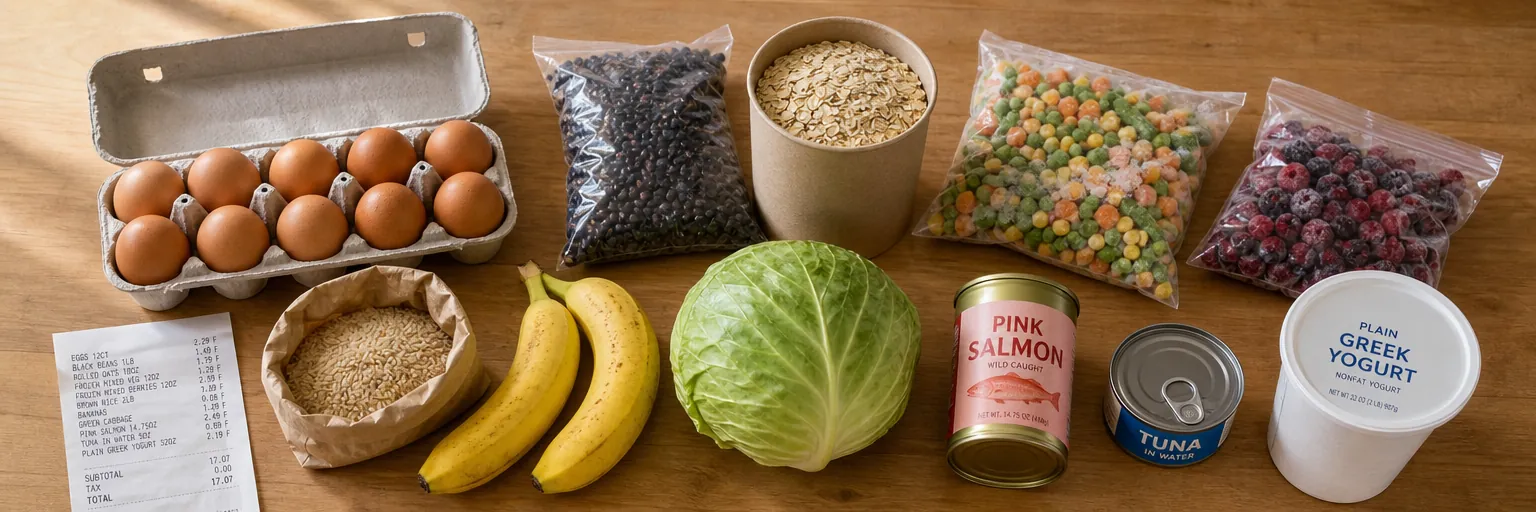
Weight Loss on a Budget: The Cheap-Food Playbook
Quick stats
- Sample-plan cost: ~$50/week for one adult (US 2026, store-brand + frozen produce)
- Daily target on the sample plan: ~1,500–1,700 kcal, ~110 g protein
- One-time kitchen setup: ~$60 total (scale, cups, spoons, one pan, one pot, one sheet pan, one bottle)
- Cost of a nutrient-dense diet vs a less-healthy one: ~$1.50/day per person (Rao 2013, BMJ Open meta of 27 studies)
- What you do not need: protein powder, gym, premium app, branded meal-replacement, MLM supplements
The single most-cited real-world adherence blocker in the weight-loss reader base is not motivation, willpower, or knowledge — it is money. A $12 protein powder tub, a $25 branded meal-replacement week, or a $60 gym membership can quietly end an otherwise-solid plan.
This guide is the alternative version. It uses the actual peer-reviewed cost-of-a-healthy-diet literature, not vibes-based grocery math, to build a plain, honest, cheap plan around foods that already sit in every US supermarket. There is no shame language, no “just quit your latte,” and no supplement pitch. The plan below assumes: one adult, in a US metro, in 2026, cooking at home, with access to at least a stove, an oven, and a fridge. Later sections cover no-oven and microwave-only setups.
The energy-density-and-cost trap (and why it is only half the story)
There is a real body of research showing that, dollar for dollar, the cheapest calories in US supermarkets tend to be refined grains, added sugar, and added fat. Adam Drewnowski’s foundational 2004 paper in the American Journal of Clinical Nutrition — followed by his 2005 review in Nutrition Reviews — showed the inverse relationship between energy density and cost on the shelf: energy-dense, nutrient-poor foods sit at the low-cost end, and produce, lean protein, and whole grains sit further up.
A 2013 meta-analysis by Mayuree Rao and colleagues in BMJ Open pooled 27 studies from 10 countries and put a specific number on it: a nutrient-dense diet costs roughly $1.50 per day per person more than a less-healthy one, or about $550 per year per person. Monsivais and colleagues (2015, Health Affairs) tracked the same price gap over time in the US and found it stable.
The narrative that usually follows is: “healthy eating is out of reach for low-income households.” That is partly true — but it collapses into a cheaper, more actionable statement once you separate two things:
- Cost per calorie — where refined grains, oil, and sugar win.
- Cost per gram of protein, per gram of fiber, or per unit of satiety — where eggs, dry beans, oats, cabbage, and frozen vegetables win, and win big.
Weight loss is not fought on cost per calorie. Weight loss is fought on cost per gram of protein and per unit of fullness — because a calorie deficit is easier to hold when a meal keeps you full for four hours. That reframes the entire budget. When you buy a dozen eggs at $3.50, you are getting 72 g of complete protein for the price of a single latte. Buy a $2 bag of dry black beans and you get 200 g of protein and 200 g of fiber. The “cheap = unhealthy” narrative was built on cost per calorie; the “cheap = filling and lean” reality is built on the two axes weight loss actually cares about.
That is the pivot the rest of this guide runs on.
The 15-food cheapest-satiety-per-dollar table
The table below ranks 15 staples by protein per dollar, fiber per dollar, and how full they actually keep you (the “satiety rating” column is directional — anchored to Rolls’s energy-density-and-volume framing (2009, Nutrition Reviews) and to what most weight-loss readers report as sustaining vs. non-sustaining). Prices are US 2026 store-brand averages (Aldi / Walmart / Costco baseline).
| Food | Typical price (2026) | kcal / $ | Protein g / $ | Fiber g / $ | Satiety | Best use |
|---|---|---|---|---|---|---|
| Eggs (large, dozen) | $3.50 / dozen | 240 | 20 | 0 | High | Breakfast anchor, hard-boiled snack |
| Dry black beans / lentils | $2.00 / lb | 1,600 | 100 | 100 | Very high | Cheapest protein + fiber combo |
| Rolled oats | $3.00 / 42 oz | 1,270 | 45 | 30 | High | 2-min microwave breakfast |
| Brown rice | $2.50 / lb | 660 | 14 | 6 | Medium | Cheap starch for dinners |
| Frozen mixed vegetables | $1.50 / lb | 220 | 15 | 20 | High (volume) | Half the dinner plate |
| Frozen berries | $3.50 / 12 oz | 100 | 1 | 8 | Medium | Fruit for yogurt, oats, smoothies |
| Cabbage (whole head) | $2.00 / 2 lb | 220 | 10 | 20 | High (volume) | Slaw, stir-fry, soup base |
| Carrots (2 lb bag) | $1.80 / 2 lb | 190 | 4 | 15 | High (volume) | Snack, soup, roast |
| Bananas | $0.30 / each | 300 | 3 | 8 | Medium | Cheapest portable fruit |
| Apples (3 lb bag) | $4.00 / 3 lb | 195 | 1 | 15 | Medium | Snack + apple-with-peanut-butter |
| Plain low-fat cottage cheese | $2.80 / 16 oz | 145 | 25 | 0 | High | Snack, breakfast, savory base |
| Store-brand plain Greek yogurt | $4.20 / 32 oz | 130 | 22 | 0 | High | Breakfast, snack, sauce base |
| Chicken thighs (bone-in, skin-on) | $2.20 / lb | 500 | 40 | 0 | High | Weekday dinner anchor |
| Canned tuna in water (5 oz) | $0.90 / can | 130 | 25 | 0 | High | Lunch salad, wrap, pasta |
| Canned pink salmon (14 oz) | $3.20 / can | 155 | 30 | 0 | High | Salmon patties, salad topper |
Two rows to notice: dry beans and lentils deliver ~100 g of protein and ~100 g of fiber per dollar — no other food on the US shelf comes close, and our beans and legumes for weight loss guide walks through the canned-vs-dry, soaking, and portion-sizing decisions in detail. Cottage cheese delivers 25 g of protein per dollar, more than 3 times the protein-per-dollar of most protein powders once you price a scoop honestly ($2–$3 per 25 g). Eggs are the cheapest complete protein per calorie on the US shelf; see our eggs for weight loss breakdown for the whole-vs-white and daily-count math.
For the store-by-store cart of most of these items, cross-reference our weight loss grocery list, which prices the same anchors at Aldi, Walmart, Costco, Trader Joe’s, and Whole Foods.
Free / near-free kitchen setup
Every “you have to buy a subscription” pitch collapses if you own a scale, a set of measuring cups, one pan, and one pot. The full one-time budget kitchen for weight loss:
| Item | Purpose | One-time cost |
|---|---|---|
| Digital kitchen scale (0.1 oz) | Portion protein and grains honestly | $12 |
| Set of measuring cups | Portion oil, oats, rice, yogurt | $6 |
| Set of measuring spoons | Portion peanut butter, oil, dressings | $8 |
| One 10-inch non-stick pan | Eggs, stir-fry, chicken | $15 |
| One 4-quart soup pot | Beans, lentils, oats, soup, rice | $12 |
| One half-sheet pan | Roast vegetables, sheet-pan dinners | $10 |
| One 24 oz reusable water bottle | Water instead of soda / juice | $5 |
| Total | ~$68 |
Most of this you can find under $60 at a discount store, warehouse club, or thrift shop. This is a one-time cost, amortized across every meal you cook for years. A $60 setup that lets you cook 21 meals a week pays for itself in the first three weeks of not ordering delivery.
The kitchen scale is the single item that pays for itself fastest. Portion estimation without a scale is the #1 reason for stalled calorie deficits — see our why the scale stops moving guide for the detailed diagnostic.
The $50/week sample plan for one adult
This is a real, receipt-level plan — not a “eat rice and beans” hand-wave. It clears about 1,500–1,700 kcal/day and ~110 g protein/day for seven days for one adult. Prices are US 2026 store-brand averages split across Aldi and Walmart with occasional Costco bulk-buys pro-rated per week.
The grocery list (~$50)
| Item | Store | Quantity | Price |
|---|---|---|---|
| Large eggs, dozen | Aldi | 1 dozen | $3.50 |
| Chicken thighs, bone-in skin-on | Aldi | 2 lb | $4.40 |
| Canned pink salmon, 14 oz | Walmart | 1 can | $3.20 |
| Canned tuna in water, 5 oz | Walmart | 3 cans | $2.70 |
| Firm tofu, 14 oz | Aldi | 1 block | $2.30 |
| Plain nonfat Greek yogurt, 32 oz | Aldi | 1 tub | $4.20 |
| Low-fat cottage cheese, 16 oz | Aldi | 1 tub | $2.80 |
| Dry black beans, 1 lb | Walmart | 1 bag | $1.80 |
| Rolled oats, 42 oz | Aldi | 1 canister | $2.90 |
| Brown rice, 2 lb | Aldi | 1 bag | $2.20 |
| Frozen mixed vegetables, 1 lb | Aldi | 2 bags | $3.00 |
| Frozen chopped spinach, 12 oz | Aldi | 1 bag | $1.50 |
| Frozen mixed berries, 12 oz | Aldi | 1 bag | $3.50 |
| Cabbage, whole | Aldi | 1 head (~2 lb) | $2.00 |
| Carrots, 2 lb | Aldi | 1 bag | $1.80 |
| Bananas | Aldi | 6 | $1.80 |
| Apples | Aldi | 4 | $2.80 |
| One yellow onion + 1 garlic bulb | Aldi | 1 each | $1.20 |
| Store-brand salsa, 16 oz | Aldi | 1 jar | $2.20 |
| Olive oil, restock (partial) | Costco pro-rated | ~½ cup | $1.20 |
| Salt, pepper, cumin, chili powder | pantry / restock | as needed | $2.00 |
| Total | ~$49.00 |
That is 21 anchor meals plus at least 7 snacks, sitting under $50. Substitute a bag of dry lentils for the black beans if the store is out; drop the salsa if the pantry already has a jar; swap chicken thighs for another dozen eggs if chicken prices spike. The plan is designed to bend.
The 7-day meal map
| Day | Breakfast | Lunch | Dinner | Snack | ~kcal | ~protein (g) |
|---|---|---|---|---|---|---|
| Mon | Overnight oats (½ cup oats + ¾ cup Greek yogurt + ½ cup frozen berries) | Tuna-and-cabbage slaw with 1 tsp olive oil, ½ cup brown rice | Baked chicken thigh (5 oz) + roasted frozen mixed veg + ½ cup rice | 1 banana + 1 hard-boiled egg | 1,620 | 115 |
| Tue | 2-egg scramble + spinach + ½ cup black beans | Cottage cheese (¾ cup) + carrots + apple | Chicken-and-cabbage stir-fry (5 oz) with onion, garlic, salsa, ½ cup rice | Greek yogurt + berries | 1,590 | 112 |
| Wed | Oatmeal (½ cup oats) with banana + 1 tbsp peanut butter (from pantry) | Salmon patties (½ can + 1 egg + 2 tbsp oats) + slaw | Black-bean-and-rice bowl (¾ cup beans + ½ cup rice) + salsa + spinach | Hard-boiled egg + carrots | 1,650 | 108 |
| Thu | Greek yogurt (1 cup) + ¼ cup oats + berries | Tuna wrap in cabbage leaves + apple | Tofu-and-veg stir-fry (5 oz tofu + 2 cups frozen veg) with rice | Cottage cheese + banana | 1,580 | 110 |
| Fri | 2-egg scramble + salsa + ½ cup black beans | Cottage cheese + apple + carrots | Chicken thigh (5 oz) + roasted cabbage + ½ cup rice | Greek yogurt + berries | 1,610 | 116 |
| Sat | Overnight oats + berries | Salmon-and-veg bowl over ½ cup rice | Bean-and-cabbage soup (1 cup beans + ½ head cabbage + onion, garlic, spices) with ½ cup rice on the side | Hard-boiled egg + banana | 1,570 | 105 |
| Sun | 3-egg veggie frittata (eggs + spinach + onion) | Cottage cheese + carrots + apple | Chicken-and-black-bean chili (leftover beans + last chicken thigh + salsa + spices) with ½ cup rice | Greek yogurt + berries | 1,640 | 113 |
The plan repeats a handful of formats — scramble, stir-fry, bean-and-cabbage soup, sheet-pan chicken — on purpose. Repetition is what keeps the grocery bill honest; every extra recipe adds a specialty ingredient. A single 90-minute Sunday session of meal prep for weight loss turns this list into portioned containers for the week — hard-boiled eggs, cooked beans, roasted vegetables, and portioned chicken all done at once. If you need help scaling to a two-person or family plan, see weight loss when cooking for family, and use the USDA Thrifty Food Plan family-of-four reference (~$237/wk in 2024 dollars) as your ceiling.
The math, honestly
- 21 meals + 7 snacks = 28 eating events across 7 days.
- ~$49 total = about $1.75 per eating event.
- ~110 g protein/day at a per-gram cost of about $0.06 — roughly one-third the per-gram cost of protein from powder.
- ~30 g fiber/day from beans, oats, cabbage, frozen veg, and fruit.
- ~1,500–1,700 kcal/day = a ~300–500 kcal deficit for most adults; expect a realistic 0.5 to 1 lb per week of fat loss on this budget alone, no gym or supplement required.
For the underlying calorie-deficit math (and how to pick your daily target), see how many calories to lose weight and TDEE and the calorie deficit for beginners.
What to skip (and the honest cost math)
Most of the food-adjacent products marketed to weight-loss shoppers do not survive a per-gram-of-protein or per-serving cost check. This is the “don’t buy” list, with the receipts:
- Protein powder for the sake of protein. A 25 g scoop of whey powder runs $2 to $3. The same 25 g of protein from plain cottage cheese costs about $0.35, from eggs about $0.60, from canned tuna about $0.70, from plain Greek yogurt about $0.80, and from chicken thighs about $0.55. Powder can be convenient — nothing wrong with it — but paying 4 to 8x for protein-in-a-shaker is a budget bleed for a cost-first shopper.
- Trendy fibers, collagen, MCT oil, “gut-health” powders. None of these outperform beans, oats, or cabbage per dollar of fiber, and none have shown a clinically meaningful weight-loss effect at the doses used in-home. If a product is being advertised on Instagram or in a wellness-influencer’s link tree, price it against a $2 bag of dry lentils before buying.
- Branded meal-replacement shakes. Typical retail price $3 to $5 per 250–400 kcal shake. That is $21 to $35 for seven weekday breakfasts — most of your $50 grocery budget spent on one meal a day.
- Delivery services above ~$8 per meal. Fees, tips, and menu markup can double the price of a meal you could cook at home for $2 to $3. If delivery is a real need (mobility, time, no kitchen), price a weekly cap first (e.g., “delivery no more than 2x/week”). See eating out for weight loss for the ordering rules that keep restaurant meals from wrecking the week.
- MLM supplements (“shakes,” “cleanses,” “boosters”). No clinically meaningful weight-loss effect over placebo in the peer-reviewed literature. Recurring monthly cost typically $80 to $200. Full-cost redirect to the grocery list is a straight-line upgrade.
- “Health food store” markups on the same product. A 42-oz canister of rolled oats is the same oats whether you buy it at Aldi for $2.90 or at a natural-foods store for $8.50. Read the ingredient list, not the storefront.
None of this is judgmental. If a $12 protein tub is what makes your week work, keep it. But nothing on this list is required for weight loss, and every one of them is optional on a $50/week plan.
Free (or almost free) exercise
You do not need a gym membership to build the exercise side of a weight-loss plan. Two anchors, both free:
- A daily walk. Walking is the cheapest, highest-adherence movement in the exercise literature. Aim for a 20 to 40 minute walk most days; sunlight and audio (podcast, music, phone call) turn it into the easiest habit on the list. See walking for weight loss for step targets by body size and calorie-burn ranges.
- A 4-week bodyweight starter — push, pull, squat, hinge. No equipment. Three 20-minute sessions a week: push-ups (or incline push-ups against a counter), a doorway or park-bar pull or an inverted row using a sturdy table, bodyweight squats, and hip hinges (Romanian-deadlift shape, no weight). The full progression is in home workouts for weight loss — every exercise scales down for beginners and up to weighted versions later if you want.
That is the full free plan: walk + push + pull + squat + hinge. If a gym becomes affordable later, add it. If not, the biology of a calorie deficit does not care.
Failure modes (and the fix)
The five most common ways a budget weight-loss plan quietly falls apart:
- “I bought 5 lb of bulk chicken and threw half of it out.” Bulk protein saves money only if it gets frozen in single-meal portions the day you unpack it. The 30-minute post-shopping workflow: portion protein into freezer bags (1 lb or 5 oz per bag), hard-boil 6 eggs, wash and dry produce. See the “60 minutes after” step in our weight loss grocery list — that hour is the highest-leverage hour of your week.
- “I only shopped at the natural-foods store.” Same rolled oats, 3x the price. Read the ingredient list, not the storefront, and price-check the store brand at Aldi or Walmart before anchoring to a specialty grocer.
- “I assumed cheap = ultra-processed.” Frozen vegetables, dry beans, oats, cabbage, eggs, and canned fish are all cheap and minimally processed. Only some cheap calories are ultra-processed (chips, soda, cookies, boxed pastries); the cheap staples on the table above are not.
- “I bought only shelf-stable food and got scurvy-adjacent.” Not literally, but a plan with no produce collapses on adherence and micronutrient adequacy fast. Frozen vegetables and fruit solve this for about $1.50 to $3.50 per bag. The USDA ERS 2024 Food Prices report confirms frozen produce has stayed within a few cents of fresh on a per-cup basis over the last decade.
- “I started skipping meals to save money.” This is the failure mode that ends the plan. A calorie deficit is planned under-eating within a reasonable range (usually 300 to 500 kcal per day below maintenance); unplanned under-eating triggers the evening binge and reverses the week’s math. Eat the three meals plus a snack; that is what the $50 plan is sized for.
SNAP, WIC, and food-bank access
Food assistance is a normal, legal part of many households’ grocery plans, and this guide would be incomplete without noting it.
- SNAP (Supplemental Nutrition Assistance Program) benefits can be used to buy most foods on the list above — eggs, produce, dairy, bread, cereal, canned and dry protein, seeds and plants for growing food. To check eligibility or apply, start at benefits.gov and your state’s SNAP portal.
- WIC (Special Supplemental Nutrition Program for Women, Infants, and Children) covers pregnant and postpartum people, infants, and children up to age 5 in eligible households. The WIC food package covers eggs, milk, cheese, whole-grain cereals, fruit and vegetables, canned fish, peanut butter, and dry beans — nearly all the anchors in this guide. Apply through your state’s WIC office or fns.usda.gov/wic.
- Food banks and pantries stock most of the shelf-stable staples on the $50 plan — dry beans, rice, oats, canned tuna, peanut butter, pasta. Locate one at feedingamerica.org/find-your-local-foodbank.
- Basu 2013 (PLoS Medicine) found SNAP participation is associated with somewhat lower diet quality on average, driven by higher sugar-sweetened-beverage intake — but the fix is the same for every shopper: put the SNAP dollars into the same staple foods on the table above, not the checkout-aisle add-ons.
Using assistance and losing weight are not in conflict. The list of foods works the same either way.
Family scaling
For two or more adults, the per-adult cost drops because staples (a whole cabbage, a 42-oz oat canister, a 25-lb bag of rice) get amortized across more meals. The USDA Thrifty Food Plan reference for a family of four ran roughly $237/week in 2024 dollars — about $60 per adult, or $30 per child — and that is a nutritionally adequate benchmark, not a starvation number. The weight loss when cooking for family guide has the multi-person scaling and the picky-eater workarounds.
The one-week starter checklist
If you are reading this at the start of a Sunday and want a plan for the week:
- Print or screenshot the $50 grocery list above. Cross off anything already in the pantry.
- Buy the missing items at Aldi or Walmart. Total shop time: ~30 minutes.
- In the first hour home: hard-boil 6 eggs, portion chicken thighs into two freezer bags, cook 1 cup dry beans in the soup pot, cook 1 cup dry brown rice, wash and chop the cabbage.
- Mix two jars of overnight oats for Monday and Wednesday breakfast.
- Take a 20-minute walk.
- Sunday night, look at the 7-day meal map and pick your two dinner-cook nights (Mon + Thu is typical).
That is the whole plan. No app, no membership, no supplement.
About the anchor evidence. This guide draws on Drewnowski (2004, Am J Clin Nutr) and Drewnowski (2005, Nutrition Reviews) for the energy-density-and-cost inverse relationship; Rao 2013 (BMJ Open) for the $1.50/day cost gap between healthy and less-healthy diets; Monsivais 2015 (Health Affairs) for the food-price differential and diet quality over time; the USDA Thrifty Food Plan 2021 ($237/wk family of four in 2024 dollars) and the USDA ERS 2024 Food Prices report for per-item price context; Feeding America / Hunger in America for food-insecurity prevalence; Rolls 2009 (Nutrition Reviews) for the energy-density-and-volume-eating framing; Wansink 2007 for the pantry-environment-and-portion work; and Basu 2013 (PLoS Medicine) for SNAP participation and diet quality.
Nothing in this guide is medical advice. If you have diabetes, kidney disease, an eating disorder history, or any medication regimen sensitive to protein or fiber intake, talk to your primary-care clinician or a registered dietitian before starting a calorie-deficit plan; many US states cover a dietitian visit under Medicaid, and community health centers often offer nutrition counseling on a sliding-scale fee.