
2026-09-03 · desk job, office job weight loss, sedentary work, remote work, standing desk, NEAT, workday movement, weight loss
Written by Tessa Morgan
Tessa Morgan is a WeightFAQ staff writer focused on the long-game side of weight loss: habits, motivation, tracking, and what happens after the first pound comes off. She has written about weight-loss maintenance, plateaus, why the scale sometimes stops moving, water-weight fluctuations, and adaptive thermogenesis, as well as practical guides to weight-loss apps, non-scale victories, emotional eating, and cheat meals and refeed days. Tessa covers realistic timelines — how long weight loss actually takes — and travel-friendly strategies. She writes for readers building routines they can hold for years, not weeks.
24 min read
Medically reviewed on Sep 3, 2026
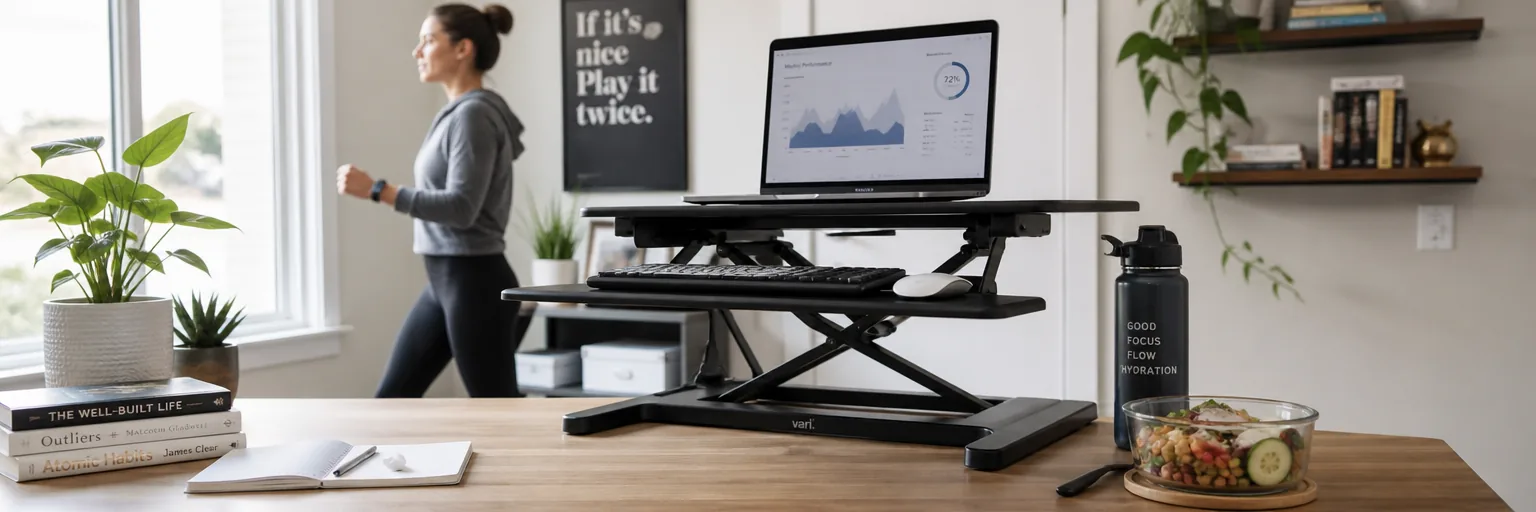
Weight Loss and Desk Jobs: The 8-Hour-Sitting Problem, Standing Desks, and What Actually Moves the Scale
Quick answer
A 40-hour-a-week desk job costs a typical adult roughly 200 to 350 fewer kcal per day than a light-manual job — anchored on Levine 2000 (Science, obesity-lean NEAT gap ~350 kcal/day), Levine 2005 (Science, lean-vs-obese sitting-and-standing time gap of ~2.5 hours/day), Chastin 2018 (Br J Sports Med, sitting-time meta), and Ekelund 2020 (Br J Sports Med, 60–75 min/day of moderate activity offsets sitting mortality). Translated into weight: ~1 to 2 lb of weight-loss headroom lost per month for the average desk worker. This is not a broken metabolism — it is an adherence problem. The deficit still has to come from somewhere, and for a desk worker that somewhere is planned eating and a scheduled movement pattern, not the natural NEAT a retail clerk or a warehouse loader gets for free. This guide gives the five anti-patterns that quietly cost desk workers weight-loss traction, the honest read on standing desks and treadmill desks, a 20-8-2 break cadence (20 min sit / 8 min stand / 2 min move), a five-row workday movement decision table, a 1,700 kcal desk-worker meal template, a step-count build for a 9-hour sitter, and the remote-vs-office pattern.
Why a desk job is a weight-loss problem, honestly
The physiology is not mysterious. Sitting is metabolically close to lying down — about 1.0 to 1.3 METs, versus 2.0 METs for standing, 2.5 for casual walking, and 3.0 to 3.3 for a brisk desk-worker’s lunch walk. Over an eight-hour workday, the sitting-vs-standing gap alone is roughly 50 to 80 additional kcal for a full standing day. That is small.
The gap that actually matters is the total-workday NEAT gap between a seated role and a role that puts a body in motion. A retail cashier walks the floor and reaches shelves; a nurse walks a hospital corridor; a construction worker climbs, lifts, and carries. Levine 2005 (Science) put motion-sensor underwear on 10 lean and 10 obese adults and measured every minute of a normal day: the obese group sat about 2.5 hours per day more than the lean group, and the lean group’s spontaneous NEAT was worth ~350 additional kcal per day. The corollary is more useful than the observation: a desk worker sitting 8 to 9 hours a day is essentially living the “obese” pattern in the Levine data by job structure, not by choice.
Chastin 2018 (British Journal of Sports Medicine), a meta-analysis of 45 studies, showed sitting time predicts weight gain independently of exercise volume — an important nuance for the “I go to the gym after work” reader who assumes a 45-minute session cancels a 9-hour sit. It does not fully. Ekelund 2020 (British Journal of Sports Medicine) later gave the honest offset: 60 to 75 minutes per day of moderate physical activity neutralizes most of the mortality risk from prolonged sitting. That is a lot of movement, and it is why desk workers who add only a 20-minute lunch walk often see less than they hoped.
The working number: a desk job costs ~200 to 350 fewer kcal per day than a light-manual job, or about ~1 to 2 lb of weight-loss headroom per month. Frame it as an adherence problem, not a metabolism problem — the math still works, the deficit just has to be manufactured on purpose. For the wider mechanism, see NEAT (non-exercise activity thermogenesis); for why “I go to the gym” does not fully patch the gap, see exercise for weight loss on the sitting-time independence signal.
Five anti-patterns that quietly drive desk-worker weight gain
The desk-worker weight-gain literature is not really about metabolism at all. It is a collection of small, honest failure modes that stack. Naming them is 80 percent of the fix.
- Commute-swap NEAT loss. The move to remote or hybrid work removed a lot of unplanned movement. Owen 2010 (Exercise and Sport Sciences Reviews) documented that public-transit commuters average roughly ~1,000 more steps per day than driving commuters; a full WFH shift often removes both. That is roughly 40 to 60 kcal per day of lost NEAT plus the small daily meal-timing structure that a commute enforces.
- Always-on snack drawer + free-office-food. Weston 2019 (Journal of the Academy of Nutrition and Dietetics) on the workplace food environment showed that proximity and visibility drive intake more than hunger does — a candy bowl at reception, a Friday bagel box, a birthday cake in the break room, a “leftover pizza in the kitchen” Slack message. Every one of these is a decision-point most workers lose by default; a home-office snack drawer or a full pantry is the same anti-pattern in a smaller room.
- Skipped lunch → 3 p.m. crash → 800-kcal DoorDash + evening overshoot. The “I’ll just work through lunch” workday almost never saves calories. Chapelot 2004 (American Journal of Clinical Nutrition) and the broader meal-skipping literature is unusually consistent: skipping a real lunch is followed by a compensatory afternoon-and-evening overshoot that erases the saved calories and then some. The 3 p.m. crash is the biological trigger — low blood glucose, low executive function, high impulsivity.
- Hydration underrun mistaken for hunger. Desk workers under-drink because a full water bottle means a bathroom break and a bathroom break means “away from Slack.” Mild dehydration produces a signal the brain reads as low-grade hunger, and mid-afternoon “I need a snack” is often “I need 16 oz of water.” The fix is a labeled 32 oz bottle at the desk refilled twice per day.
- Reward-myself evening deficit-erase cycle. Chao 2015 (Journal of Health Psychology) on stress and emotional eating showed that a hard workday reliably triggers evening compensatory eating — chips-and-wine, second-dinner, dessert-after-dessert. The pattern is not weakness; it is a predictable response to workday cortisol and decision-fatigue. Naming it lets you plan around it, which we cover in the emotional eating guide.
None of these are metabolic. All of them are structural, which is good news — structural problems have structural fixes.
The standing desk, honestly
Standing desks are the most-asked-about desk-worker weight-loss intervention, and the honest evidence is not what the marketing suggests. Reiff 2012 (Journal of Physical Activity and Health) measured energy expenditure and found standing adds about ~8 kcal per hour over sitting — a full 8-hour standing day is roughly 50 to 80 extra kcal. Buckley 2015 (British Journal of Sports Medicine) authored a consensus statement recommending desk workers accumulate at least 2 to 4 hours per day of standing and light activity to break up sitting bouts — a real health target for musculoskeletal and cardiometabolic reasons, but not framed as a weight-loss intervention.
Chambers 2019 (Occupational and Environmental Medicine) ran a 6-month sit-stand desk workplace trial and found no meaningful weight-loss signal relative to the sitting-only comparison group, though sitting time dropped and self-reported back pain improved. MacEwen 2015 (Preventive Medicine Reports) meta-reviewed the sit-stand desk literature and reached the same conclusion — real benefits for sitting-time reduction and musculoskeletal outcomes, no reliable weight-loss effect.
Two mechanisms explain why the calorie-per-hour math does not translate to the scale. First, the 50 to 80 kcal daily gain is small — about the calories in a single sugar packet in coffee. Second, Levine 2005 and later replication studies show the body compensates for a modest increase in NEAT by eating slightly more, roughly half the added expenditure. That leaves a real signal of ~25 to 40 kcal/day of net headroom, which is inside the noise of daily calorie counting.
The honest read: standing desks help back and posture and reduce continuous sitting time — real benefits — but they are not a weight-loss intervention on their own. Where they earn their keep for a desk worker’s weight plan is as a sitting-interrupter — a raise-lower cadence that makes 2-minute movement breaks easier to actually take, because standing up is already the default. A 3-minute walking break every hour beats a 3-hour static stand for both calorie burn and glucose response, per the Dunstan and Peddie evidence below.
Break cadence: the 20-8-2 rule
The break-cadence literature is the most actionable piece of desk-worker weight-loss science, and it is not really about calories — it is about metabolic health that supports weight loss.
Dunstan 2012 (Diabetes Care) put 19 overweight adults through three 5-hour protocols after a standard meal: continuous sitting, continuous sitting broken by a 2-minute light walk every 20 minutes, and continuous sitting broken by a 2-minute moderate walk every 20 minutes. Both broken-sitting arms cut post-meal glucose response by 24 to 30 percent and insulin response by ~24 percent versus continuous sitting. Same total food, same total sitting time — the interruption pattern moved the metabolic signal.
Peddie 2013 (American Journal of Clinical Nutrition) directly compared 1 minute of walking every 30 minutes across a 9-hour workday against a single continuous 30-minute walk of the same total volume. The frequent-interruption arm beat the single-walk arm on both glucose and insulin response — the walk-break pattern is not just a calorie question, it is a metabolic-signaling question that the single-workout structure of most fitness plans does not address.
Diaz 2019 (Annals of Internal Medicine), a NHANES accelerometer study, showed prolonged sitting bouts of 30 minutes or more predicted higher all-cause mortality even after controlling for total sitting time and total activity. Reynolds 2016 (Diabetologia) added the post-meal specificity — a 10-minute walk after each of the day’s three main meals cut 24-hour glucose more than a single 30-minute walk at any other time.
Put together, the workable protocol for a desk worker is the 20-8-2 rule:
- 20 minutes of focused sitting work
- 8 minutes of standing (email, reading, calls)
- 2 minutes of moving (walk to the kitchen, refill water, take the long way to the bathroom, do 10 air squats)
If 20-8-2 is too aggressive for the work pattern (deep-focus coding, back-to-back meetings), the minimum-viable default is a 60-minute alarm plus a 3-minute walk-and-water break — small enough to actually take, large enough to move the metabolic signal. On both patterns, use a physical timer on the wrist or phone; a Slack-set “focus mode” without an alarm reliably drifts into a 3-hour sit.
Add a 10-minute walk after each main meal on top — the Reynolds 2016 signal is separate and additive, and post-meal walks are the single most-cited habit in the desk-worker weight-loss literature that is both effective and easy to actually keep.
The workday movement decision table
Five patterns, honest kcal and step math, ordered from easiest-to-add to hardest-to-sustain. Mix two or three; a desk worker does not need all five.
| Pattern | Time cost | Added kcal/day | Added steps/day | Sticking difficulty | Best fit reader |
|---|---|---|---|---|---|
| 10-min pre-work walk (around block before laptop opens) | 10 min | ~50–70 | ~1,000 | Low | Morning routiner, dog owner, coffee walker |
| Walking phone calls (headphones, laps of hallway or driveway) | 0 added time | ~80–150 | ~1,500–2,500 | Very low | Manager, salesperson, high-meeting role |
| Top-of-hour 3-min break (every 60 min, 6 to 8 times/day) | 20 min total | ~40–70 | ~1,500–2,500 | Medium (needs an alarm) | Every desk worker; the highest-leverage default |
| Lunch-hour walk (20 to 30 min, outside if possible) | 20–30 min | ~90–150 | ~2,000–3,000 | Medium (protects lunch break, adds daylight) | WFH worker, urban office with sidewalks |
| After-shutdown post-work walk (before couch, 15 to 30 min) | 15–30 min | ~70–150 | ~1,500–3,000 | Medium-high (competes with family and dinner) | Evening decompression eater, no-morning-time reader |
How to read this table: pick the two rows that fit your calendar and the one row you would most easily forget. Cover the forget-row with an alarm. The top-of-hour break is the highest-leverage single habit — it stacks calories, steps, glucose control, back health, and eye-strain relief in one 3-minute unit, six to eight times per day.
The desk-worker meal template: 500-500-200-500
Meal timing matters less for weight loss than most timing gurus claim; meal structure matters more. A desk worker who eats on autopilot (bagel at 7, coffee at 9, forgotten lunch, DoorDash at 3, big dinner at 8, snacks at 10) reliably overshoots. A desk worker who eats to a repeatable template reliably lands the deficit.
The workable default for a 155-lb desk worker at a ~0.75 lb/wk deficit is a 1,700 kcal template split roughly:
- 500 kcal breakfast — plated the night before or a 5-minute assemble. Greek yogurt (200 kcal) + berries (60) + granola (100) + walnuts (100) + coffee with milk (40). Or 3 eggs (215) + 2 slices whole-grain toast (160) + avocado (120). Anchor is ~30 g protein, which sets the day’s satiety. See high-protein breakfast ideas for 10 more assemble-in-5 patterns.
- 500 kcal lunch — 2-container prep beats DoorDash-roulette every day of the year. Rice or grain (150) + protein (200–250 — chicken, tofu, salmon, or beans) + roasted vegetables (100) + a small dressing (50). The failure mode is not prepping and eating the closest food; every weight-loss meal-plan study that improves adherence protects the lunch slot.
- 200 kcal snack — protein-and-fiber tier, timed to the 3 p.m. crash. Apple + 1 tbsp peanut butter (~200). Cottage cheese + berries (~150). String cheese + jerky stick (~180). See high-protein snacks for weight loss for the working list.
- 500 kcal dinner — the “closing bell” meal. Protein (250) + vegetables (100) + starch or grain (150) + a splash of olive oil (50). Cook once, plate to a normal plate size, and — critically — close the kitchen at 8 p.m.
Scale down to ~1,500 kcal for a 130 lb desk worker or up to ~1,900 for a 190 lb desk worker; the split ratio stays approximately the same. The template protects a busy weekday, not a weekend or a holiday — expect a ±300 kcal weekend variance and design the weekly deficit around it rather than pretending you’ll hit 1,700 on Saturday.
The single most useful sentence in this section: skipping lunch to “save calories” is the most reliably self-defeating desk-worker eating pattern, and every meal-skipping trial shows compensatory evening overshoot. Eat the 500 kcal lunch on purpose.
Step count for a desk worker: 7,000 to 8,500
The average sedentary office worker averages 3,000 to 4,500 steps per day — well below the mortality-benefit floor of ~6,000 to 8,000 shown in Paluch 2022 (Lancet Public Health). A realistic weight-loss target for a desk worker is 7,000 to 8,500 steps per day, which is a ~3,000 to 4,000 step lift worth roughly 120 to 200 additional kcal per day.
The build looks like this:
- 20-minute lunch walk: ~2,000 steps
- 10-minute pre-shutdown walk: ~1,000 steps
- 3 to 4 top-of-hour 3-min breaks: ~1,000 steps
- Whatever ambient steps the day generates (kitchen, bathroom, kids, dog): 2,000 to 3,500 steps
That comfortably lands 7,000 to 8,500 on a normal desk workday with no formal workout. Add a 30-minute weekend walk or a treadmill/elliptical session to bring the weekly average toward the higher band. The 10,000-step target is fine if it fits, but it is a 1965 Japanese pedometer marketing figure, not a physiologic threshold — chasing it can add unwanted evening pressure without a proportional benefit. See daily step count for weight loss for the full dose-response read.
Remote vs office: different problem, same fix
Remote work removes roughly 800 to 1,500 steps per day for most workers — no commute walk, no walk from the parking lot, no cafeteria walk, no walk to the meeting room down the hall, no walk to the printer. Wilms 2022 (International Journal of Environmental Research and Public Health) documented that remote workers actually take fewer breaks than in-office workers, not more — the “roomier calendar” assumption is a myth, and the “just one more email” pattern is stronger without a colleague standing up to say lunch.
On paper, WFH is worse for a desk worker’s daily NEAT. In practice, WFH is easier to intervene on:
- Private walking breaks — a 5-minute loop of the driveway is easier when no one is watching.
- Kitchen access = better meals if you plan them, worse meals if you don’t — the pantry is 15 feet away in both directions.
- Camera-off treadmill-desk meetings are legitimate and often improve engagement; a 1.5–2 mph walking pace during a status meeting is a real 100–130 kcal/hour.
- No commute time = movement time if you claim it — the 45 minutes you would have spent driving is a 30-minute walk plus a shower.
A hybrid schedule (2 to 3 days remote, 2 to 3 days in-office) tends to be the pattern that stalls quiet — office days keep meal structure, WFH days lose it, and total weekly kcal drifts. The fix is a single template that runs both — same breakfast, same 500 kcal lunch prepped ahead, same 3 p.m. snack, same 8 p.m. kitchen close — with the movement plan customized (lunch walk at the office is a loop of the parking lot; at home it is a loop of the neighborhood).
If the desk job is new (first 6 months in the role) — the drivers stack differently in the acute transition window than in a chronic-sedentary desk pattern, and the intervention priority is protecting a maintenance baseline through onboarding rather than chasing a deficit. See weight loss and a new job for the first-90-days scaffold and the 4-driver (routine-anchor loss, commute-swap NEAT loss, free-office-food default, new-boss stress) mechanism table.
The 6 to 9 p.m. decompression zone
Most desk-worker weight gain does not happen at the desk. It happens between 6 and 9 p.m., in the “I sat down to relax and ate a full second dinner” window. Chips and salsa while making dinner, wine with dinner, dessert after dinner, popcorn during the show, cereal at 10 p.m. These are stacked reward-eating episodes, and they add up to 400 to 1,000 kcal on top of a day the desk worker thought was on target.
Three alternatives that reliably move the pattern without white-knuckling:
- Walk before the couch. A 15-minute post-dinner walk changes the transition. It uses the same reward pathway (a break, fresh air, a small dopamine hit) and downgrades the appetite signal for the next 60 to 90 minutes.
- Tea before snack. A 5-minute pause for herbal tea between “I want a snack” and the snack itself resolves ~30 to 40 percent of the impulse — a real behavioral-economics effect that costs nothing.
- Put food away by 8. Physically move the visible food off the counter and into a cabinet by 8 p.m. Wansink 2007 and the food-visibility literature are unusually consistent — out of sight quietly wins.
For deeper coverage of the pattern itself, see emotional eating and weight loss and late-night eating and weight loss — both dig into the specific physiology and the workable behavioral fixes.
Ergonomics: a desk worker in pain will not walk enough
A desk worker with back pain who cannot walk enough will not lose weight. Ergonomics belongs inside a weight-loss plan for the same reason a knee-pain workaround belongs in a running plan — the movement is the intervention, and the movement stops when the pain gets bad enough.
The short list:
- Monitor at eye level — top of the screen roughly at brow height, arm’s length away. Laptop-primary workers need a laptop stand plus external keyboard and mouse — the built-in laptop screen is the single most common cause of desk-worker neck strain.
- Feet flat on the floor, thighs parallel to the ground, elbows at ~90 degrees. A footrest is a $20 fix for shorter workers on tall chairs.
- Standing-desk cadence — raise and lower in ~30 to 60 minute blocks, not “stand all day, collapse in afternoon.” All-day standing fatigues legs and drives an afternoon sitting collapse.
- Anti-fatigue mat for standing sessions — a real biomechanical difference on hard floors.
- Chair with real lumbar support — a $200 to $400 mid-range office chair is cheaper than a chiropractor appointment.
If back pain is already a factor, see back pain and weight loss for the honest read — a 5 to 10 percent body-weight loss reduces lower back pain in most adults, and the ergonomic-plus-walking-plus-deficit combination is more effective than any single lever.
What not to do
The desk-worker weight-loss literature has a matching don’t-do list that is almost as important as the do list. Skipping these saves money and prevents the small-failure spirals that stall a plan.
- Do not buy a $500 walking treadmill desk before proving you’ll use one. Return rates on under-desk treadmills are unusually high. The honest sequence: buy a $30 to $60 under-desk pedal machine first, use it for 30 minutes a day, 4 days a week, for 2 weeks. If the pedal collects dust, the treadmill will too. If the pedal stays in use, a treadmill desk is a reasonable next step and adds ~100 to 130 kcal per hour at a 1.5 to 2 mph typing pace.
- Do not stand all day. Fatigues legs, drives an afternoon sitting-collapse, and studies show heavy prolonged standing has its own musculoskeletal cost. Alternate.
- Do not treat “gym after work” as full compensation for 9 hours sitting. Ekelund 2016 in Lancet showed the sitting-time signal is partly independent of exercise volume — you need both the workout and the sitting-interruption pattern.
- Do not skip lunch to “save calories.” Every skipped-lunch study shows compensatory evening overshoot (Chapelot 2004, and every meal-timing trial since). Eat the 500 kcal lunch.
- Do not eat conference-room leftovers by reflex. The “office snack tax” is real — bring your own snack, and treat the free-office-food environment as a place where the default answer is no thank you. If it is your birthday, or you actually want the food, eat it on purpose.
- Do not weigh daily and react to the number. Desk-worker weight fluctuates 2 to 4 lb across a single week on water alone. Weekly weigh-in average is the honest signal; see weighing yourself daily vs weekly for the tracking read.
- Do not skip strength training because “I already sit all day.” The opposite is what a desk worker needs — sedentary work atrophies hips, glutes, and posterior chain, and a 2× per week 30-minute strength session is the single highest-leverage add for both weight-loss quality and desk-related pain prevention.
Frequently asked questions
Is a desk job the reason I’m not losing weight? Partly, yes. A 40-hour-a-week desk job costs a typical adult about 200 to 350 fewer kcal per day than a light-manual job (Levine 2005 in Science, Owen 2010 in Exerc Sport Sci Rev) — roughly 1 to 2 lb of weight-loss headroom per month. That is not a metabolic broken-ness; it is an adherence problem. The math still works — the deficit just has to come from planned eating and a scheduled movement pattern instead of the natural NEAT you would get standing behind a counter or walking a warehouse. See our guide on non-exercise activity thermogenesis for the mechanism, and the meal-plus-break template below for the fix.
How many calories does a desk job burn per day vs a physical job? A typical adult in a seated office role expends roughly 1,900 to 2,200 total daily calories, versus 2,200 to 2,600 for a light-active retail or teaching role and 2,600 to 3,200 for a manual trades or warehouse role — a 200 to 800 kcal per day range that is almost entirely NEAT, not exercise. Levine 2005 in Science measured lean-vs-obese adults and found the obese group sat about 2.5 hours per day more than the lean group, worth roughly 350 kcal per day. That gap accumulates into 3 to 5 lb per month of weight-loss headroom, which is why desk workers need a deliberate movement pattern to reach parity.
Does a standing desk help you lose weight? Not meaningfully on its own. Standing burns about 8 additional kcal per hour versus sitting (Reiff 2012 in J Phys Act Health) — a full 8-hour standing day is roughly 50 to 80 extra kcal, half of which the body tends to compensate for by eating slightly more (Levine 2005). Chambers 2019 in Occup Environ Med ran a 6-month sit-stand desk trial and found no meaningful weight-loss signal. Standing desks help with back pain, posture, and reducing continuous sitting time — real benefits — but they are not the lever that moves the scale. A 3-minute walking break every hour beats a 3-hour static stand for both calorie burn and glucose response.
How often should I get up from my desk to lose weight? Every 20 to 30 minutes is the evidence-backed target. Dunstan 2012 in Diabetes Care showed that a 2-minute activity break every 20 minutes cut post-meal glucose 24 to 30 percent versus continuous sitting, and Peddie 2013 in Am J Clin Nutr found a 1-minute walk every 30 minutes beat a single 30-minute walk at the same total volume. The workable protocol is a 20-8-2 rule (20 minutes sitting, 8 minutes standing, 2 minutes moving), or a minimum-viable 60-minute alarm plus a 3-minute walk-and-water break. Both add roughly 1,500 to 2,500 steps across a workday without a formal workout.
How many steps should a desk worker aim for per day? 7,000 to 8,500 steps per day is a realistic weight-loss target for a desk worker, up from the 3,000 to 4,500 most sedentary office workers actually average. That is roughly a 3,000 to 4,000 step lift, which corresponds to about 120 to 200 additional kcal per day. The build is a 20-minute lunch walk (~2,000 steps), a 10-minute pre-shutdown walk (~1,000 steps), and 3 to 4 short 3-minute breaks during the workday (~1,000 steps). See our daily step count guide for the honest read on the 10,000-step figure — it is a 1965 pedometer marketing target, not a physiologic threshold.
Is remote work making me gain weight? The setup change removes about 800 to 1,500 steps per day for most workers — no commute walk, no cafeteria walk, no walk to the meeting room, no walk to the printer. On paper that is worse, but WFH is easier to intervene on: private walking breaks are simpler when no one is watching, kitchen access means better meals if you plan them, and a camera-off treadmill-desk meeting is legitimate. Wilms 2022 in Int J Env Res Public Health documented that many remote workers actually take fewer breaks than in-office workers, not more — the roomier-calendar assumption is a myth. Build a schedule that puts the movement back in on purpose.
Can I lose weight if I sit 9 hours a day? Yes. The Ekelund 2016 Lancet meta-analysis showed that 60 to 75 minutes per day of moderate physical activity offsets most of the mortality risk from prolonged sitting, and the same volume — plus a calorie deficit — supports weight loss at the same rate as any less-sedentary worker. The catch is that adherence, not physiology, is the failure mode: skipped lunch, evening decompression eating, and unplanned snack-drawer access are what usually stall a desk worker’s plan. A 1,700 kcal template (500-500-200-500), a 60-minute movement alarm, and a 6 p.m. kitchen-closed rule are the three levers that reliably work together.
Should I buy a walking treadmill desk? Not before you prove you will use it. Return rates on $400 to $800 under-desk treadmills are unusually high — most stall out within 2 to 3 weeks. The honest sequence is a $30 to $60 under-desk pedal machine for 2 weeks first: if you log 30 minutes per day, 4 days a week, on the pedal, then the treadmill is a reasonable step up. If the pedal collects dust, so will the treadmill. When a treadmill desk does stick, 1.5 to 2 mph typing pace adds roughly 100 to 130 kcal per hour above sitting — a real contribution that is still smaller than a single 20-minute lunch walk, without the crash-fatigue of standing all day.
Sources
- Levine JA, Eberhardt NL, Jensen MD. Role of non-exercise activity thermogenesis in resistance to fat gain in humans. Science (2000).
- Levine JA, Lanningham-Foster LM, McCrady SK, et al. Interindividual variation in posture allocation: possible role in human obesity. Science (2005).
- Chastin SFM, De Craemer M, De Cocker K, et al. How does light-intensity physical activity associate with adult cardiometabolic health and mortality? Systematic review with meta-analysis. British Journal of Sports Medicine (2018).
- Ekelund U, Tarp J, Fagerland MW, et al. Joint associations of accelerometer-measured physical activity and sedentary time with all-cause mortality. British Journal of Sports Medicine (2020).
- Dunstan DW, Kingwell BA, Larsen R, et al. Breaking up prolonged sitting reduces postprandial glucose and insulin responses. Diabetes Care (2012).
- Peddie MC, Bone JL, Rehrer NJ, et al. Breaking prolonged sitting reduces postprandial glycemia in healthy, normal-weight adults. American Journal of Clinical Nutrition (2013).
- Diaz KM, Duran AT, Colabianchi N, et al. Potential effects of replacing sedentary time with short sitting bouts or physical activity on mortality. Annals of Internal Medicine (2019).
- Reiff C, Marlatt K, Dengel DR. Difference in caloric expenditure in sitting versus standing desks. Journal of Physical Activity and Health (2012).
- Buckley JP, Hedge A, Yates T, et al. The sedentary office: an expert statement on the growing case for change towards better health and productivity. British Journal of Sports Medicine (2015).
- Chambers AJ, Robertson MM, Baker NA. The effect of sit-stand desks on office worker behavioral and health outcomes: a scoping review. Applied Ergonomics (2019).
- Ekelund U, Steene-Johannessen J, Brown WJ, et al. Does physical activity attenuate, or even eliminate, the detrimental association of sitting time with mortality? Lancet (2016).
- Wilms P, Schröder J, Reer R, Scheit L. The impact of "home office" work on physical activity and sedentary behavior during the COVID-19 pandemic: a systematic review. International Journal of Environmental Research and Public Health (2022).
- Chapelot D, Marmonier C, Aubert R, et al. A role for glucose and insulin preprandial profiles to differentiate meals and snacks. American Journal of Clinical Nutrition (2004).
- Paluch AE, Bajpai S, Bassett DR, et al. Daily steps and all-cause mortality: a meta-analysis of 15 international cohorts. Lancet Public Health (2022).