
2026-07-07 · microbiome, gut health, probiotics, prebiotics, Akkermansia, FMT, SCFA, fiber
Written by Nora Kim
Nora Kim is a WeightFAQ staff writer who translates clinical, surgical, and pharmacological weight-loss research into plain-English guidance. She covers the GLP-1 landscape — semaglutide, tirzepatide, and next-generation drugs — alongside bariatric surgery types, post-op nutrition protocols, and revision options. Her articles also address type 2 diabetes remission, cardiovascular risk, PCOS, fatty liver, night eating syndrome, sarcopenic obesity, and how common medications like antipsychotics, statins, and antidepressants affect weight. Nora writes for readers weighing serious clinical decisions and wanting a clear read on evidence, safety, cost, and realistic outcomes.
16 min read
Medically reviewed on Jul 7, 2026
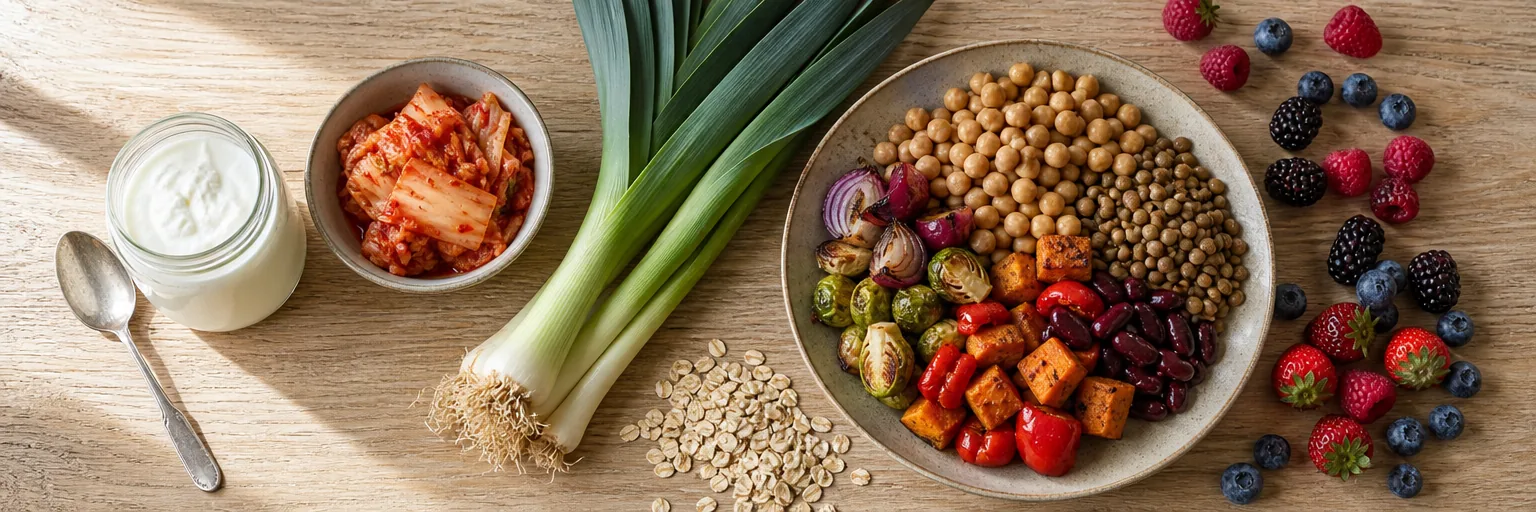
Gut Microbiome and Weight Loss: What Firmicutes, Bacteroidetes, and Akkermansia Actually Do to Body Weight
Quick answer: The gut microbiome is genuinely involved in energy harvest, appetite signalling, gut-barrier function, and bile-acid metabolism, and it shifts with body weight. But the popular story that a probiotic pill, a Firmicutes-to-Bacteroidetes ratio, or a microbiome test-to-diet product can drive meaningful weight loss is not what the peer-reviewed literature supports. The strongest, most reproducible microbiome-plus-weight signals come from eating 30+ different plants per week (McDonald 2018), a daily fermented-food habit, and prebiotic fiber. Fecal microbiota transplant for obesity is investigational, probiotic weight-loss effects are small (~0.5 to 1 kg in meta-analysis), and pasteurized Akkermansia (Depommier 2019) is not a weight-loss drug.
Who this is for — and who it is not for
This article is for adults who want an honest read on how much the gut microbiome contributes to body weight and what actually changes it. It is written for the reader who has seen probiotic marketing, microbiome-test-kit ads, or fecal-transplant hype and wants to know which claims survive peer review.
It is not medical advice for anyone with an active gastrointestinal disease. If you have suspected inflammatory bowel disease, active Clostridioides difficile infection, small intestinal bacterial overgrowth (SIBO), post-bariatric malabsorption, or a compromised immune system, microbiome decisions belong with a gastroenterologist, not a supplement label. Call 911 for signs of sepsis (fever with confusion or a fast heart rate) in someone recovering from C. difficile. Call 1-800-222-1222 (US Poison Control) for suspected supplement over-ingestion.
The 5 microbes people ask about — a primer
| Microbe or ratio | What it does | Weight-loss signal | Honest read |
|---|---|---|---|
| Firmicutes / Bacteroidetes ratio | Phylum-level shorthand for gut composition | Original 2006 obese-vs-lean signal (Ley 2006) | Meta-analysis (Sze & Schloss 2016) does not reproduce it in individual humans |
| Akkermansia muciniphila | Mucin-degrading species; supports gut-barrier layer | Depommier 2019: pasteurized supplement improved insulin sensitivity, ~2.3 kg vs placebo | Real but modest; not a weight-loss drug |
| Christensenella minuta | Associated with lower BMI in observational data | Heritable; low abundance correlates with higher BMI (Goodrich 2014) | Interesting biomarker; no supplement demonstrated to move human weight |
| Prevotella vs Bacteroides enterotypes | Two broad dietary-style enterotypes | Prevotella tracks fiber-heavy diets; Bacteroides tracks Western diets (Wu 2011) | Useful for describing populations; not a personal prescription |
| Bifidobacterium longum / Lactobacillus rhamnosus | Common probiotic species | Small strain-specific signals; Wilson 2019 meta ~0.5-1 kg | Modest, inconsistent; strain and dose matter more than the genus name |
The 4 mechanisms — how the microbiome touches body weight
1. Energy harvest — short-chain fatty acids from indigestible fiber
Gut bacteria ferment fiber humans cannot digest and produce short-chain fatty acids (SCFAs) — mostly acetate, propionate, and butyrate. SCFAs are absorbed and used for energy, so a more efficient fermenter effectively extracts more calories from the same meal. Turnbaugh 2006 in Nature first quantified this in obese vs lean mice; the obese-type microbiota had greater SCFA output and produced more adiposity when transplanted into germ-free recipients. The honest translation to humans is that the effect is real but small — probably 50 to 150 kcal/day at the extremes — and it is dwarfed by voluntary calorie intake.
2. Gut barrier integrity and metabolic endotoxemia
The gut epithelium is a selective barrier; when the mucus layer thins or tight-junction proteins loosen, lipopolysaccharide (LPS) from Gram-negative bacterial cell walls translocates into circulation and drives low-grade inflammation. Cani 2007 in Diabetes named this metabolic endotoxemia and showed it links a Western diet to insulin resistance and weight gain in mice. Sonnenburg 2016 in Nature showed that dietary fiber deprivation degrades the mucus layer within days. Practically, this is why a fiber-poor diet damages metabolic health beyond its calorie content.
3. Bile acid signalling — FXR and TGR5
Gut microbes deconjugate primary bile acids into secondary bile acids that signal through FXR (in the liver and gut) and TGR5 (in brown adipose tissue and enteroendocrine L-cells). This signalling touches lipid handling, glucose metabolism, and energy expenditure. It is one of the mechanisms behind the metabolic improvement after Roux-en-Y gastric bypass, where the bile-acid pool shifts dramatically. It is also the physiological rationale behind FXR-targeted drugs in metabolic-associated liver disease.
4. Gut-brain axis appetite hormones
Enteroendocrine L-cells in the distal ileum and colon release PYY and endogenous GLP-1 in response to nutrients and to SCFAs from microbial fermentation. Ghrelin from the stomach is modulated indirectly by the microbiome as well. A fibre-fed microbiome that produces steady SCFAs supports better postprandial satiety through these hormones — the same pathway that GLP-1 medications like Wegovy, Ozempic, and Zepbound engage pharmacologically. See protein intake for weight loss for the parallel satiety lever that does not depend on your microbiome.
What the evidence actually shows
Humanized-mouse work. The most-cited translational study is Ridaura 2013 in Science. Fecal samples from four sets of human twin pairs — one twin obese, one lean — were transplanted into germ-free mice; recipients of the obese-twin microbiota gained more fat than recipients of the lean-twin microbiota, even on matched diets. This is a clean mechanistic result but a mouse result. Human trials that follow it have been more equivocal.
Fecal microbiota transplant in humans. Kootte 2017 in Cell Metabolism randomised adults with metabolic syndrome to lean-donor FMT or their own microbiota. Insulin sensitivity improved modestly at 6 weeks in the lean-donor arm; body weight was essentially unchanged at 6 or 18 weeks. Alang & Kelly 2015 in Open Forum Infectious Diseases is the counter-example that gets repeated everywhere — a woman treated with FMT for C. difficile using stool from an overweight donor gained weight afterward. It is a case report, not a controlled trial, but it establishes that donor selection matters and that FMT for obesity is not a done deal. FMT is FDA-approved for recurrent C. difficile, not for weight loss.
Probiotic RCTs. Wilson 2019 in NPJ Biofilms and Microbiomes meta-analysed probiotic trials for weight and reported small (~0.5 to 1 kg) reductions, with substantial heterogeneity and evidence of publication bias. Álvarez-Arraño & Martín-Peláez 2021 in Nutrients looked at probiotics plus prebiotics (synbiotics) and reached similar conclusions — a real but modest effect, strain-specific, and not competitive with dietary change. For a strain-by-strain breakdown of which probiotic products are worth trying and which are marketing, see probiotics for weight loss.
Prebiotic fiber trials. David 2014 in Nature showed that a plant-based diet reproducibly increases fiber-fermenting taxa within days, and an animal-based diet does the reverse. Cotillard 2013 in Nature showed that a diet-intervention shifted the microbiome of low-gene-richness participants toward higher richness and improved metabolic markers. Le Chatelier 2013 in Nature — the parallel MetaHIT paper — showed that low bacterial richness correlates with worse insulin resistance and higher inflammation. Fibre works; the mechanism runs through the microbiome; the effect size is diet-scale, not supplement-scale.
Time course — what changes when
| Time from diet or supplement change | What is happening |
|---|---|
| Day 1 | Transit-time and pH shift as new substrates arrive; microbial gene expression changes within 24 hours (David 2014) |
| Day 3 | Composition of dominant fermenters begins to shift measurably in stool samples |
| 2 weeks | A high-plant, high-fiber diet has produced a visibly different community structure vs baseline |
| 4 weeks | SCFA production stabilises; symptoms of a fibre ramp (bloating, gas) typically subside |
| 12 weeks | Body-composition and insulin-sensitivity signals from probiotic/synbiotic RCTs, when present, are measurable |
| After a course of antibiotics | Diversity crashes within days; partial recovery over weeks; full recovery can take months, and some taxa never return (Suez 2018) |
How to actually improve your gut microbiome — 5-step protocol
Step 1 — Eat 30 or more different plants per week. The American Gut Project (McDonald 2018) is the largest citizen-science microbiome dataset and its clearest heuristic is that 30+ different plant species per week correlates with higher microbial diversity than 10 or fewer. Plants includes vegetables, fruits, whole grains, legumes, nuts, seeds, herbs, and spices. A cup of black beans and a cup of pinto beans are two plants, not one. See fiber for weight loss for a food-first fibre playbook and mediterranean diet for weight loss for the diet pattern that hits 30-plants naturally.
Step 2 — Add fermented foods daily. Wastyk 2021 in Cell randomised adults to a high-fibre or high-fermented-food diet for 10 weeks. Both arms produced microbiome changes; the fermented-food arm produced a larger reduction in inflammatory markers and greater microbial-diversity gains. Practical targets: yogurt with live cultures, kefir, sauerkraut, kimchi, miso, tempeh, or naturally-fermented pickles. Combucha counts but is often high in added sugar — read the label.
Step 3 — Ramp prebiotic fibre slowly. Prebiotic fibres — inulin, galacto-oligosaccharides (GOS), resistant starch — feed fermenters and raise SCFA output, but too much too fast produces gas and bloating that makes people quit. Start at 3 to 5 g/day and add 3 to 5 g every 5 to 7 days to a target of 10 to 15 g/day of added prebiotic on top of whole-food fibre. See fiber protein supplements for the supplement side and constipation during weight loss for the symptom that most often derails a fibre ramp.
Step 4 — Use antibiotics wisely and re-seed afterwards. Take antibiotics when clinically indicated; do not push for them for viral illness. During and after a course, prioritise fibre and fermented foods. The Suez 2018 study in Cell is a cautionary note on reflexive probiotic supplementation post-antibiotics — in that trial, an 11-strain probiotic actually delayed the return of the native microbiome. Food-based re-seeding is safer than blanket probiotic pills. If you were prescribed antibiotics for a metabolic reason (e.g., H. pylori eradication), talk to your prescriber about a probiotic-versus-food-only recovery plan.
Step 5 — Sleep, exercise, and stress management as microbiome levers. Poor sleep, sedentary weeks, and chronic stress all show measurable microbiome effects in observational and small experimental studies. The direction of causation is not always clean, but the practical action is the same — the behaviours that support the sleep-stress-weight axis also support the microbiome. See walking for weight loss for the lowest-friction activity option that reliably shifts the microbiome in observational cohorts.
Treatment comparison — which lever does what
| Approach | Mechanism | Evidence quality | Magnitude | Downside |
|---|---|---|---|---|
| Plant-diverse diet (30+ species/week) | Feeds diverse fermenters; SCFA production | Strong (McDonald 2018; David 2014) | Largest reproducible diversity shift | Requires grocery planning |
| Targeted probiotic supplement | Strain-specific transient colonisation | Moderate; strain-dependent | ~0.5-1 kg over 8-12 weeks (Wilson 2019) | Effect fades if you stop; strain matters more than genus |
| Prebiotic fibre (inulin, GOS, resistant starch) | Substrate for existing beneficial fermenters | Strong for SCFA output; moderate for weight | 1-3 kg over 12+ weeks in some trials | Bloating during ramp |
| Synbiotic (probiotic + prebiotic) | Combined delivery + feeding | Moderate (Álvarez-Arraño 2021) | Similar to probiotic alone in most trials | Cost; overlaps with food-based approach |
| Fecal microbiota transplant (research only for obesity) | Wholesale community transfer | Kootte 2017 improved insulin sensitivity, not weight | Insulin-sensitivity signal; not a weight-loss result | Investigational; FDA-approved only for C. difficile |
| Pasteurized Akkermansia muciniphila supplement | Gut-barrier support; incretin signalling | Depommier 2019 (single RCT, n=32) | ~2.3 kg vs placebo at 3 months | Small trial; expensive; not weight-loss drug |
Special situations
On a GLP-1 (Wegovy, Ozempic, Zepbound, Mounjaro)
GLP-1 medications reduce food intake, which reduces fibre intake and shrinks the substrate available for fermenters. A fibre floor of 25 to 35 g/day protects the microbiome and reduces constipation and nausea side effects. See glp-1 weight loss overview and weight loss drug safety.
After a course of antibiotics
Antibiotic-induced diversity loss recovers partially over weeks to months. Food-first re-seeding (fibre plus fermented foods) is better supported than blanket probiotic supplementation, which Suez 2018 showed can actually delay native recovery.
IBS, SIBO, and IBD
Diet-based microbiome advice does not apply cleanly. Low-FODMAP protocols may be warranted temporarily, and prebiotic ramps that help a healthy gut can worsen an IBS or SIBO gut. Active inflammatory bowel disease belongs under specialist care; over-the-counter probiotics are not a substitute for disease-modifying medication.
After bariatric surgery
Sleeve gastrectomy and Roux-en-Y gastric bypass produce large microbiome shifts driven by altered anatomy and bile-acid flow. This is part of the mechanism behind post-bariatric metabolic improvement. See bariatric surgery overview for the full post-op picture.
Gestational and infant considerations
Some probiotic strains have long safety records in pregnancy, but no probiotic is a weight-loss strategy during pregnancy. Breastfeeding, mode of delivery, and infant antibiotic exposure all shape the developing infant microbiome; the largest evidence-based lever a mother has is breastfeeding when possible.
Prediabetes and insulin resistance
Fibre-microbiome-SCFA-insulin sensitivity is one of the mechanisms behind why the prediabetes and weight-loss playbook emphasises whole-plant intake, and why the insulin-resistance weight-loss recommendations converge on the same foods. The anti-inflammatory-diet pattern in anti-inflammatory diet for weight loss captures much of the same signal.
C. difficile infection
FMT is a recognised therapy for recurrent C. difficile, delivered under specialist supervision. It is not a DIY procedure and it is not a weight-loss intervention.
GERD and reflux
If reflux is the dominant symptom, see GERD and weight loss for symptom-management strategies that overlap with microbiome-friendly eating patterns.
Basic calorie balance still runs the show
The microbiome sits on top of energy balance, not underneath it. See TDEE and calorie deficit for beginners for the primary lever most readers still have the most to gain from.
6 myths and red flags to know
- “You can transplant thinness by swapping poop with a lean donor.” No. Kootte 2017 improved insulin sensitivity, not weight, and Alang & Kelly 2015 documented weight gain after FMT from an overweight donor. FMT for obesity is investigational, not a done deal.
- “The Firmicutes-to-Bacteroidetes ratio predicts obesity in individual humans.” No. Sze & Schloss 2016 meta-analysed 10 studies and found the ratio does not reliably distinguish lean from obese individuals. Consumer tests reporting an F/B “risk score” are selling a discarded marker.
- “Any probiotic pill will fix your metabolism.” No. Effects are strain-specific and small (~0.5 to 1 kg in meta-analysis) and often fade when you stop the pill.
- “Antibiotics permanently ruin your microbiome.” No. Most people recover most of the diversity over weeks to months. Reflexive post-antibiotic probiotics can slow that recovery (Suez 2018) — food-first is safer.
- “Akkermansia supplements produce clinically meaningful weight loss.” Overstated. Depommier 2019 is a single 32-person 3-month RCT with a real but modest ~2.3 kg signal — smaller than what a modest calorie deficit and walking programme produces.
- “Microbiome tests can prescribe your diet.” Not yet reliably. Personalised-nutrition claims outrun the replication data. Call 911 for suspected sepsis (fever with confusion or a fast pulse) in a C. difficile patient; call 1-800-222-1222 for suspected supplement over-ingestion.
Practical next steps
This week
- Count the different plant species you ate over the last 7 days; if it is under 20, add three new ones this week.
- Add one fermented food to daily rotation — a serving of yogurt with live cultures, a spoonful of sauerkraut, a cup of kefir, or a side of kimchi.
- If you are on a GLP-1 medication, hit 25 g of fibre for the next 7 days.
Over the next 4 to 12 weeks
- If you plan to add a prebiotic supplement, ramp slowly (3-5 g/day, add 3-5 g every week).
- Skip the consumer microbiome-test upsell; the money is better spent on groceries.
- Do not start a probiotic stack around an antibiotic course without asking your prescriber; the Suez 2018 result changes the reflex.
Long term
- Aim for 30+ different plants per week as a permanent floor.
- Keep resistance training and walking on the schedule; both correlate with better microbiome diversity in observational cohorts.
- Treat FMT-for-weight-loss and consumer microbiome tests as marketing, not medicine, until stronger evidence arrives.
How this article was researched
We reviewed peer-reviewed research on gut microbiome ecology, energy harvest, gut-barrier physiology, bile-acid signalling, and the clinical trials of probiotics, prebiotics, synbiotics, fecal microbiota transplant, and pasteurized Akkermansia muciniphila for body-weight and metabolic outcomes. We paired the mechanistic mouse work (Turnbaugh, Ridaura, Cani, Sonnenburg) with the human trial and meta-analysis evidence (Kootte, Depommier, Wilson, Álvarez-Arraño, Sze & Schloss, McDonald), and framed the popular biomarker claims — F/B ratio, microbiome-test-to-diet, thinness-by-FMT — against the peer-reviewed replication record. Claims are limited to what the literature supports; practical steps are framed as starting points rather than individualised medical advice.
Sources
- Turnbaugh PJ, Ley RE, Mahowald MA, et al. An obesity-associated gut microbiome with increased capacity for energy harvest. Nature (2006).
- Ridaura VK, Faith JJ, Rey FE, et al. Gut microbiota from twins discordant for obesity modulate metabolism in mice. Science (2013).
- Le Chatelier E, Nielsen T, Qin J, et al. Richness of human gut microbiome correlates with metabolic markers. Nature (2013). MetaHIT.
- Cotillard A, Kennedy SP, Kong LC, et al. Dietary intervention impact on gut microbial gene richness. Nature (2013).
- Kootte RS, Levin E, Salojärvi J, et al. Improvement of insulin sensitivity after lean donor feces in metabolic syndrome is driven by baseline intestinal microbiota composition. Cell Metabolism (2017).
- Alang N, Kelly CR. Weight gain after fecal microbiota transplantation. Open Forum Infectious Diseases (2015).
- Depommier C, Everard A, Druart C, et al. Supplementation with Akkermansia muciniphila in overweight and obese human volunteers: a proof-of-concept exploratory study. Nature Medicine (2019).
- Cani PD, Amar J, Iglesias MA, et al. Metabolic endotoxemia initiates obesity and insulin resistance. Diabetes (2007).
- Desai MS, Seekatz AM, Koropatkin NM, et al. A dietary fiber-deprived gut microbiota degrades the colonic mucus barrier and enhances pathogen susceptibility. Cell (2016). Sonnenburg lab.
- David LA, Maurice CF, Carmody RN, et al. Diet rapidly and reproducibly alters the human gut microbiome. Nature (2014).
- Suez J, Zmora N, Zilberman-Schapira G, et al. Post-antibiotic gut mucosal microbiome reconstitution is impaired by probiotics and improved by autologous FMT. Cell (2018).
- Wu GD, Chen J, Hoffmann C, et al. Linking long-term dietary patterns with gut microbial enterotypes. Science (2011).
- McDonald D, Hyde E, Debelius JW, et al. American Gut: an open platform for citizen science microbiome research. mSystems (2018).
- Ley RE, Turnbaugh PJ, Klein S, Gordon JI. Human gut microbes associated with obesity. Nature (2006).
- Sze MA, Schloss PD. Looking for a signal in the noise: revisiting obesity and the microbiome. mBio (2016).
- Álvarez-Calatayud G, Wilson AS, et al. Probiotics for the treatment of overweight and obesity: a systematic review. NPJ Biofilms and Microbiomes / Nutrients (2019). Wilson meta.
- Álvarez-Arraño V, Martín-Peláez S. Effects of probiotics and synbiotics on weight loss in subjects with overweight or obesity: a systematic review. Nutrients (2021).
- Wastyk HC, Fragiadakis GK, Perelman D, et al. Gut-microbiota-targeted diets modulate human immune status. Cell (2021). High-fiber vs high-fermented-food trial.
- Goodrich JK, Waters JL, Poole AC, et al. Human genetics shape the gut microbiome. Cell (2014). Christensenella heritability.