
2026-09-02 · weight-loss, beginners, first-month, expectations, timeline, water-weight, adherence
Written by Tessa Morgan
Tessa Morgan is a WeightFAQ staff writer focused on the long-game side of weight loss: habits, motivation, tracking, and what happens after the first pound comes off. She has written about weight-loss maintenance, plateaus, why the scale sometimes stops moving, water-weight fluctuations, and adaptive thermogenesis, as well as practical guides to weight-loss apps, non-scale victories, emotional eating, and cheat meals and refeed days. Tessa covers realistic timelines — how long weight loss actually takes — and travel-friendly strategies. She writes for readers building routines they can hold for years, not weeks.
14 min read
Medically reviewed on Sep 2, 2026
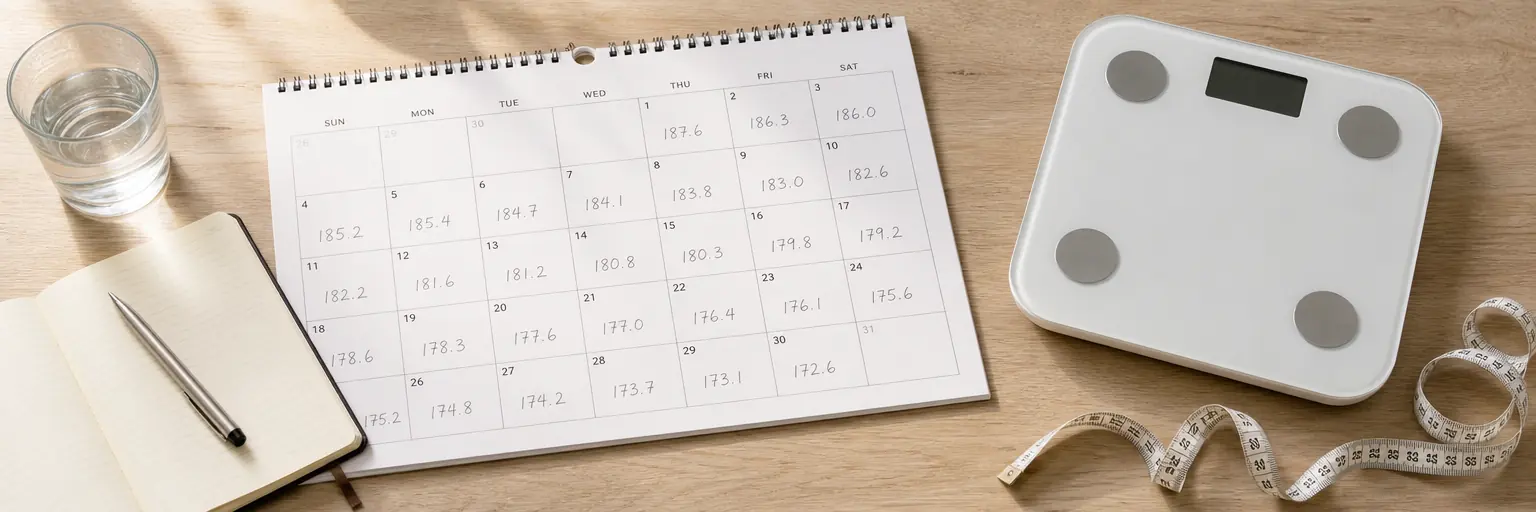
The First 30 Days of Weight Loss: What to Expect and What to Actually Do
Quick answer: In your first 30 days, a realistic loss is 4 to 8 pounds (1.8–3.6 kg) for an adult in the BMI 25–30 range on a moderate 500 kcal/day deficit — or 8 to 15 pounds for a reader starting at BMI 35+, where a bigger early water-and-glycogen drop is normal. That first-week loss is not pure fat: it is a mix of glycogen-bound water, reduced gut contents, a small amount of true fat, and a small amount of lean tissue. Week 2 is where real fat loss starts to show on the scale. Week 3 often slows or plateaus for a week — that is normal biology, not failure. Week 4 settles into the sustainable rate of about 0.5 to 1% of body weight per week. The right plan for the month is small, staged, and boring — start with just the calorie deficit, add walking in Week 2, add strength training in Week 3, measure and photograph on Day 30 before touching the plan.
The 30-day arc, week by week
The single most important thing to understand about your first month is that the scale does not move in a straight line. It moves in four different phases, each driven by a different mechanism.
Week 1: the honeymoon (3 to 6 lb drop, mostly water)
Most people lose 3 to 6 pounds in the first 7 days. The temptation is to assume this is fat loss and that the same pace will continue. It will not. Roughly 60–80% of Week 1’s loss is glycogen and its bound water. Human muscle stores about 400–600 g of glycogen at full replenishment, and each gram of glycogen holds about 3 to 4 grams of water (Kreitzman 1992, American Journal of Clinical Nutrition; Fernández-Elías 2015, European Journal of Applied Physiology). Cutting refined carbs, restaurant sodium, or alcohol empties much of that glycogen store within 5–7 days, releasing 1 to 2 kg of water. Reduced bowel contents from a higher-fiber, lower-processed-food diet add another 1 to 3 pounds. Actual fat loss in Week 1 is usually 0.5 to 1 pound — which is exactly what a 500 kcal/day deficit predicts.
The right response is to write this down and move on. You did not lose 5 pounds of fat in Week 1, and that is fine. That number will partially reverse the first time you eat a big carb meal — again, water, not fat regain.
Week 2: the lull (0 to 2 lb loss)
Week 2 is where confidence often wavers. The scale is barely moving. But this is actually the first week where the reading reflects real fat loss — the glycogen-and-water phase is done. A 500 kcal/day deficit produces about 1 lb of fat loss per week (the 3,500 kcal ≈ 1 lb rule of thumb), so a Week 2 loss of 0.5 to 2 pounds is exactly on-plan. If the scale is flat or up 1 lb, that is normal noise — sodium from a single restaurant meal or a hard workout can hide a week of fat loss.
Week 3: the slowdown (0 to 1 lb loss, sometimes a small gain)
Week 3 is where most first-month plans break, and it is almost always for the wrong reason. Two things are happening. First, mild adaptive thermogenesis starts to show up — resting energy expenditure drops a few percent below body-composition math (Fothergill 2016, Obesity; Byrne 2018 MATADOR, International Journal of Obesity). Second, hormonal fluid retention often peaks around this window, especially for menstruating readers. The result: a flat scale or even a 1-pound gain.
This is a biology signal, not evidence of failure and not “starvation mode” (which is not a thing in a 3-week timeframe). The correct response is to do nothing different for one more week. Do not cut calories further. Do not add a second cardio session on top. Do not switch to a new diet. Wait, and re-check the 7-day rolling average on Day 28.
Week 4: the settle (1 to 2 lb loss)
Week 4 is where the plan reveals its real long-run pace. For most adults, this is 0.5 to 1% of body weight per week — about 1 to 2 pounds for a 180-pound reader, or about 1.5 to 3 pounds for a 260-pound reader. This is the number that will repeat, week after week, if you hold the plan for the next 3 to 6 months.
What a realistic 30-day loss looks like
| Starting weight | Expected 30-day loss (moderate 500 kcal/day deficit) |
|---|---|
| 150 lb (BMI ~24) | 3 to 5 lb |
| 180 lb (BMI ~28) | 4 to 8 lb |
| 220 lb (BMI ~32) | 6 to 11 lb |
| 260 lb (BMI ~37) | 8 to 15 lb |
| 300 lb (BMI ~42) | 10 to 18 lb |
Larger bodies see a bigger Week 1 drop because glycogen stores and total body water are proportionally larger, and a fixed 500 kcal deficit is a smaller fraction of total needs so it is easier to sustain. For a fuller timeline beyond the first month, see how long it actually takes to lose weight.
What to actually do — the 4-week framework
The first month is when you are building the habit, not maxing out the plan. A common mistake is to launch Week 1 with a big calorie cut and an hour of daily cardio and a new food plan and a new sleep schedule. This is a compensation trap — hunger, fatigue, and adherence all break together (Turner 2010, Medicine & Science in Sports & Exercise, compensation review). The staircase below adds one thing per week.
Week 1: eat at your target deficit, weigh daily, nothing else
- Set your calorie target using how many calories to lose weight or use a ready-made template like the 1,500 calorie meal plan.
- Do not change your exercise. If you already walk, keep walking; if you don’t, do not add it yet.
- Weigh daily at the same time, but only read the 7-day moving average (Steinberg 2013, Journal of the Academy of Nutrition and Dietetics).
- Take Day 1 measurements (see below).
Week 2: add 3 walks of 20–30 minutes and start a protein floor
- Add three walks of 20 to 30 minutes on non-consecutive days — see walking for weight loss for how to build the base without triggering hunger spikes.
- Hit a protein floor of about 0.7 g per pound of goal body weight per protein intake for weight loss — this protects muscle and blunts hunger.
- Keep the calorie deficit unchanged.
Week 3: add 2 resistance sessions, hold the deficit
- Add two 30-minute resistance sessions per strength training for weight loss. Full-body, basic movements — do not chase a program.
- Keep the deficit unchanged even though the scale slows. This is the week most people wrongly cut calories further.
- Keep the walks and the protein floor.
Week 4: measurement day, no plan changes yet
- Retake Day 1 measurements and progress photos on Day 30.
- Look at the 4-week average loss.
- Only adjust the plan if the 4-week average loss is under 0.3% of body weight per week (add walking, don’t cut calories) or over 1.5% (raise calories 100–150 kcal/day to protect lean tissue).
Track the right 5 measurements on Day 1 and Day 30
The scale is one number. The tape often moves when the scale doesn’t (Wing 2007 STOP Regain findings). Log all five on Day 1 and Day 30:
- Scale weight — first thing in the morning, fasted, post-void, minimal clothing
- Waist at navel — soft cloth tape, standing, no sucking in
- Hip at widest — usually across the buttocks
- Chest at bust/nipple line
- Thigh at widest — one leg, mark it so you measure the same spot
Also useful and free:
- Front, side, and back progress photos in the same lighting and clothing per the weight loss progress photos guide
- 7-day rolling average scale weight on a phone note or app
- One benchmark clothing item (jeans, bra band, ring, watch band) — check the fit at Day 1 and Day 30
- Resting heart rate on waking — drops with cardio adaptation, an early non-scale win
For a fuller system, see how to track weight loss progress.
The Week 3 slowdown — the honest read
The single most common reason a first-month plan gets abandoned is the Week 3 slowdown, misread as “the diet stopped working.” Two lines of evidence say otherwise. First, Byrne 2018 MATADOR (International Journal of Obesity) — a 2-week diet-break RCT — showed that adaptive thermogenesis reliably appears around Weeks 2–3 of a continuous deficit and reduces resting energy expenditure by a few percent below the math prediction. Second, Fothergill 2016 (Obesity, “Biggest Loser” follow-up) confirmed that this adaptation is a normal, expected feature of active dieting — not a permanent metabolic break.
Two rules for Week 3:
- Do not cut calories further. A bigger deficit does not fix adaptive thermogenesis; it makes it worse and increases lean-tissue loss.
- Do not add a second cardio session on top. Compensation — mostly through hunger and reduced non-exercise movement — usually eats most of the extra burn (Turner 2010).
Wait one more week. Re-check the 7-day rolling average on Day 28. In most cases, the scale resumes moving down in Week 4.
What not to do in your first month
Five common first-month anti-patterns that predict early quitting:
- Crash-cutting below your BMR. Drives lean-tissue loss and rebound hunger. See very low calorie diets for why this is not a shortcut.
- Daily “detox” or “cleanse” juice weeks. The scale drop is water and colonic residue, not fat. Everything comes back within 48 hours.
- Adding an hour of daily cardio in Week 1 on top of a big deficit. Compensatory hunger + fatigue + adherence collapse.
- Weighing yourself only once, at Day 30. You lose the trend line and magnify random noise. Weigh daily; read the moving average.
- Quitting on Day 10 because “it isn’t working.” Week 2 is a lull by design, and the Week 3 slowdown is coming right after. Both are normal. Hold the plan.
Am I losing fat or just water? A quiet-scale self-audit
Five signals that fat loss is happening even when the scale is flat:
- Waistband feels looser — the fastest-changing tape measurement
- Morning fasted photos flatter through the midsection — same lighting, same time of day
- Rings and watch band fit differently — small joints show visceral fluid changes early
- Resting heart rate down 3 to 5 bpm — cardio adaptation from the Week 2 walks
- Mid-afternoon energy more stable — lower glucose swings from lower processed-carb intake
These are the property’s non-scale victories applied to the 30-day window. If four of these five are true, the plan is working — even if the scale is telling a different story that week.
Menstrual cycle: read month-over-month, not week-over-week
For menstruating readers, the scale can jump 2 to 4 pounds in the week before a period from progesterone- and aldosterone-driven fluid retention — see menstrual cycle and weight fluctuations. This is not real weight gain; it clears within the first 2 to 4 days of the next follicular phase.
The right comparison during Weeks 1–4 for a menstruating reader is the same cycle day, month over month, not week over week. If your Day 1 weigh-in was in the luteal phase and your Day 30 weigh-in is in the follicular phase, the drop will look artificially large. If it is the other way around, the drop will look artificially small. Do not act on a scale bump that lines up with a predictable cycle phase.
Sleep and stress in Weeks 1–2
The first two weeks of a new calorie deficit disrupt sleep for many people — hunger, cortisol changes, and a new evening routine all bite. This is the wrong time to also cut sleep. Nedeltcheva 2010 (Annals of Internal Medicine) is the classic reference: adults on a 14-day −680 kcal/day deficit lost the same weight on 5.5 hours vs 8.5 hours of sleep, but the fat-loss fraction of that weight dropped from 55% (well-rested) to 25% (sleep-restricted). The other 75% was lean tissue.
Practical rule: get 7+ hours in Weeks 1–2 before adding a second cardio session in Week 3 or later. See sleep, stress and weight management for the specific interventions.
End-of-month decision tree
On Day 30, look at the 4-week average loss (final week 7-day average minus Day 1 weight, divided by 4):
- 0.5 to 1% of body weight per week → hold the plan another 4 weeks. Do not change anything.
- Under 0.3% per week → recheck logging accuracy first (see calorie tracking accuracy), then add 10–15 minutes of daily walking. Do not cut calories yet.
- Over 1.5% per week → you are probably losing too fast for muscle preservation. Raise calories 100–150 kcal/day and prioritize protein per preserve muscle during weight loss.
If you have hit a real 3+ week stall on consistent tracking, the full playbook is in how to break a weight loss plateau.
Who this is not for
This 30-day framework assumes an otherwise healthy adult with a modest amount to lose. It is not designed for:
- Pregnancy or breastfeeding — calorie deficits during pregnancy require obstetric supervision.
- Active eating-disorder recovery — food journaling and calorie targeting can be triggering; call or text NEDA at 1-800-931-2237 and see binge eating disorder and weight loss, bulimia recovery and weight, and anorexia recovery and weight restoration.
- BMI under 18.5 — weight loss is not the goal at this weight.
- Type 1 diabetes without clinician oversight — calorie and carb changes affect insulin dosing and need supervision.
If your scale is up 5+ pounds at Day 30 despite honest deficit tracking, that is a signal to review your medication list — some antidepressants, antipsychotics, and hormonal birth control can drive fluid retention or appetite in a way a calorie deficit cannot outrun. See antidepressants and weight changes, antipsychotics and weight changes, and birth control and weight changes, and bring the pattern to a clinician.
Frequently asked questions
How much weight should I lose in my first month? For a typical BMI 25–30 adult on a 500 kcal/day deficit, 4 to 8 pounds is realistic. BMI 35+ readers often see 8 to 15 pounds. See the starting-weight table above for a fuller range.
Why did I lose so much weight the first week? Most of it is not fat. Muscle glycogen carries 3 to 4 grams of water per gram (Kreitzman 1992), and emptying it releases 1 to 2 kg of water in the first week alone. Reduced bowel contents and a small amount of true fat make up the rest.
Why did my weight loss stop after two weeks? It usually has not — it has slowed to what real fat loss looks like on the scale. Week 3 also brings mild adaptive thermogenesis and often hormonal fluid retention. Hold the plan one more week.
How often should I weigh myself? Daily, at the same time, but read the 7-day rolling average, not the single-day number.
Do I need to exercise in my first month? Not in Week 1. Add three walks in Week 2 and two short resistance sessions in Week 3. Do not front-load the training.
How can I tell if I’m losing fat and not just water? Waistband looser, morning photos flatter, rings looser, resting heart rate down 3–5 bpm, mid-afternoon energy stable. Four out of five is a working plan.
What should I do differently in month two? Nothing, if the 4-week loss was 0.5–1% of body weight per week. If under 0.3%, tighten tracking and add walking. If over 1.5%, raise calories 100–150 kcal/day.
Is 10 pounds in a month too fast? For BMI 35+, no — much of it is water. For BMI 25 readers with only 15–20 lb to lose, yes — that pace usually includes meaningful lean-tissue loss.
Practical next steps
This week (Week 1)
- Set your calorie target with the calorie deficit guide.
- Take Day 1 measurements — scale, waist, hip, chest, thigh — plus front/side/back photos.
- Weigh daily at the same time. Track only the 7-day rolling average.
- Do not add exercise yet. Do not cut sleep.
Weeks 2 to 4
- Week 2: add three 20–30 minute walks; hit a protein floor.
- Week 3: add two short strength sessions; do not touch the deficit even if the scale slows.
- Week 4: retake measurements and photos on Day 30 before changing anything.
Know when to ask for help
- If Day 30 shows a 5+ lb gain despite honest tracking, review medications with a clinician.
- If daily weighing is triggering anxiety, restriction, or shame, switch to weekly weighing or stop weighing entirely and use the tape and photos instead.
- If food journaling is driving obsessive thoughts about food, stop journaling and reach out to NEDA (1-800-931-2237).
Sources
- Kreitzman SN, Coxon AY, Szaz KF. Glycogen storage: illusions of easy weight loss, excessive weight regain, and distortions in estimates of body composition. American Journal of Clinical Nutrition (1992).
- Fernández-Elías VE, et al. Relationship between muscle water and glycogen recovery after prolonged exercise in the heat in humans. European Journal of Applied Physiology (2015).
- Fothergill E, et al. Persistent metabolic adaptation 6 years after "The Biggest Loser" competition. Obesity (2016).
- Byrne NM, et al. Intermittent energy restriction improves weight loss efficiency in obese men: the MATADOR study. International Journal of Obesity (2018).
- Nedeltcheva AV, et al. Insufficient sleep undermines dietary efforts to reduce adiposity. Annals of Internal Medicine (2010).
- Steinberg DM, et al. The efficacy of a daily self-weighing weight loss intervention using smart scales and email. Journal of the Academy of Nutrition and Dietetics (2013).
- Wing RR, et al. STOP Regain: are there negative effects of daily weighing? Journal of Consulting and Clinical Psychology (2007).
- Turner JE, et al. Nonprescribed physical activity energy expenditure is maintained with structured exercise and implicates a compensatory increase in energy intake. Medicine & Science in Sports & Exercise (2010).